


Northern wobbegong - Orectolobus wardi
Body structure, features & anatomy
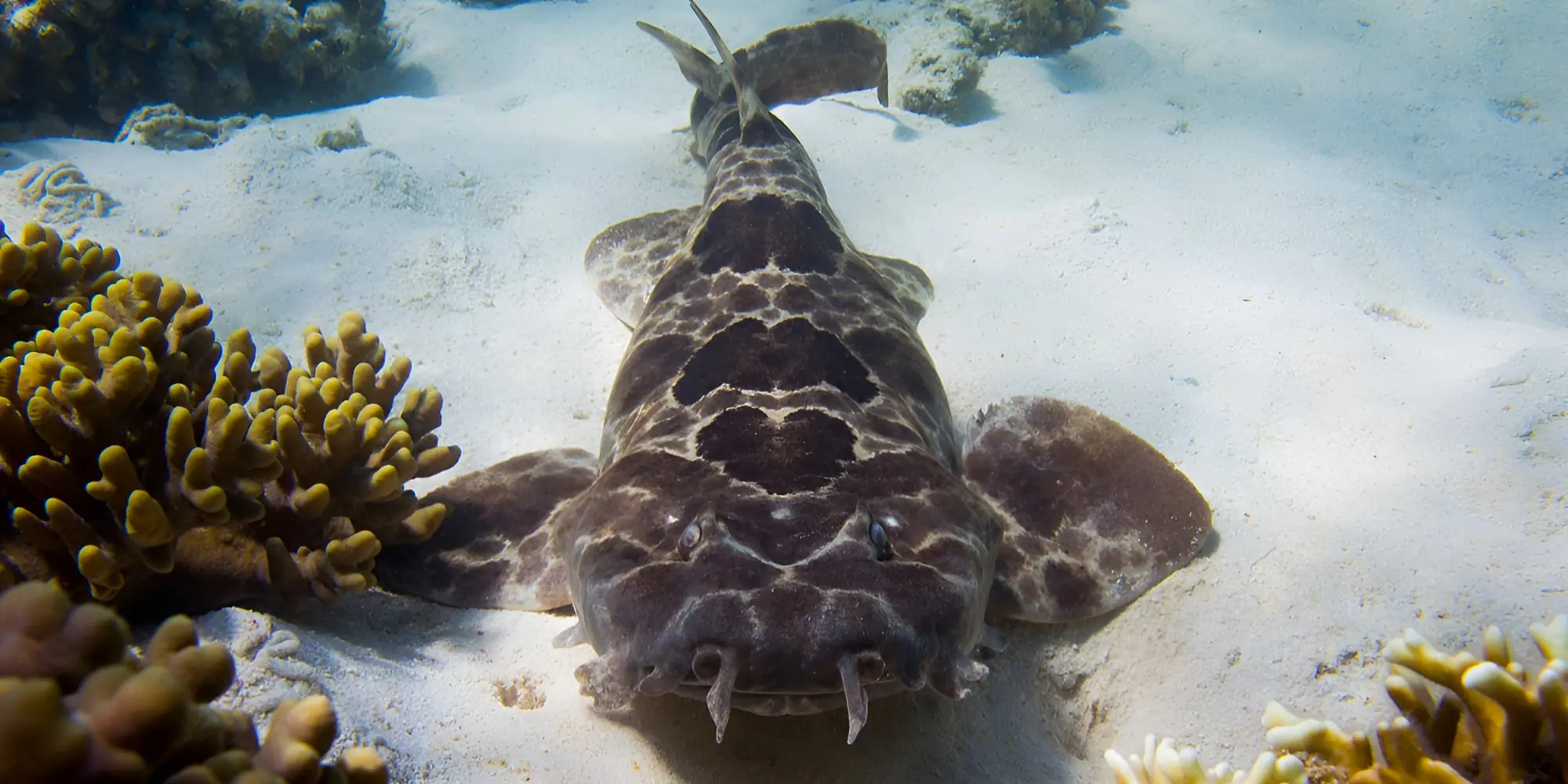
The northern wobbegong Orectolobus wardi is a small, elongated and flattened carpet shark reaching about 63 cm. WoRMS lists it as an accepted living species; the broad head, upward-facing eyes and two rear-set spineless dorsal fins suit life on the bottom.
Its brownish or greyish body carries widely spaced dark rounded saddles with pale edges. Markings on the head and trunk can form conspicuous eyespots, while a few smaller dark spots help break up the outline on sand, rubble and reef.
A small wobbegong with eyespots
Head lobes are simpler and less densely branched than those of the tasselled wobbegong. Nasal barbels, broad pectoral fins and a forward mouth still give it the characteristic form of a bottom-dwelling wobbegong documented by Shark-References.
Identification should combine small adult size, saddle pattern, eyespots and a northern Australian locality. Small wobbegongs are easily confused with juveniles of other species when only one photograph is available.
Distribution & habitat
The northern wobbegong is considered endemic to Australia. Its known range extends across the tropical north, roughly from Onslow in Western Australia through the Northern Territory to the Fraser Island region of Queensland; records beyond Australia are not securely confirmed.
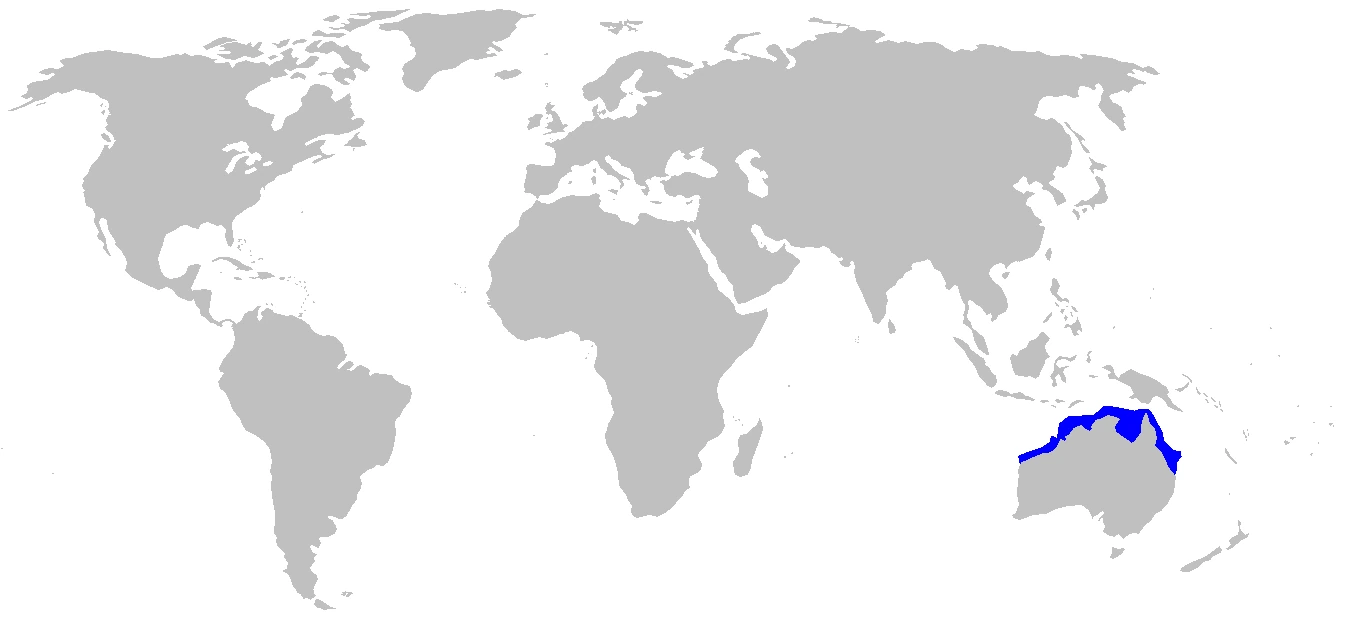
Fishes of Australia describes a reef-associated shark of coastal and shelf waters and lists records down to about 40 metres. Other summaries emphasise very shallow occurrences around one to three metres, reflecting a limited and uneven evidence base.
Tropical shallows of northern Australia
Likely habitats include protected bays, shallow sandy or coral-rich areas, reef edges, small caves and structured seabed where the shark can rest concealed and become active near dusk.
The different depth figures should not be merged into a false exact limit. Many records come from very shallow water, while reliable observations also extend deeper; the species may be present but easily overlooked in suitable habitat.
Life history, diet & reproduction
The biology of Orectolobus wardi is much less documented than that of larger Australian wobbegongs. It probably rests camouflaged by day and becomes more active at dusk or at night, but species-specific behavioural studies are scarce.
FishBase lists bottom fishes and invertebrates as presumed food while explicitly noting that the diet has not been directly recorded. Naming particular prey species would therefore go beyond the available evidence.
Much remains undocumented
Reproduction is thought to be aplacental viviparous: embryos develop inside the mother, rely on yolk and are born alive. Reliable species-specific data on litter size, gestation, birth length and maturity are lacking.
These gaps matter. Sightings with date, depth, size and habitat can improve knowledge, but observations should remain clearly separated from confirmed life-history data and should not be turned into fixed biological values.
Threats & conservation status
The current IUCN Red List assessment lists Orectolobus wardi as Least Concern, following reassessment in 2024. This confirms the favourable global category but does not remove the need for regional monitoring.
Its close association with shallow coasts exposes the shark to nets, traps, hooks and bycatch. Coastal development, pollution, reef damage and loss of structured shallow habitats can also have local effects.
Least Concern, but strongly coastal
The Australian Shark Report Card assesses the Australian population as sustainable. The whole known range lies within a country with comparatively strong fisheries management and numerous marine protected areas.
Accurate bycatch identification, better catch and sighting records, and protection of shallow reef and coastal habitats remain useful. A narrow endemic range means local pressure can matter even when the global category is favourable.
Northern wobbegong & humans
The northern wobbegong is small and not a typical danger to people. Like other wobbegongs it has strong teeth and may bite if touched, held or cornered; resting quietly on the seabed is not an invitation to handle it.
Divers and snorkellers should approach slowly, keep distance and leave an escape route. Do not step on the shark, reach into hidden crevices, block a cave or drive an animal from cover for a photograph.
Observe without touching
Its small size and very shallow habitat make encounters possible while snorkelling or wading. Effective camouflage increases the chance of accidental contact, so careful attention to the seabed is more useful than fear.
Documented observations on platforms such as iNaturalist can add range information. Date, depth, habitat and several identification images are valuable as long as the animal is not disturbed.
Profile
- First described:
- Max. size:
- Depth:
- Max. age:
- Max. weight:
- Water type:
- IUCN Status:
Taxonomy
- Kingdom:
- Phylum:
- Subphylum:
- Infraphylum:
- Parvphylum:
- Class:
- Subclass:
- Superorder:
- Order:
- Family:
- Genus:
Newsletter
Shark Alert in Your Inbox