


Indonesian wobbegong - Orectolobus leptolineatus
Body structure, features & anatomy
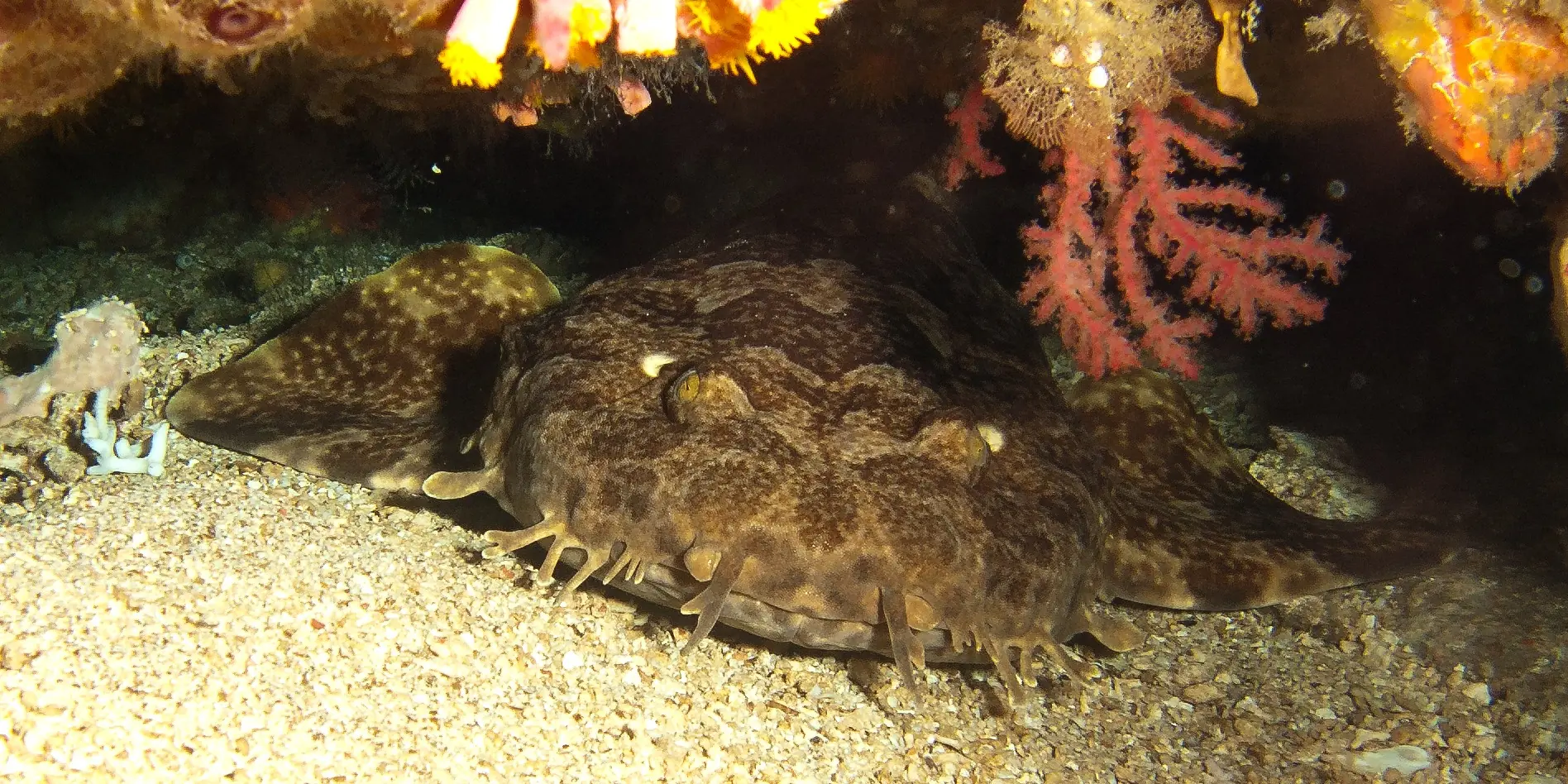
The Indonesian wobbegong Orectolobus leptolineatus is a medium-sized, broadly flattened representative of the Real carpet sharks. The initial scientific description describes females up to at least 120 centimeters and males up to at least 112 centimeters in total length. The broad head, terminal mouth, and large, rounded pectoral and pelvic fins are consistent with a bottom-hugging shark.
Fine lines instead of big spots
Its upper surface bears a complex, variable pattern of very fine, worm-shaped lines, dark transverse bands, saddles and light-edged eyespots. The upper sides of the paired fins are also densely marked, while the ventral side of the torso remains predominantly light in color. The species name leptolineatus refers precisely to this fine line drawing.
Skin flaps, barbels and fin position
There are several groups of simple to terminally branched skin flaps in front of the eyes. The nasal barbel has a side branch; behind the spiracles there are further clearly developed, leaf-like lobes. Enlarged bumps above the eyes or warty bumps on the back are absent. The two dorsal fins are comparatively high and upright, the first begins approximately above the base of the pelvic fin.
Risk of confusion with similar Wobbegongs
It is particularly easy to confuse the species with the Japanese wobbegong. In the Indonesian wobbegong, the fine-meshed pattern of worm-like lines is usually denser; Body proportions and coloring must still be examined together. Older photos or reports without clearly visible head and back features should therefore not be determined based solely on the location where they were found.
Distribution & habitat
The confirmed distribution area is in western Pacific. The species is definitely proven Indonesia, including Bali, Lombok and West Java, as well as a confirmed image from Sarawak in Malaysia. The FishBase distribution overview also mentions reports from Sabah, the Philippines, Taiwan and the Ryukyu Islands; These records further north are considered unconfirmed or provisional due to their similarity to related species.
Continental shelf and cooler water
Many known specimens were examined at fish landing sites on Bali and Lombok. They probably came from deeper areas of the continental shelf because they were landed along with typical shelf and upper slopes. From this the first describers derived a preference for deeper, cooler water; An exactly defined depth distribution has not yet been proven.
A rare observation on the reef
A repeatedly photographed sighting is from Silayukti Point on Bali’s east coast from about 20 meters depth. Cold buoyant water regularly occurs there. Databases often summarize the currently known depth range as approximately 20 to 110 meters, but this range should not be understood as a fully studied habitat profile.
For divers, encounters are therefore more likely to occur in structured, bottom-hugging areas with cooler water than on warm, open shallow reefs. Because of the uncertain species boundaries in the northern part of the suspected area, a sharply drawn distribution map is currently less informative than documented, verifiable locations.
Life history, diet & reproduction
Unusually little is known about the Indonesian wobbegong’s lifestyle. Body shape and camouflage markings suggest that it is a benthic ambush predator, but species-specific studies on activity rhythm, range of prey and hunting success are lacking. A concrete list of preferred prey would therefore currently be more a inference from other wobbegongs than reliable knowledge about this species.
Sexual maturity at around 90 centimeters
The in Florida Museum The summarized measurement data show: All males examined were sexually mature from around 90 centimeters. The smallest mature female measured 94 centimeters. Two pregnant females were 104 and 108 centimeters long. These values are from a limited sample and do not describe an exact maturity size for each population.
Four embryos as direct evidence
The smaller of the two pregnant females contained four mid-stage embryos, each 13 to 14 centimeters long. This provides direct evidence of development in the mother animal. However, the four embryos should not be interpreted as typical or maximum litter size because the pregnancy was not yet complete and only very few females were examined.
Big gaps in knowledge
Birth size, gestation period, reproductive interval, age, growth and seasonal movements are not sufficiently described. It is also unclear whether shallow reefs are only used occasionally or host important phases of life. Good underwater photos with date, depth and carefully chosen location can therefore be valuable as long as the animal is not moved or harassed for the purposes of documentation.
Threats & conservation status
The FishBase distribution overview leads Orectolobus leptolineatus as Near Threatened. The underlying assessment was conducted on May 19, 2020 and published in 2021. The classification according to criterion A2d indicates a decline related to actual or potential use; The species is therefore close to an endangered category.
Fishing pressure is directly documented
In one Fisheries study from Tanjung Luar A total of 93 Indonesian wobbegongs were recorded in the Tanjung Luar monitored shark fishery between January 2014 and December 2015. That was 0.8 percent of the shark landings recorded there. The number is not a population estimate, but shows that the species regularly ends up in bottom and surface longline fisheries.
Why local withdrawals can be difficult
- Limited confirmed area: Losses in Indonesia and Borneo may affect a large proportion of the known population.
- Life close to the ground: Bottom longlines, trawls and other demersal fishing gear reach the preferred habitat.
- Slow recovery: The few reproductive data do not indicate a high offspring rate.
- Risk of confusion: Wrongly identified wobbegongs make catch statistics and population monitoring difficult.
Protection needs better data
Important are species-specific recording at landing sites, correct photo documentation, management of bottom and longline fisheries and protection of important shelf and reef habitats. The following also applies to diving companies: Do not force sightings by touching, moving or feeding and only publish exact resting places to the extent that this is compatible with the protection of the animal.
Indonesian wobbegong & humans
The Indonesian wobbegong is not considered a shark species dangerous to humans. At the same time, it is a strong, well-camouflaged wild shark with a mouth and sharp teeth. The practical risk therefore arises less from an active approach of the animal than from accidentally touching, stepping on or harassing it in a resting place.
Correct behavior during a sighting
- Approach slowly and sideways; Keep enough distance so that the shark does not change its position.
- Do not touch, pull by the tail, or move out of hiding for a photo.
- Keep the mouth area, cave entrance and escape route clear and never reach into confusing crevices.
- Use lamps and flashlights sparingly; multiple divers should not circle the animal.
The original scientific description classifies bites after touching, harassing, feeding or releasing a shark from fishing gear as provoked incidents. This general rule is particularly relevant for a resting wobbegong: immobility is not consent to contact, but rather part of its way of camouflage and resting.
Observe instead of directing
Good photos can help distinguish the Japanese wobbegong. For this purpose, an overall view of the back pattern and, if possible without disturbance, images of the head, nasal barbel and skin flaps are more useful than a close-up of the mouth. Date, depth and region should be noted; A sensitive resting place does not have to be publicly specified to the exact meter.
An encounter should be ended calmly as soon as the shark becomes uneasy, tenses its fins, raises its head or tries to leave the spot. If you keep your distance and give the animal a free route, you can safely experience the rarely observed wobbegong without changing its behavior for a photo.
Profile
- First described:
- Max. size:
- Depth:
- Max. age:
- Max. weight:
- Water type:
- IUCN Status:
Taxonomy
- Kingdom:
- Phylum:
- Subphylum:
- Infraphylum:
- Parvphylum:
- Class:
- Subclass:
- Superorder:
- Order:
- Family:
- Genus:
Newsletter
Shark Alert in Your Inbox