


Grey bamboo shark - Chiloscyllium griseum
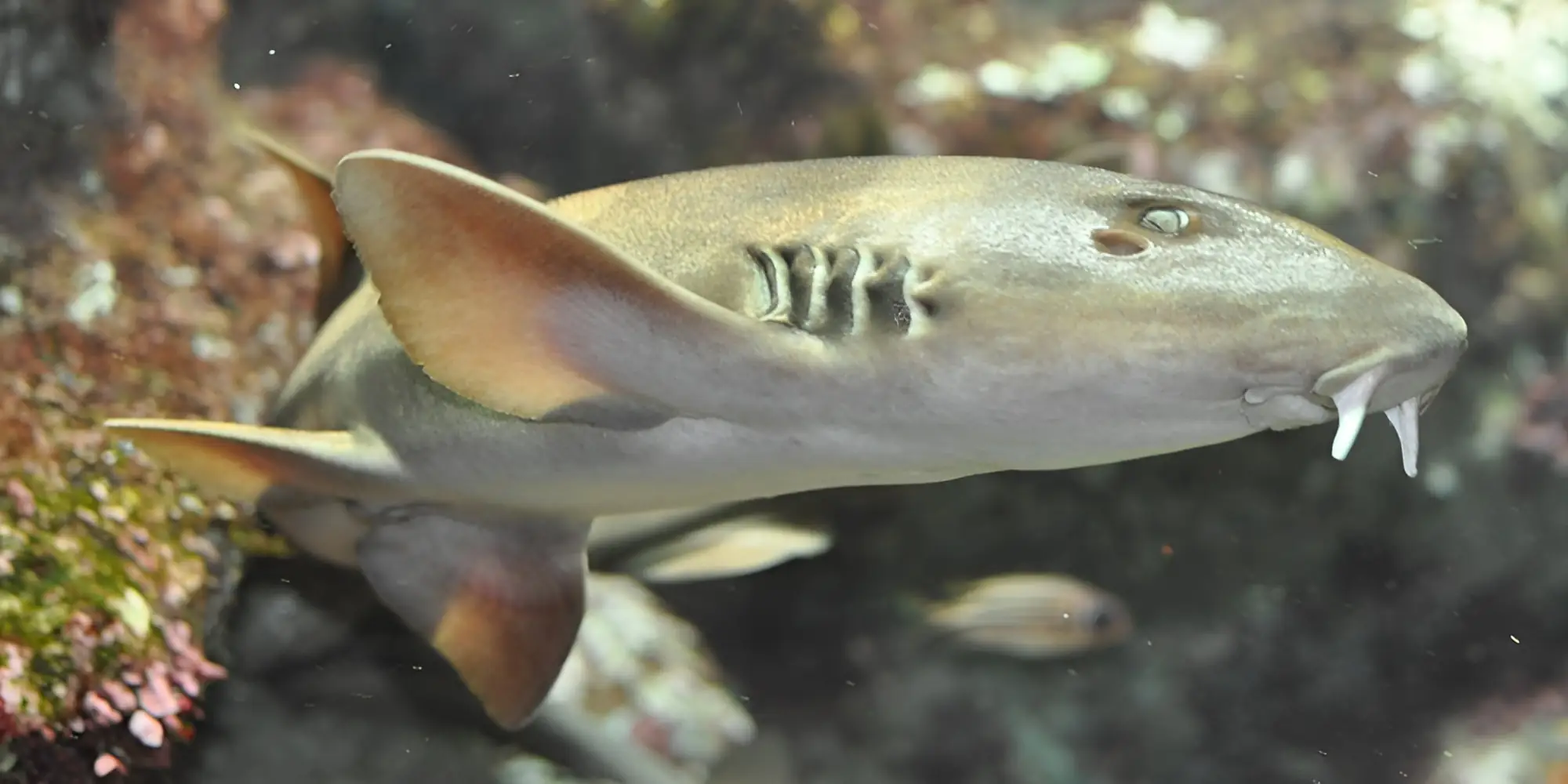
Body structure, features & anatomy
The grey bamboo shark Chiloscyllium griseum is a small bottom-living carpet shark in the Hemiscylliidae. WoRMS treats the name as valid; on Haitauchen it sits within Selachii, Galeomorphi, Orectolobiformes and the genus Chiloscyllium.
FishBase describes it as a marine and brackish-water tolerant, reef-associated bottom shark reaching about 77 cm. The body is long and slender, the tail region is extended, and the two dorsal fins are smaller than the pelvic fins.
Colour pattern and identification
Young sharks show 12 to 13 dark saddles or crossbands on a pale brown to grey-brown background. The pattern fades with growth; adults are usually more uniformly brown to grey-brown above and cream below. Slightly raised eyes, a subterminal notch in the tail and the lack of a lateral skin ridge help with identification.
That mix of traits separates the grey bamboo shark from several similar bamboo sharks. Older photographs, aquarium names and regional records should be treated carefully because Chiloscyllium species have often been confused.
Distribution & habitat
The grey bamboo shark belongs to the warm Indo-West Pacific. Its best-supported core lies in the northern Indian Ocean and Southeast Asia, especially shallow coastal and shelf waters of Pakistan, India, Sri Lanka, Bangladesh, Myanmar, Thailand and Malaysia.
Shark-References also lists a broader Indo-West Pacific frame with records toward Indonesia, Vietnam, China and Papua New Guinea. That range should not be read as equally secure everywhere: FishBase notes that historical records from the Philippines, Taiwan and Japan may be misidentifications of Chiloscyllium punctatum, and many country records still need confirmation.
Shallow water, estuaries and reefs
The species uses coastal habitats between the northern Indian Ocean and the western Pacific Ocean: sand and mud bottoms, seagrass and algal areas, lagoons, reef-adjacent flats and estuaries. It is mainly a bottom shark of very shallow to moderately deep water.
For divers, this is not a blue-water or classic reef-shark target. Encounters are more plausible during careful searches over suitable bottom, at dusk or at night than on open-water shark trips.
Life history, diet & reproduction
Grey bamboo sharks are bottom-searching predators. They move across sand, mud, seagrass, algae and reef edges and probably feed mainly on small invertebrates; small fishes and other bottom prey may also be taken.
The body plan fits a shark that searches crevices, structure and shallow coastal ground rather than swimming fast in open water. Like other bamboo sharks, it can rest on the bottom and make short movements between shelter, feeding spots and cover.
Egg-laying and young sharks
The species is oviparous and lays egg cases. Small oval egg cases are deposited on the bottom, and embryos develop on yolk. During mating the male holds the female by biting the pectoral fin, a behaviour also known from related bamboo sharks.
In an Indian captive study, Jagadis & Ignatius 2003 documented 27 egg cases over three months, usually laid in pairs; young hatched after 67 to 85 days. Aquarium data do not replace field biology, but they show why this species matters for reproductive and husbandry research.
Threats & conservation status
The IUCN Red List lists the grey bamboo shark as Vulnerable. The main reasons are its reliance on shallow coastal habitats, documented fishing pressure and a data situation in which similar bamboo sharks have not always been separated cleanly.
Important pressures include coastal fisheries, bycatch, habitat degradation in seagrass and estuary areas, confusion with other bamboo sharks and probably limited local recovery. Small bottom sharks can disappear from the data when landings are recorded only as small sharks or bamboo sharks.
Main pressures
Protection therefore means better species identification in landings, less bycatch in shallow coastal habitats, protection of estuaries and seagrass beds, and cautious use in regions where small bamboo sharks have so far been grouped too broadly.
Grey bamboo shark & humans
The grey bamboo shark is not dangerous to people. It is small, bottom-living and focused on small prey. A bite is mainly conceivable when an animal is caught, held or directly harassed.
For divers and underwater photographers the species is interesting precisely because it is understated: not a show shark, but a quiet coastal animal that rests on the bottom, retreats into structure and usually avoids contact when approached.
Encounters and conduct
Encounters should stay hands-off: do not pull animals from crevices, uncover them for photographs or overuse lights at night. Egg cases on the bottom or attached to structure should not be moved; they are part of the life cycle.
For Haitauchen, Chiloscyllium griseum stands for the quiet, easily overlooked sharks of shallow tropical coasts. These species show why shark conservation must include small bottom sharks in estuaries, seagrass beds and lagoons.
Profile
- First described:
- Max. size:
- Depth:
- Max. age:
- Max. weight:
- Water type:
- IUCN Status:
Taxonomy
- Kingdom:
- Phylum:
- Subphylum:
- Infraphylum:
- Parvphylum:
- Class:
- Subclass:
- Superorder:
- Order:
- Family:
- Genus:
Newsletter
Shark Alert in Your Inbox