


Ganges shark - Glyphis gangeticus
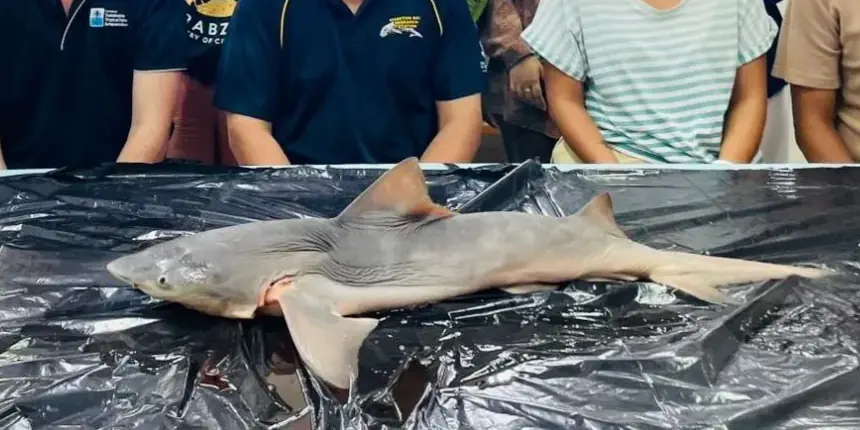
Body structure, features & anatomy
The Ganges shark Glyphis gangeticus is a stocky requiem shark with a short, broadly rounded head, tiny eyes and a plain grey-brown to grey body. FishBase gives a maximum length of about 204 cm, while newborns are already roughly 56 to 61 cm long.
Its very small eyes fit a life in turbid water, where smell, the lateral line and electroreception matter more than clear sight. Externally the species looks understated, but tooth shape, head profile and dorsal-fin proportions help separate it from similar river sharks and from bull sharks.
Teeth, fins and senses
The upper teeth are triangular and serrated, while the front lower teeth are slimmer and more hook-like. That combination points to a fish and ray predator in rivers and estuaries, not to a shark specialised for large mammal prey.
Distribution & habitat
The historical range spans river and estuary systems from the northern Indian Ocean into Southeast Asia. The Sesayap ISRA is especially important today: the Sesayap River in North Kalimantan links river channels, mangroves and a dynamic estuarine delta at the edge of the Sulu-Celebes Sea.

Many older reports are uncertain because true Ganges sharks were long confused with bull sharks and other carcharhinids. Secure modern records are therefore unusually valuable and can change the distribution picture more than they would for a well-studied shark.
Turbid rivers and mangrove estuaries
Typical habitat is warm, sediment-rich lower river, mouth and brackish-water habitat. In the Sesayap, the estuary shifts seasonally and with tides; such transition zones can give young river sharks food, cover and suitable salinity.
Life history, diet & reproduction
Direct observations of Ganges shark ecology remain scarce. The ISRA-Factsheet describes mostly neonates and young animals in the Sesayap, pointing to an important nursery area. The sharks probably move within a narrow salinity window between fresh, brackish and nearshore marine water.
Diet is inferred from anatomy and capture context: small fishes, rays and other river or estuary-bottom animals are likely important prey. In muddy water, active searching with chemical, mechanical and electrical senses probably matters more than visual hunting.
Reproduction
Ganges sharks are live-bearing. The small number of known animals, large newborns and likely slow maturity make the species sensitive to additional fishing pressure, especially where juveniles are caught in gillnets or other small-scale gears.
Threats & protection status
The IUCN Red List lists the Ganges shark as Critically Endangered. Risk comes from the combination of extreme rarity, uncertain range, fishing pressure and alteration of major river and estuary habitats.
Main pressures
- Bycatch: juveniles and small sharks can be taken in gillnets, set nets and other river or coastal fisheries.
- Habitat loss: mangrove loss, river modification, pollution and changed freshwater flows weaken nursery habitat.
- Misidentification: if Ganges sharks are not recognised, key records disappear inside market and catch data.
Protection therefore needs more than rules on paper. It needs local collaboration with fishers, fast identification support and spatial measures for known nursery areas.
Ganges shark & humans
The Ganges shark has a dramatic reputation because its name has often been attached to attack stories from large rivers. Scientifically, caution is needed: many historical cases likely involved bull sharks instead. A modern record in the Journal of Fish Biology mainly shows how rare confirmed evidence is.
For people, the species is now primarily a conservation issue. In-water encounters are very unlikely; fisheries, markets, river use and the chance to recognise and release rare juveniles matter far more.
Why the Sesayap discovery matters
The Shark Conservation Fund project describes North Kalimantan as a possible last opportunity to secure a viable population. That moves the Ganges shark away from almost mythical river-shark stories and back into practical conservation with communities, authorities and researchers.
Profile
- First described:
- Max. size:
- Depth:
- Max. age:
- Max. weight:
- Water type:
- IUCN Status:
Taxonomy
- Kingdom:
- Phylum:
- Subphylum:
- Infraphylum:
- Parvphylum:
- Class:
- Subclass:
- Superorder:
- Order:
- Family:
- Genus:

Newsletter
Shark Alert in Your Inbox