


Frilled shark - Chlamydoselachus anguineus
Body structure, features & anatomy
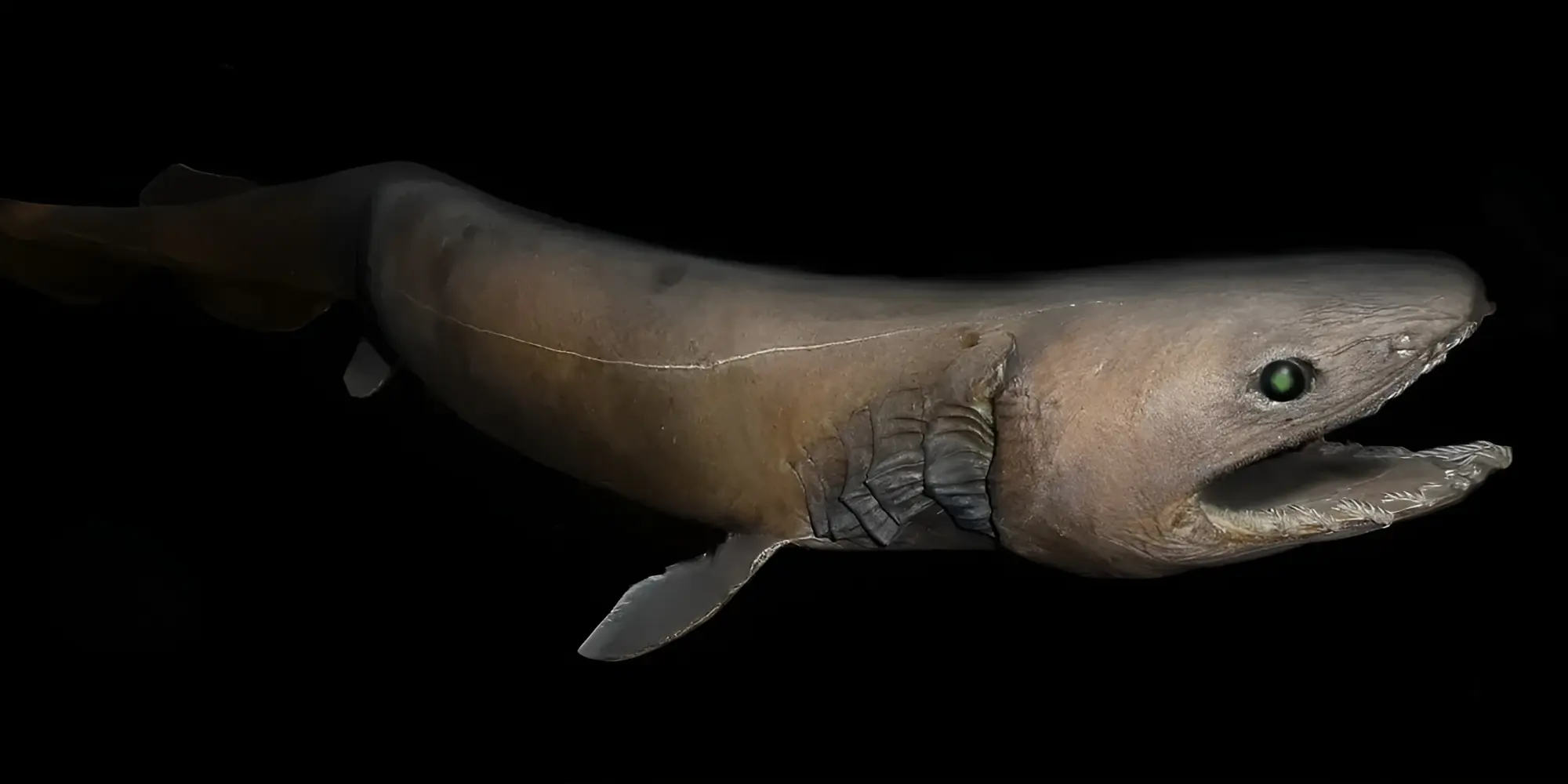
The frilled shark has a long, snake- to eel-like body and reaches a total length of around two meters. The head is flattened, the snout is very short and the large mouth is located at the front edge of the head. The color ranges from dark brown to gray-brown; the paired fins are small, while the dorsal, ventral and anal fins are located far back on the body. The caudal fin has only a weakly developed lower lobe.
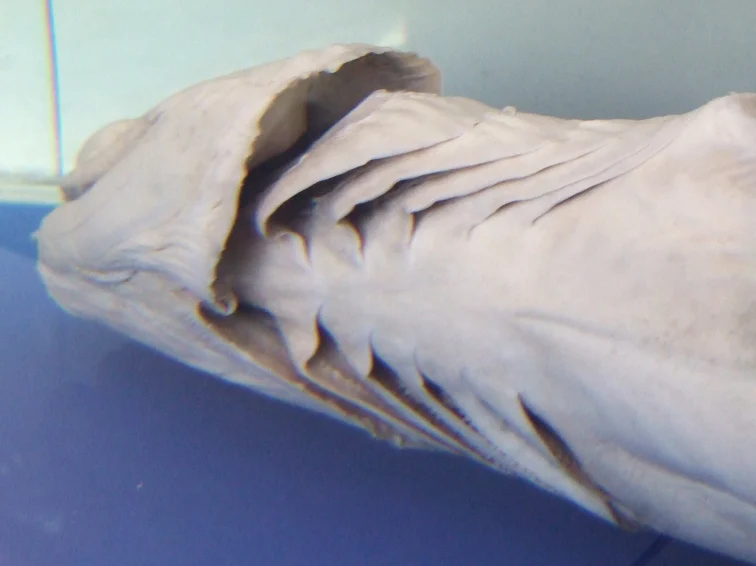
The species portrait of Australian Museum names six pairs of gill slits, a single dorsal fin and the three-pointed teeth as the central identifying characteristics. Unlike most sharks, the lower ends of the first pair of gill slits meet under the throat. Folds of skin and the red, fringed edges of the gills form the ‘collar’ that gives it its name.
Six gill slits and the eponymous collar
The six gill slits are located laterally and extend far to the underside. The first fold in particular encloses the throat almost like a loose hem. When the slits are opened, the gill filaments, which are heavily supplied with blood, become visible. This feature distinguishes frilled sharks not only from most fivegill shark orders, but also from the related crested sharks within the Hexanchiformes.
Wide mouth and rows of three-pointed teeth
The mouth can be opened very wide. There are numerous small teeth in loose rows in both jaws. Each tooth has three long, backward-curving main tips; small secondary peaks can be added at the base. The light rows of teeth stand out clearly from the dark area of the mouth. Worn teeth on the edge of the jaw are continually replaced by teeth from the back rows.

The combination of a terminal mouth, movable jaws and many slender hooked teeth is suitable for holding soft and smooth prey such as squid. The long body can bend a lot, but is not built like that of an eel: The frilled shark remains a cartilaginous fish with typical shark skin, paired pectoral and pelvic fins, lateral line system and electroreceptors on the head.
- slender, dark colored body with a very short snout
- six pairs of fringed gill slits
- terminal, wide-opening mouth with three-pointed teeth
- a single dorsal fin located far back
- long caudal fin without a clearly defined lower lobe
Distribution & habitat
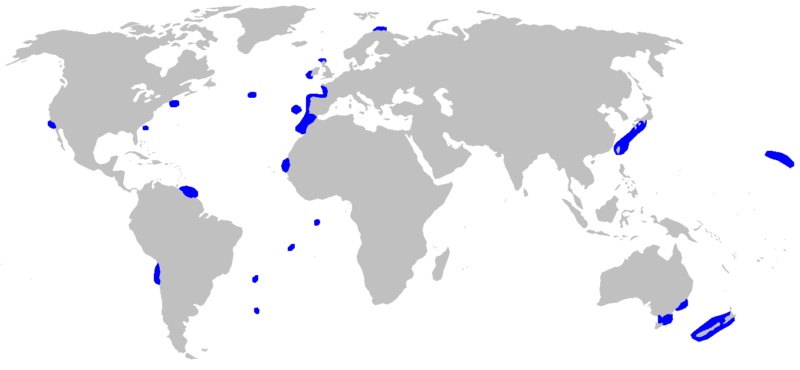
The frilled shark has a wide but distinctly patchy distribution in the Atlantic and Pacific. Records include the eastern Atlantic from Norway to West Africa, parts of the western Atlantic, waters off Japan and New Zealand, and the eastern Pacific from California in the USA to Chile. Large areas between these regions lack confirmed records. Its range should therefore not be understood as a continuous belt.
Outer shelf and continental slope
FishBase classifies Chlamydoselachus anguineus as a deep-sea bathydemersal species. Most catches come from the outer continental or island shelf and the upper continental slope. The usual depth range is around 120 to 1,280 meters; documented individual catches range up to approximately 1,570 meters. Regionally, the species is particularly frequently detected between around 500 and 1,000 meters.
The shark lives over mud and sandy bottoms, on steep slopes and on the edges of submarine channels. It can swim close to the ground, but also uses the water column near the ground. Temperature, topography, prey availability and the location of oxygen-rich water layers determine which sections of a continental slope are actually used.
A map with historical data
The map shown here was created in 2007 based on ‘Sharks of the World’ (2005) and later graphically updated. It shows the summarized level of knowledge at the time, not the frequency of the species. In addition, Chlamydoselachus africana was only scientifically described in 2009. Older finds from southern Africa may therefore have been reassessed or may not have been assigned with certainty to one of the two species.
Rare surface catches are not an indication of typical shallow water habitat. They usually affect weakened animals, special hydrographic conditions or catches over steeply sloping ground. When classifying evidence, fishing depth, position, water temperature and a verifiable species identification are therefore more important than the mere distance from the coast.
Regional records around New Zealand
A 2026 study preprint examines 341 records from the Southwest Pacific. Chatham Rise and the Kaikōura Canyon region account for 35% of captures, with reported depths of 305–1,344 metres. About a quarter of records lie beyond national jurisdiction. This distribution describes the sampled records, not population density; the regional depth range does not replace worldwide depth records.
Behaviour, diet & reproduction
The frilled shark lives slowly and energy-efficiently in a deep-sea habitat with little light. Its elongated body appears mobile, but is not designed for sustained high speed. It probably approaches prey calmly and strikes at close range. The terminal mouth, expandable jaws and numerous hooked teeth help to hold onto prey that is difficult to grasp in open water.
Squids, fish and other cartilaginous fish
The stomach contents examined primarily contained squid, as well as bony fish and other cartilaginous fish. Many captured animals have empty or heavily digested stomachs, making the exact importance of individual prey groups difficult to determine. The large eyes and sensitive lateral line and electroreception system aid hunting when there is little remaining light.
How exactly a frilled shark attacks has rarely been observed in natural environments. The often repeated comparison with a snake’s head snapping is therefore a plausible, but not fully proven, interpretation. What is certain is that the jaws can be pushed far forward and opened and that the backward-facing tooth tips make it difficult for soft prey to escape.
Aplacental live birth
The reproduction study from Suruga Bay describes aplacental vivipary: the eggs remain in the mother, the embryos hatch in the uterus and live primarily on the large supply of yolk during their development. A placenta like that of some demersal sharks does not form. Litters usually contain a few young animals; Published information ranges from approximately two to 15. At birth, the young are already around 40 to 60 centimeters long.
The Study on Embryonic Development summarizes estimates according to which embryos only grow about 10 to 17 millimeters per month. From this, a possible gestation period of up to three and a half years was derived; other calculations are around one to two years. Because mating, early pregnancy, and parturition are rarely observed directly in the deep sea, the extreme maximum estimate should not be represented as an accurately measured duration.
Mature females grow larger than males. The combination of late sexual maturity, small litters and long embryonic development limits the number of offspring. For population growth, it is not only the number of animals caught that is crucial, but also whether there are large pregnant females or young animals from spatially limited breeding areas.
Evidence suggesting births in New Zealand waters
The regional study preprint includes biological data from 32 animals. Estimated total length at maturity is 164–173 cm for females and 124–132 cm for males. Newborns and females that had recently given birth suggest births occur in New Zealand waters, without establishing a confirmed nursery. Depth use also differs with size and sex. Limited dietary observations identify deepwater squaliform sharks as prey, without quantifying their share of the overall diet.
Threats & conservation status
The IUCN Red List assesses the frilled shark globally as Least Concern. This classification does not mean the species is insensitive to fishing pressure. It reflects its very large overall range, the absence of a significant targeted fishery and the available population information, which remains incomplete at regional level.
Bycatch in deep sea fisheries
Frilled sharks occasionally become caught in bottom trawls, gillnets and longlines used on the outer shelf or continental slope. Some of the animals are used as fishmeal or locally as food fish, and many catches are discarded. Animals that have been released can also die from injuries, long periods of capture, changes in pressure and time on deck.
Reproductive biology increases caution: few young animals and very long embryonic development make rapid population recoveries seem unlikely. At the same time, the wide, patchy distribution protects part of the population from local fishing pressure. These two factors explain why global Least Concern assessment and high biological sensitivity can coexist.
What is particularly important for protection
- Record by-catches at species level instead of just as unspecified deep-sea sharks.
- Document catch depth, gender, size and condition when released.
- Detect spatial concentrations of pregnant females or young animals early.
- Shorten the catching time and time on deck and release live animals as gently as possible.
- Manage deep-sea fishing so that sensitive slope habitats are not permanently overfished.
Population trends are difficult to calculate because the species is rare, often not identified to the species level, and older data sets may contain catches of the South African frilled shark, which was only described in 2009. Long-term research series and verifiable photos or tissue samples therefore not only improve the distribution map, but also the assessment of regional risks.
The regional evidence of differing depth use suggests that bycatch monitoring should analyse capture location and depth alongside size, sex and reproductive condition. These findings do not demonstrate population decline.
Frilled shark & humans
The frilled shark poses no known danger to people in the water. Its typical habitat is well below safe recreational diving depths, and the species is rare even on deep sea trips. Encounters usually occur as bycatch, during scientific sampling or through cameras on remote-controlled and manned deep-sea vehicles.
The FAO species catalog describes the species as harmless to humans in the water, but points out the sharp teeth. A caught animal should therefore not be touched by its mouth or gills. Suitable release tools, hand protection, the shortest possible air time and rapid return to the catching depth reduce injuries to animals and people.
Not a predictable species for shark divers
A targeted dive with frilled sharks cannot be offered seriously. Retrieving a deep-sea animal for photography or viewing causes severe temperature and pressure stress and is not a responsible form of encounter. ROV recordings at natural depths, in which position, depth, temperature and behavior are documented, are more informative.
Usage, research and public perception
frilled sharks have little commercial importance. Regionally, bycatch is processed into fishmeal or used as food; a large part has no market value. Well-documented catches are still valuable for research because they provide data on distribution, reproduction and species delimitation. However, a sample should never replace the careful handling of a live animal.
In the media, the frilled shark is often referred to as a ‘living fossil’. The expression refers to a body structure that is reminiscent of early shark lines, but should not be taken literally: the species living today is not a fossil that has remained unchanged since prehistoric times, but rather part of an independent, evolving lineage. Precise language makes their unusual anatomy more interesting without repeating scientifically untenable age statements.
- Document sighting or catch with date, coordinates, depth and photos.
- Do not pick up a live animal by its mouth, gills or tail.
- Consider confusion with Chlamydoselachus africana in South African finds.
- Prefer ROV observations to bringing an animal out of the deep sea.
Profile
- First described:
- Max. size:
- Depth:
- Max. age:
- Max. weight:
- Water type:
- IUCN Status:
Taxonomy
- Kingdom:
- Phylum:
- Subphylum:
- Infraphylum:
- Parvphylum:
- Class:
- Subclass:
- Superorder:
- Order:
- Family:
- Genus:
Newsletter
Shark Alert in Your Inbox