


Cuban dogfish - Squalus cubensis

Body structure, features & anatomy
The Cuban dogfish Squalus cubensis is a slender, deep-dwelling dogfish shark of the western Atlantic. Taxonomically it leads WoRMS as a valid species in the Selachii, within the Squalomorphi, Squaliformes, Squalidae and the genus Squalus. The species was described from Cuba in 1936 and is one of the smaller, spine-bearing dog sharks.
Shorefishes of the Greater Caribbean describes Squalus cubensis as a narrowly built shark with a narrow head, a pointed to slightly rounded snout profile, large eyes, five gill slits in front of the pectoral fins and a long, slender spine in front of each of the two dorsal fins. An anal fin is missing, as is typical for dogfish sharks.
Identifying features
- gray to grey-brown upper side, significantly lighter to whitish underside
- broad dark tips of the two dorsal fins
- light to white trailing edges on the pectoral, ventral and caudal fins
- strongly concave posterior edge of the pectoral fins with tapered free posterior corners
- small, single-pointed cutaneous teeth on the body flanks
In the field the species can be confused with other dogfish sharks. The combination of slim body, dark dorsal fin tips, light fin edges, missing anal fin and the position of the first dorsal fin in relation to the pectoral fins are helpful.
Distribution & habitat
The Cuban dogfish lives in the western Atlantic. FishBase names an area of North Carolina and Florida about the Gulf of Mexico, Cuba and Hispaniola into southwest Atlantic waters Brazil and Argentina. For shark diving, this is a large-scale, deep-water shark Atlantic Ocean, with a strong connection to Caribbean Sea and to the Gulf of Mexico.
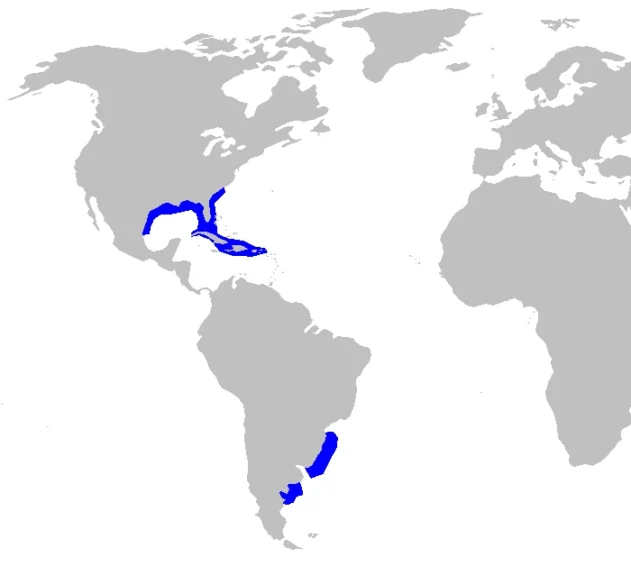
Important countries and island areas in the distribution picture include: USA, Mexico, Bahamas, Cuba, Haiti, the Dominican Republic and Colombia. The species is not restricted to Cuba; the German name refers to the first historical description and the Caribbean focus.
Depth and habitat
The Cuban dogfish stays mostly close to the bottom, especially on the outer continental shelf and the upper continental slope. Depending on the source, depth information ranges from around 50 to over 900 meters; Areas around 60 to several hundred meters are often mentioned. Juveniles may appear flatter than adults.
The species uses warm subtropical to tropical marine environments, including reef edges, soft bottoms, sand and gravel areas and near-bottom water layers. Encounters during normal recreational diving are therefore rare because the species usually lives deeper than classic reef and coastal dives.
Life history, diet & reproduction
Florida Museum summarizes the Cuban dogfish as a deep-water, school-forming species that eats smaller bony fish and bottom-level invertebrates. Among other things, squid, shrimp and other crustaceans are mentioned. The species seeks food on or near the seabed, but can also travel in the water column near the bottom.
Reproduction and growth
The Cuban dogfish is viviparous or ovoviviparous. Older standard works mentioned around ten young animals per litter, more recent works and summaries indicate smaller litters for the animals examined. This uncertainty is typical for underfished or difficult-to-access deep-water sharks, where samples remain small.
The maximum length is usually given as around 110 centimeters; adult animals are often significantly smaller. Females are considered sexually mature at around 50 centimeters or more; At the same time, recent studies show that older size and maturity data for this species must be read carefully.
Parasites and deep-water ecology
What is striking is the detection of large woodlice in the mouth or body area of individual animals. What is particularly important for practical species protection is that many ecological details are still incomplete: diet, migration, age structure and regional population trends are significantly less well known than for sharks that are frequently observed near the coast.
Threats & protection status
The IUCN Red List currently rates the Cuban dogfish as not endangered globally (least concern). This classification is based on data that is uneven across regions: many catches are not reported with species specificity, and deep-water sharks often only appear in statistics as collective groups.
The most important burden is fishing. Cuban dogfish may occur as bycatch in deepwater, longline and trawling fisheries; They were sometimes used because of the liver, which was rich in oil and vitamins. Because the species can occur in groups, local catches can quickly affect many animals, even if the global status is not currently alarming.
Why monitoring remains important
Deepwater sharks often respond slowly to overexploitation: late maturity, limited litter sizes, and uncertain population trends make rapid recovery difficult. For the Cuban dogfish, species-specific catch data, bycatch monitoring and the observation of deep shelf and slope fisheries are more important than a blanket protection status alone.
From a marine conservation perspective, the species is a good example of how a current least concern status does not automatically mean that regional caution is not necessary. Where deep-water fishing is increasing, small spiny dogfish species should be consistently documented.
Cuban dogfish & humans
The Cuban dogfish is not a typical risky shark for humans. It remains relatively small, usually lives deep and is rarely encountered during normal swimming or reef diving. Attacks on humans are not the issue for this species; the relationship is primarily a fishing and bycatch issue.
Shark-References mentions the use of the species in connection with liver oil, among other things. For research, fishing and accidental catches, the dorsal fin spines can cause painful injuries, even if the shark itself is not aggressive. Live animals should be treated as briefly as possible, wet and without unnecessary pressure on the stomach or gills.
Observation and handling
- Do not touch animals or hold them by their dorsal fin spines
- In case of bycatch, secure the mouth, tail and spines in a controlled but careful manner
- Document find data with location, depth, fishing gear and photo
- Release live animals as quickly as possible if collection is not required
The Cuban spiny dogfish is particularly interesting for shark diving as a deep-water species. It shows that the Caribbean is not only made up of shallow reef sharks, but also has a barely visible depth with its own rarely observed spiny dogfish species.
Profile
- First described:
- Max. size:
- Depth:
- Max. age:
- Max. weight:
- Water type:
- IUCN Status:
Taxonomy
- Kingdom:
- Phylum:
- Subphylum:
- Infraphylum:
- Parvphylum:
- Class:
- Subclass:
- Superorder:
- Order:
- Family:
- Genus:
Newsletter
Shark Alert in Your Inbox