


Cobbler wobbegong - Sutorectus tentaculatus

Body structure, features & anatomy
The cobbler wobbegong Sutorectus tentaculatus is a small, comparatively slender carpet shark. Its body is less flattened than many larger wobbegongs, but the head remains broad and flat. The mouth is located far forward on the underside of the head; small, pointed teeth stand in several rows.
Conspicuous rows of wart-like skin nodules begin above the eyes and extend down the back. There are only a few narrow flaps of skin around the snout and mouth. The two nasal barbels are simply built and not branched. This combination of back humps and a less pronounced skin fringe is the most important external characteristic.
Coloring and fins
The upper surface is yellowish brown to grey-brown and bears irregular dark saddles, spots and numerous small black dots. The drawing visually breaks up the body contours on rocky or overgrown surfaces. The underside is significantly lighter and has significantly less markings.
- Broad, flat head with small eyes and spray holes.
- Simple nasal barbels and a few narrow flaps of skin on the head.
- Several rows of clearly palpable, wart-like skin nodules on the back.
- Two similarly shaped dorsal fins far back on the body.
- Broad pectoral and pelvic fins and an asymmetrical caudal fin.
- Brown camouflage pattern consisting of dark saddles, spots and black dots.
The Australian Museum indicates a maximum documented total length of about 92 centimeters. This means the species remains significantly smaller than the spotted and banded carpet sharks. Males become sexually mature at approximately 65 centimeters; There is less reliable size information for females.
Distribution & habitat
The cobbler wobbegong is in Australia endemic. Its known range extends from the Houtman-Abrolhos Islands and the central coast of Western Australia southwards around the southwest coast into the Adelaide area and eastern South Australia. There are no confirmed occurrences outside Australia.
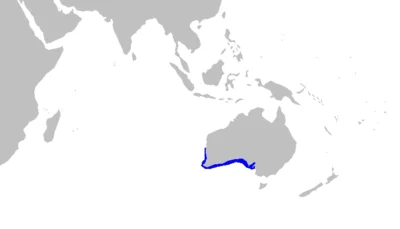
Flat, structurally rich coastal habitats
FishBase specifies a depth range from the intertidal zone to at least 35 meters. The species lives on the inner continental shelf and is found primarily on rocky and coral reefs, in algae and seaweed populations, and on other densely structured soils. Crevices, overhangs and dense vegetation provide cover during the day.
The distribution area is in temperate to warm temperate coastal waters. The shark is not an inhabitant of the open ocean, but is closely tied to habitats close to the bottom. Suitable microhabitats may be patchily distributed within its range, so that the species does not occur equally frequently on every coast.
The map is a historical, schematic representation from 2007. The red area shows the coastal area that was summarized at that time and not a precise database of finds. It should therefore be read neither as a current inventory map nor as evidence of a continuously populated area.
Life history, diet & reproduction
cobbler wobbegongs are ground-dwelling and predominantly nocturnal. During the day they rest motionless under rocky outcrops, between algae or on the reef. Their markings and irregular body surface allow them to merge with the ground. After dark they become more active and search for prey close to the ground.
Food and hunting methods
Direct gastric content data are rare. As a lurking hunter, the species is likely to prey on small bottom-dwelling bony fish and invertebrates that come within range of its mouth. A quick opening of the mouth creates a suction that pulls prey into the oral cavity. The large pectoral fins do not serve to hold on, but rather stabilize the body on the ground.
How often individual animals change their resting place, how large their activity areas are and whether there are seasonal migrations have not been sufficiently investigated. Activity patterns can also depend on water temperature, prey availability and disturbance. Much of the information so far is based on a few catches and individual observations.
Reproduction
After Shark-References The species is aplacental viviparous: the eggs develop in the womb, with the embryos initially being nourished by the yolk. The young animals are born fully developed. There is no placental connection to the mother animal.
Reliable information on mating season, gestation period, whelping interval and birth areas is missing. The litter size is also poorly documented. These knowledge gaps are important for stock assessment because without a reproductive rate it is not possible to reliably estimate how quickly local losses will be compensated.
Threats & conservation status
The IUCN Red List lists the cobbler wobbegong as not endangered (Least Concern). The species has a limited Australian range, but is not considered a target of a significant fishery there. There is currently no documented decline in the population.
The Australian species assessment primarily mentions unintentional bycatch in bottom gillnets and longlines. Because of their small body size, captured animals are usually not marketed and are often released. Whether they survive release depends on the length of capture, injuries and handling on board.
Possible burdens
- Bycatch in demersal gillnets, longlines and other bottom-level fishing gear.
- Injuries or stress caused by improper handling and delayed release.
- Local loss of rocky reefs, kelp stocks and other shallow coastal habitats.
- Small amount of data on frequency, reproduction and long-term population development.
- Climate-related changes in temperate algal and reef communities.
A large part of the area overlaps with regions in which fishing effort is monitored and in some cases spatially limited. Protected areas can secure refuges, but are no substitute for species-related recording. It is important to have standardized bycatch reports with location, depth, length, gender and condition at release.
The classification as not at risk is therefore not evidence of a completely known or risk-free population. In an endemic species, regional changes can affect a large proportion of the total population. Repeated fishery and reef monitoring is necessary to identify trends early.
Cobbler wobbegong & humans
cobbler wobbegongs are not usually aggressive towards humans. They rely on their camouflage and often lie motionless during the day. This means that divers, snorkelers or waders can miss an animal and get too close to it.
Like other wobbegongs, the species can snap forward very quickly if touched, harassed or prevented from escaping. The small, sharp teeth can cause painful wounds. Calm behavior is not a signal that touching is safe.
behavior during an encounter
- Keep a sufficient distance and do not touch or feed the shark.
- Never block the possible escape route to the open reef.
- Maintain good buoyancy and do not rest your hands on rocks, seaweed or in crevices.
- When taking photos, do not move your tail or fins and do not startle the animal.
- If you are bitten, do not pull suddenly, but seek professional medical help.
Regional rules apply to recreational fishermen. The South Australia Fisheries Authority stocks wobbegongs in South Australia under common catch limits. Regardless of permitted removal, a quick, gentle release is the more prudent decision for this small, underused species.
Gentle release
If an animal is caught, it should stay in the water if possible. If lifting is unavoidable, the body must be fully supported; The shark must never be carried by its tail, gills or fishing tackle alone. Hooks are quickly removed or the line is cut as close to the mouth as possible if safe removal is not possible.
A sighting with location, date, depth and photos can aid research and inventory monitoring. To do this, the animal should not be moved or lured out of its hiding place. Good documentation is particularly valuable when it is created without additional stress for the shark.
Profile
- First described:
- Max. size:
- Depth:
- Max. age:
- Max. weight:
- Water type:
- IUCN Status:
Taxonomy
- Kingdom:
- Phylum:
- Subphylum:
- Infraphylum:
- Parvphylum:
- Class:
- Subclass:
- Superorder:
- Order:
- Family:
- Genus:
Newsletter
Shark Alert in Your Inbox