


Caribbean roughshark - Oxynotus caribbaeus
Body structure, features & anatomy
The Caribbean roughshark Oxynotus caribbaeus is a small, very unusually built deep-water shark. Taxonomically it leads WoRMS as a valid species within the Selachii, the Squalomorphi, the Squaliformes, the family Oxynotidae and the genus Oxynotus. The scientific name refers to the Caribbean; The species was described in 1961 based on material from the Venezuelan coast.
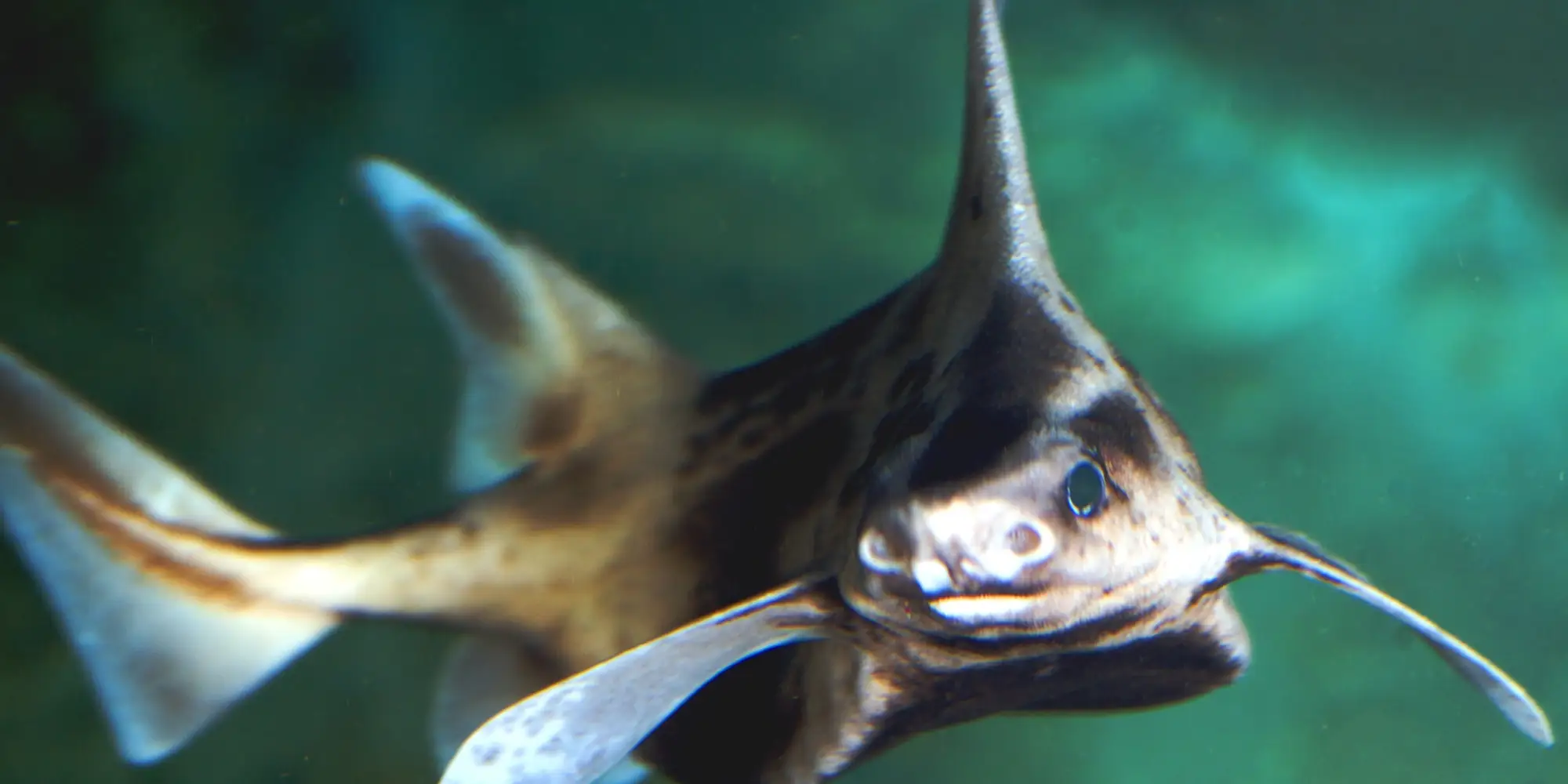
The body appears almost triangular in cross-section: high, strongly compressed at the sides and with an angular back. The skin is extremely rough because the skin teeth are large and stalked. In addition, there is a short, broad head, large spray holes behind the eyes, very small gill slits and a small, almost transverse mouth with thick lips.
Identifying features
- very high, laterally compressed body with a triangular profile
- two high, sail-like dorsal fins with strong thorns, some of which are hidden in the fin
- no anal fin; the tail has a distinct subterminal notch
- Light gray base color with dark spots, fin markings and two dark head stripes
- different teeth: narrower at the top, wider at the bottom and built like a knife
Shorefishes of the Greater Caribbean describes the species in particular detail: the first dorsal fin begins far forward above the gill slits, the second is smaller, and the ventral side has strong lateral keels between the pectoral and pelvic fins. For photos and observations, body height, dark bands, rough skin and the two large dorsal fins are more important than pure size.
Distribution & habitat
The Caribbean roughshark is a shark of the western Atlantic. FishBase mentions Venezuela and possibly other parts of the Caribbean; more recent observations and regional databases provide a broader picture. On shark diving is the species with the Atlantic Ocean, dem Gulf of Mexico and that Caribbean Sea linked.

The German art page lists, among other things Bahamas, Venezuela, Mexico, USA, Aruba, Curacao, the Cayman Islands and Saint Lucia. This selection fits a rarely detected but not purely Venezuelan Caribbean and Gulf of Mexico shark.
Deep water on the shelf slope
The habitat is on the upper continental slope and in deep areas close to the ground. Older summaries often give around 400 to 450 meters, while regional data and direct observations show a wider window. The current shark diving field ranges from 218 to 579 meters; Shorefishes even says 220 to 800 meters.
The habitat is not the bright shallow water reef area, but soft and hard bottom in deeper Caribbean zones: mud, sand, gravel, rocks and reef edges can play a role. Normal recreational diving does not reach this range; Sightings are more likely to come from deep-sea submersibles, research cameras or fishing contacts.
Lifestyle, diet & reproduction
Shark-References summarizes the Caribbean roughshark as a bathydemersal marine species that lives on the upper continental slope. The few direct data indicate cold deep water in the warm tropical belt: classic data sets indicate ground temperatures of around 9.4 to 11.1 degrees Celsius.
Food and exercise
Little has been directly studied about nutrition. The species probably eats bottom-dwelling invertebrates and small fish. The shape suits a slow-swimming, bottom-hugging predator: tall body, rough skin, small mouth opening, powerful lower incisors and large dorsal fins that can provide stability in deep, structured habitat.
Messing et al. 2013 documented for the first time in situ observations and photographs from several regions of the tropical western Atlantic, including repeated observations off Roatán. This work expanded the known distribution, depth and temperature picture of the species and shows how much of its lifestyle is only visible through submersibles and modern deep-water observation.
Reproduction
The species is viviparous or ovoviviparous: embryos develop in the mother and are born as finished young animals. However, reliable information on litter size, age of maturity and growth is scarce. Such life history data often remains incomplete, especially for rarely caught deep-water sharks, although they would be important for population assessments.
Threats & conservation status
The IUCN Red List currently rates the Caribbean roughshark as not endangered globally (least concern). This should not be confused with a well-studied species: much evidence is scattered, observations in its natural habitat remain rare, and older regional overviews sometimes listed the species as lacking data.
The main potential exposure is deep-water fishing. Caribbean roughsharks have little targeted market value, but may occur as bycatch at depths where trawls, longlines or other bottom-hugging fishing gear operate. For a species that is rarely documented, it is not only the number of catches that is important, but also whether they are reported accurately to the species.
Why data quality matters
- Deep habitats are observed much less often than coastal reefs.
- Small, unusual squaliformes can disappear under collective names in catch statistics.
- Dissemination points from diving boats and museum material complement each other, but do not replace monitoring.
- The absence of strong commercial interest does not automatically protect against bycatch.
Clean documentation is therefore particularly important for protection: photos, location, depth, temperature, fishing gear and whereabouts should be recorded. This makes it possible to distinguish whether the species is only rarely seen because it lives deep, or whether individual areas are actually under pressure.
Caribbean roughshark & humans
The Caribbean roughshark is considered harmless to humans. It is small, lives at great depths and is not a shark that bathers, snorkelers or scuba divers typically encounter. Their mouths and teeth are built for small ground-level prey, not for active interaction with humans.
When people see this species, it is usually via submersibles, remote cameras, research trips or as rare bycatch. This is precisely why encounters should not be treated like ordinary reef shark sightings: each documented observation can be valuable for distribution, depth, temperature and behavior.
Classification for shark diving
- Not a realistic target species for normal Caribbean dives.
- When observing deep sea or submersible boats, do not harass or follow with light.
- If possible, document finds with a photo, position, depth and habitat information.
- When it comes to bycatch, species-specific reporting and careful handling are more important than recycling.
The Caribbean roughshark is less a classic type of encounter than an example of the hidden diversity of sharks below the usual diving depth. Its value to the site lies in broadening the view beyond well-known reef sharks to include rare, peculiarly constructed deep-water sharks of the Caribbean.
Profile
- First described:
- Max. size:
- Depth:
- Max. age:
- Max. weight:
- Water type:
- IUCN Status:
Taxonomy
- Kingdom:
- Phylum:
- Subphylum:
- Infraphylum:
- Parvphylum:
- Class:
- Subclass:
- Superorder:
- Order:
- Family:
- Genus:
Newsletter
Shark Alert in Your Inbox