


Broadnose sevengill shark - Notorynchus cepedianus
Body structure, features & anatomy
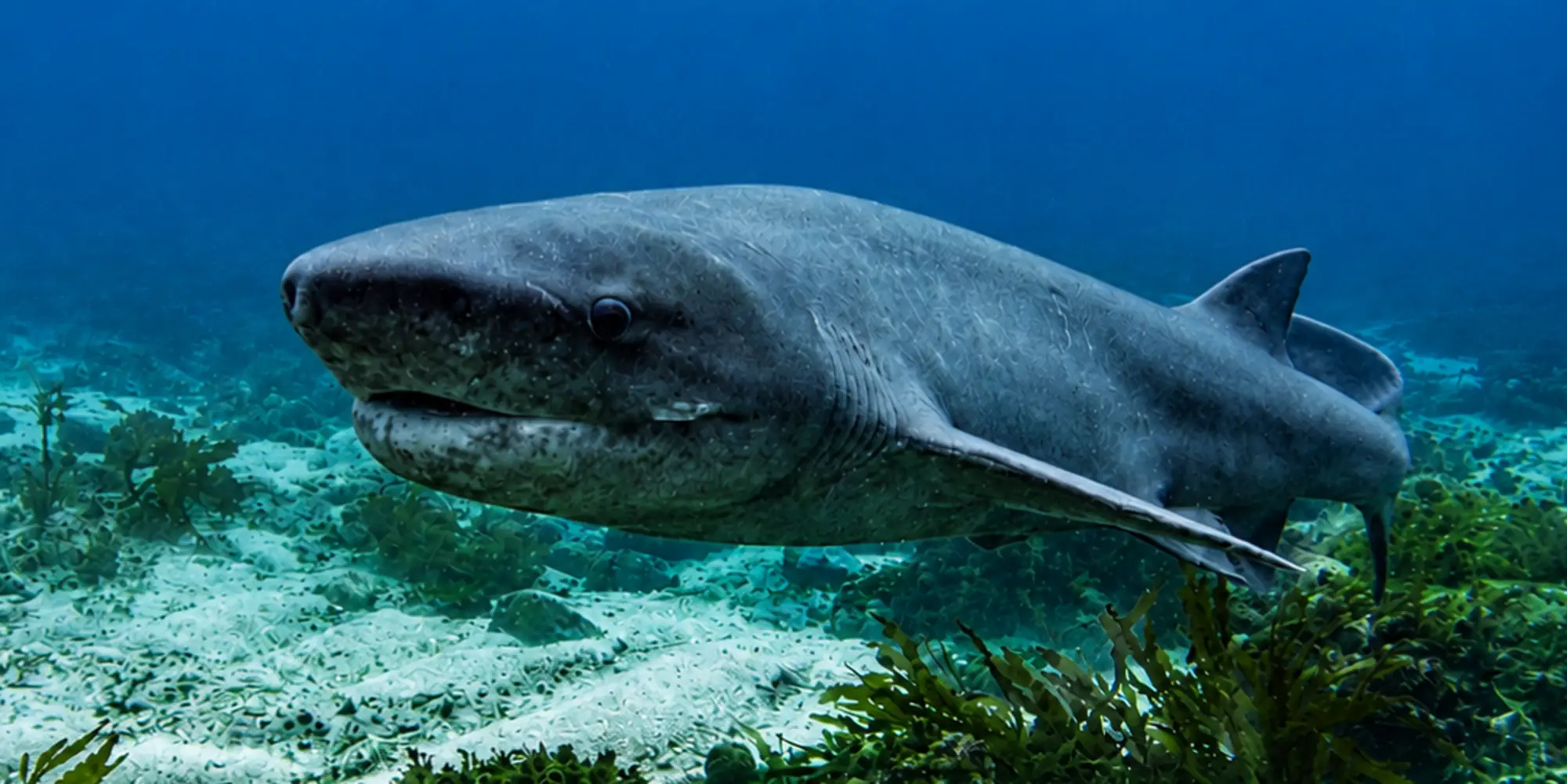
The broadnose sevengill shark Notorynchus cepedianus belongs to the Hexanchiformes and the family Hexanchidae. Its strongest field mark is the seven gill slits on each side; most familiar sharks have only five. The broad, blunt head, small eyes and single dorsal fin set far back give the species an unmistakably ancient-looking profile.
The Australian Museum describes it as a large, broad-headed cow shark that reaches at least about 3 metres. The upper side is silvery grey, olive brown or reddish brown, the belly is pale, and the body and fins carry many small dark and light spots that can stand out clearly in young animals or good visibility.
Teeth and jaws
The lower teeth are broad and comb-like, while the upper teeth are better suited to gripping. That combination fits a powerful coastal predator able to hold, cut and tear fishes, rays, other sharks and larger prey. The comb-shaped lower jaw teeth are one of the details that separate this shark from many five-gilled reef and open-water sharks.
Taxonomic position
Within the Squalomorphi, the genus Notorynchus represents a very distinctive modern shark line. For divers this is useful: a large spotted shark with a broad snout, one dorsal fin and seven gill slits is a shark with unusually strong identification clues.
Distribution & habitat
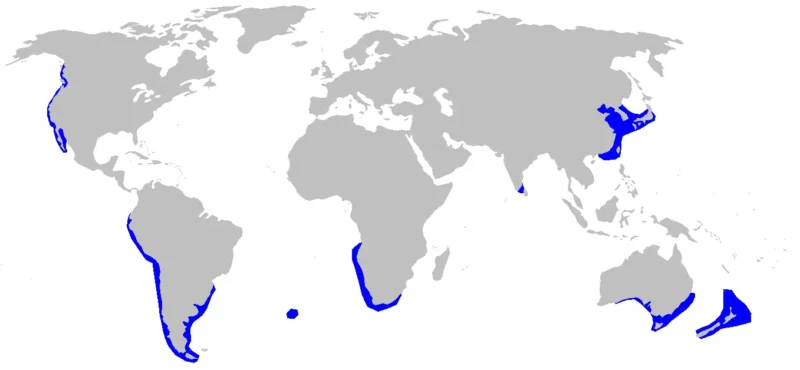
The broadnose sevengill shark has a wide but patchy distribution in temperate and subtropical coastal seas. Its range links the southern Atlantic Ocean, the Indian Ocean and the Pacific Ocean; it is absent from the North Atlantic and the Mediterranean.
FishBase gives a circumglobal coastal pattern: in the southwest Atlantic from Brazil and Uruguay to Argentina; in the southeast Atlantic from Angola, Namibia and South Africa; in the western Pacific from Japan, North Korea, China, Taiwan, Russia, Australia and New Zealand; and in the eastern Pacific from Canada, the USA, Mexico, Colombia, Ecuador, Peru and Chile.
Coasts, bays and shelf edges
The species uses marine and brackish habitats from the surface to about 570 metres, but it is often encountered in shallow coastal water. Bays, estuaries, channels, rocky bottom, sand and mud all belong to the habitat spectrum. Juveniles often use shallower sheltered areas, while large animals also occur deeper and farther offshore.
Its global range should not be read as one continuous safety net. Genetic and tagging work point to regionally separated populations, so fishing pressure and coastal change can affect local stocks very differently.
Life history, diet & reproduction
Broadnose sevengill sharks are active, opportunistic predators and scavengers. They often patrol close to the bottom with slow, deliberate movement, but can accelerate quickly when they strike. Their broad diet makes them important predators within many cool coastal ecosystems and within the wider Selachii.
The Florida Museum describes the species as a powerful cow shark that can take fishes, rays, other sharks, marine mammals and carrion. Group hunting has also been reported around larger prey, showing that this is not merely a slow bottom shark but a flexible coastal hunter.
Reproduction
The species is ovoviviparous: embryos develop inside the mother and are nourished first by yolk before live young are born. Litters can be very large, with several dozen pups. Birth appears to take place in shallow bays that may function as nursery areas.
Females mature late, in some assessments well after the first decade of life. Together with a long life span, this slow life history means that local removals cannot always be replaced quickly, even where the shark is seen regularly.
Juveniles and nurseries
Newborns are about 40 to 53 centimetres long and use shallow, protected coastal areas. These same bays and estuaries are often busy with fishing, boating, swimming and coastal development, so nursery habitat deserves particular attention.
Threats & protection status
Globally, the broadnose sevengill shark is listed by the IUCN Red List as Vulnerable. The fish.gov.au Shark Report separates that from the Australian assessment, where the species is treated locally as Least Concern and the current fishery status is considered sustainable.
Main pressures
- Coastal fisheries: the species is taken as bycatch and is also targeted in some regions.
- Gillnets and nearshore gear: Australian assessments especially highlight vulnerability to gillnets.
- Late maturity: females mature late, so sustained removal of adults can affect populations for a long time.
- Nursery bays and estuaries: productive shallow habitats are also exposed to coastal development, pollution and heavy use.
- Separated populations: a broad world range does not automatically mean a single resilient stock.
Useful protection depends on species-level catch data, careful release practice, gillnet management and protection of shallow nurseries. Australian monitoring suggests that local management can help, while the global picture remains more sensitive because of fishing pressure and data gaps.
Broadnose sevengill shark & humans
The broadnose sevengill shark is not a typical beach shark, but it is a large, powerful coastal species that deserves respect. Risk is most likely when an animal is provoked, caught, crowded or associated with food in the water.
For divers the species is fascinating because it feels different from many classic reef sharks: seven gill slits, one dorsal fin, a broad head and a calm search pattern over cool reefs, kelp beds, bays and productive coastal zones.
Diving encounters
Good practice is simple: do not corner, feed or touch the shark, and leave a clear escape route. Large sevengill sharks can seem direct and curious, especially around bait, fish waste or hooked fish. Calm observation is safer and usually produces better encounters.
Fishing and use
Meat, skin and liver oil are used regionally, and the species is also caught by recreational anglers in some areas. Because it lives close to shore, matures late and gives birth in shallow bays, any use should be managed carefully.
Profile
- First described:
- Max. size:
- Depth:
- Max. age:
- Max. weight:
- Water type:
- IUCN Status:
Taxonomy
- Kingdom:
- Phylum:
- Subphylum:
- Infraphylum:
- Parvphylum:
- Class:
- Subclass:
- Superorder:
- Order:
- Family:
- Genus:
News

Newsletter
Shark Alert in Your Inbox