


Blackmouth catshark - Galeus melastomus
Body structure, features & anatomy
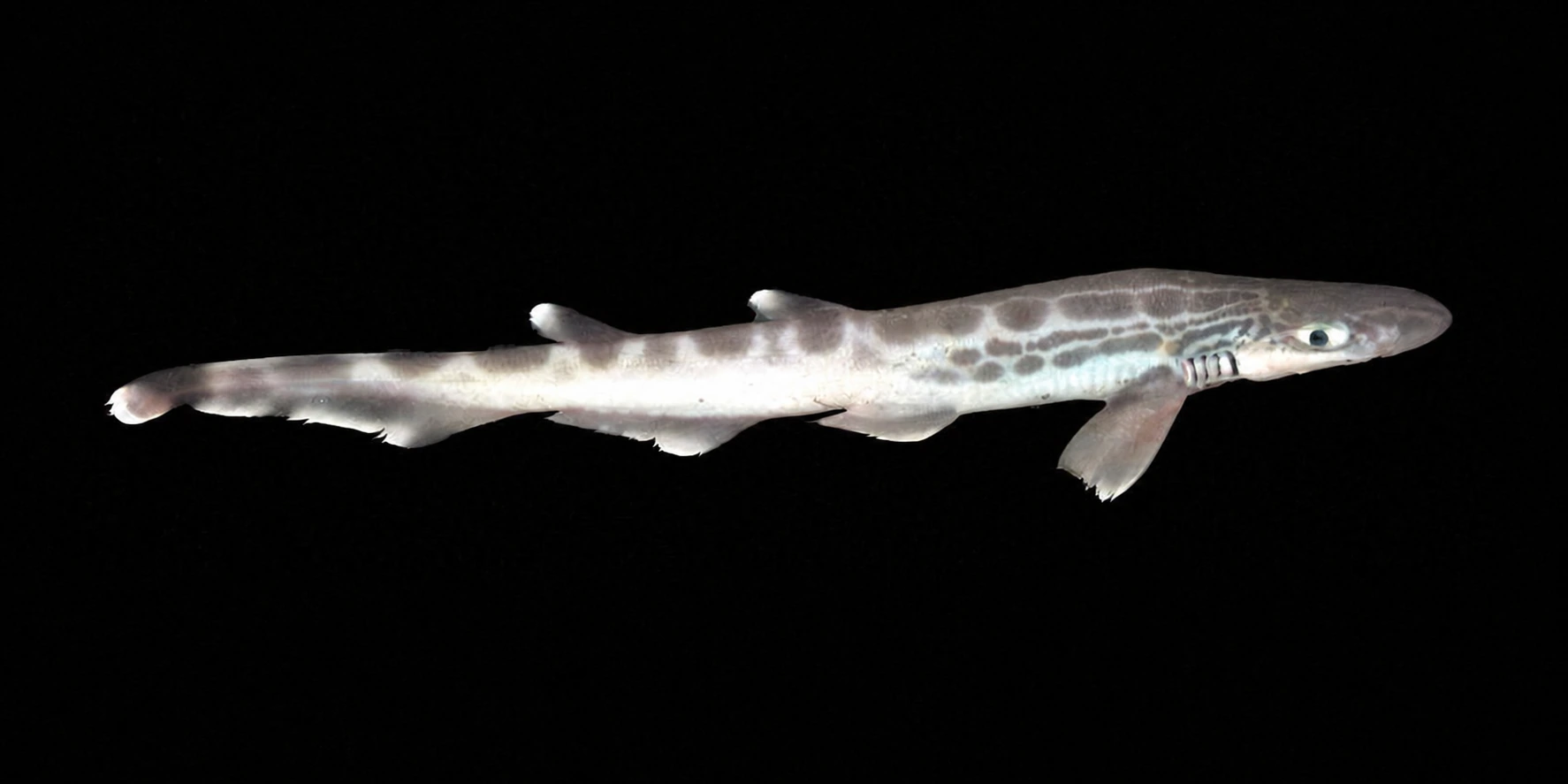
The blackmouth catshark has a very slender, elongated body, a flattened head and a long, pointed snout. Its oval eyes sit on the sides of the head, with small spiracles behind them. Five short gill slits lie in front of the pectoral fins; the last two are positioned above the fin bases.
The name comes from the almost completely black inside of the mouth. There are dark saddles and spots with light edges on the gray-brown back. According to the FAO species catalog for North Atlantic sharks, a particularly characteristic feature is a ridge of enlarged cutaneous teeth along the upper edge of the caudal fin, which acts like a fine saw.
Black mouth and saw-like tail edge
Both dorsal fins are located far back on the body. The first begins approximately above the posterior part of the pelvic fins, the second above the long anal fin. The caudal peduncle is narrow and the lower half of the caudal fin is only weakly developed. These proportions are suitable for a deep-sea shark that lives close to the bottom and swims rather slowly.
Females can grow to around 90 centimeters long, while males usually remain smaller and reach around 75 centimeters. Often animals are around 50 centimeters. The highest published weight is around 1.4 kilograms. For identification, the black mouth, the light-edged dorsal spots and the toothed crest on the tail are more important than size alone.
Habitat & distribution
The distribution area extends in the Atlantic Ocean from Norway and the Faroe Islands southwards across the North Sea and the waters off Portugal and Morocco to Senegal. The species also lives throughout the Mediterranean.
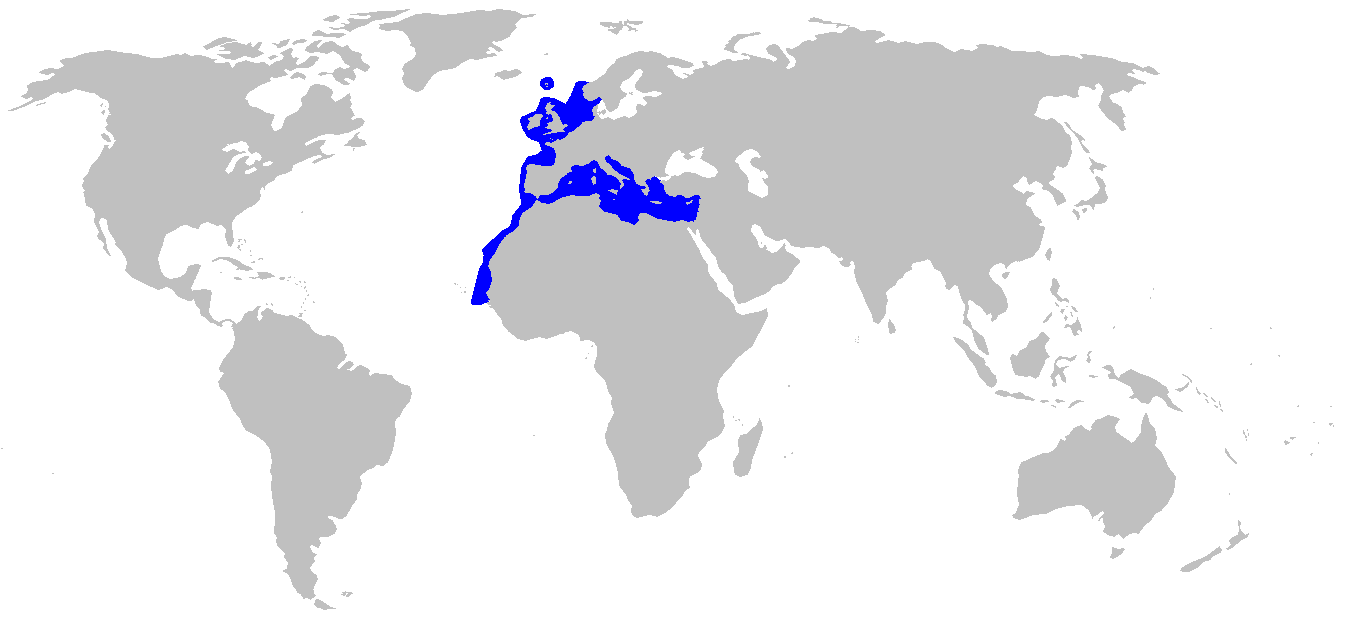
The Norwegian Institute of Marine Research describes the Blackmouth catshark as a small deep-sea shark of the continental slopes. It usually stays between around 150 and 1,000 meters, and particularly often between 200 and 500 meters. However, evidence ranges from approximately 55 to 1,873 meters deep.
Continental slopes in the eastern Atlantic
Typical substrates consist of mud, sand or gravel on the outer continental shelf and upper continental slope. On average, young animals live shallower than large juvenile and adult animals. Cold-water corals can serve as a place to lay egg capsules; Such areas are therefore not only a lounge, but also a nursery.
The map shows a rough historical distribution picture and not a current find frequency. Individual marginal evidence, population shifts and the demarcation from the similar Atlantic sawcat shark may be missing on older maps. When classifying today’s finds, current scientific surveys are therefore more important than the sharp edge of an area map.
Life history, diet & reproduction
Blackmouth catsharks usually swim slowly near the seabed while searching for prey. They are opportunistic feeders that eat crustaceans, squid and other cephalopods as well as small bony fishes. Diet composition can change markedly with body size and depth.
A scientific review of diet in the Mediterranean describes the species as an opportunistic predator and scavenger. In addition to prey close to the bottom, mesopelagic fish are also eaten. Fishing waste on the bottom can be used additionally, whereby trawling indirectly changes the food supply.
Egg-laying hunter of the continental slope
Reproduction occurs through egg capsules. Females can carry several capsules in their oviducts at the same time; up to twelve or thirteen are documented. The capsules, which are approximately five to six centimeters long, do not have long tendrils like the eggs of some coastal cat sharks and are attached to suitable hard substrate or coral.
A study from Italian waters confirms the egg-laying, repeatedly reproducing life cycle and at the same time examined plastic in stomachs and tissues. Sexual maturity is reached at different sizes regionally; Data from the Northeast Atlantic indicate about 56 centimeters for males and 60 centimeters for females.
Threats & conservation status
The IUCN Red List assesses the blackmouth catshark globally as Least Concern. The 2020 assessment describes the species as common across much of its range and found no evidence of a decline that would justify a higher threat category.
The most important human-caused pressure is bycatch in bottom trawls, gillnets and longlines. Many animals are thrown overboard, but the depth of capture, injuries and long sorting times can reduce the chances of survival. Incomplete reports and confusion with closely related species make population monitoring difficult.
Frequent bycatch despite a stable global assessment
The current report by NatureScot mentions fluctuating to increasing stocks for parts of the northeast Atlantic, but at the same time points out protection and catch restrictions. Cold-water coral reefs with egg capsules deserve special protection from bottom-touching fishing gear.
The global status is therefore not a license for unlimited catches. Species-specific data, protection of known egg-laying sites, effective avoidance of bycatch and rapid, as gentle as possible release of live animals are crucial. Regional rules may be stricter than the global red list category suggests.
Blackmouth catshark & humans
The blackmouth catshark is not a species divers commonly encounter. Most of its range on the continental slope lies far below recreational diving depths. Sightings in accessible shallow water are rare and localized; even research divers usually encounter it only at specialized deep-water or cold-water coral sites.
This small shark poses no relevant danger to humans. Although it has numerous small teeth for grasping slippery prey, it does not exhibit any behavior that would make it a risk to swimmers or divers. Like any wild animal, an observed animal should neither be touched nor harassed.
Not a typical shark for diving encounters
FishBase classifies the species as a fishery of low commercial importance. Larger specimens are used locally fresh or dried and salted; Historically, the skin was also processed. However, the far more common contact occurs as an accidental catch in deep-sea fishing.
Correctly determined by-catches are valuable for research and stock control. Photos of the inside of the mouth, the pattern on the back and the edge of the tail as well as information about the location, depth and fishing gear help to avoid confusion. Live animals should be released without unnecessary delay and with as little physical contact as possible.
Profile
- First described:
- Max. size:
- Depth:
- Max. age:
- Max. weight:
- Water type:
- IUCN Status:
Taxonomy
- Kingdom:
- Phylum:
- Subphylum:
- Infraphylum:
- Parvphylum:
- Class:
- Subclass:
- Superorder:
- Order:
- Family:
- Genus:
Newsletter
Shark Alert in Your Inbox