


Bigeye thresher - Alopias superciliosus
Body structure, features & anatomy
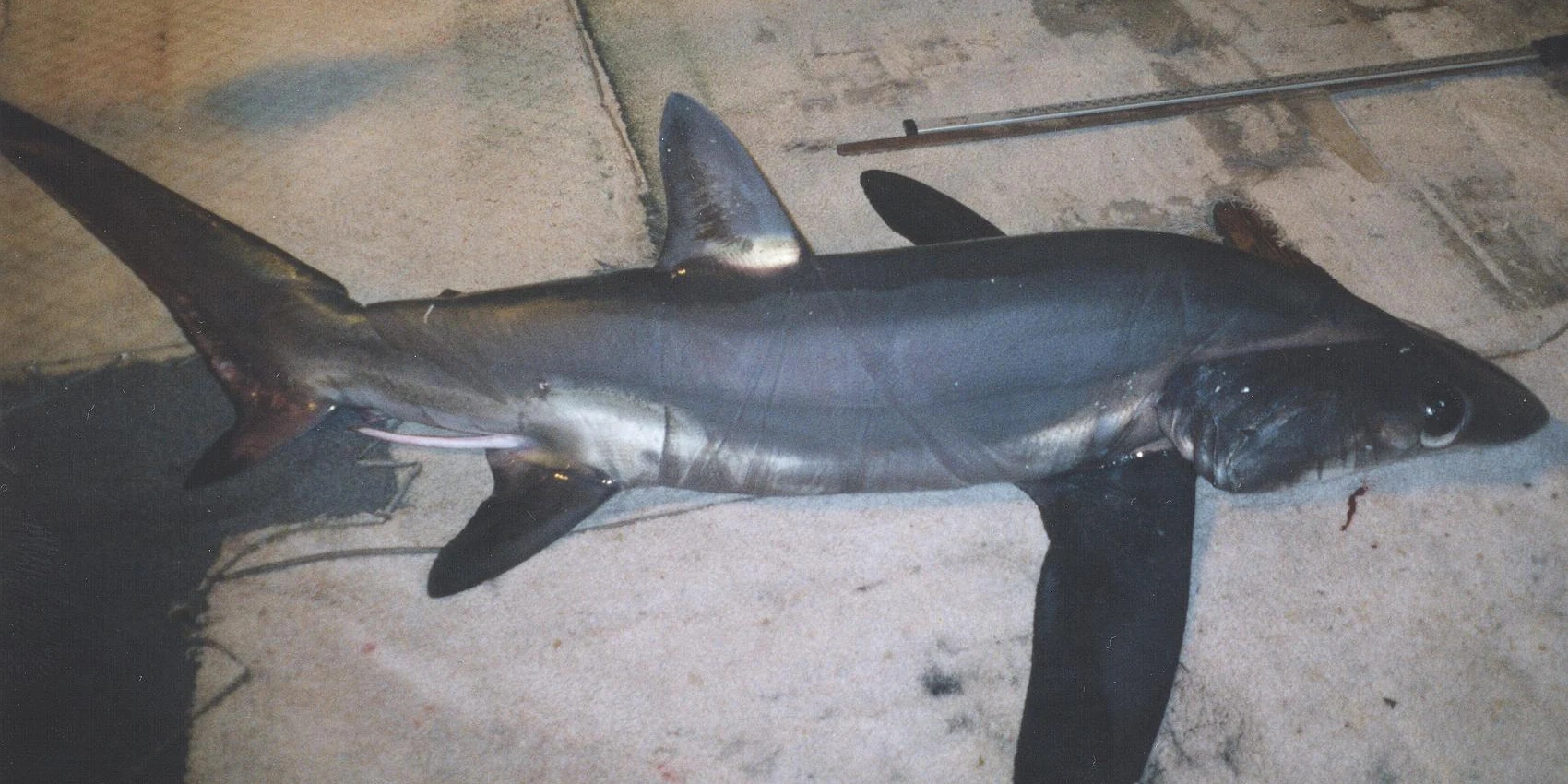
The bigeye thresher has a sturdy, spindle-shaped body and a comparatively broad head. Its most striking feature is the very large, vertically oval eyes, which are positioned high on the head and face upwards. Deep longitudinal grooves run from the forehead to behind the eyes, giving the head a characteristic profile in cross-section.
The upper lobe of the tail fin reaches approximately half of the total length. FishBase also mentions broad, curved pectoral fins, a first dorsal fin positioned far back, and a short but clearly developed lower tail fin lobe. The long upper lobe is not merely a swimming ornament but a specialized hunting tool.
This is how he differs from other fox sharks
The species differs from the common thresher particularly in having significantly larger, upward-looking eyes, the head ridges, and the first dorsal fin positioned further back. In the common thresher, the light belly coloration also extends over the bases of the pectoral fins; in the bigeye thresher, this area remains dark on the top side.
The upper side is violet-gray to brownish gray and can have a metallic sheen, while the underside is cream-colored. Adult animals are often between about 3.3 and 4 meters in total length. Maximum values are reported to be approximately 4.88 meters and around 364 kilograms. A very large portion of this length is accounted for by the tail fin, which means that pure length comparisons with more compactly built shark species can easily give a false impression of body mass.
Habitat & distribution
The bigeye thresher is found almost worldwide in tropical, subtropical, and warm-temperate marine areas. Its range includes the Atlantic Ocean, the Indian Ocean, and the Pacific Ocean. Historical and current records are also present in the Mediterranean Sea.
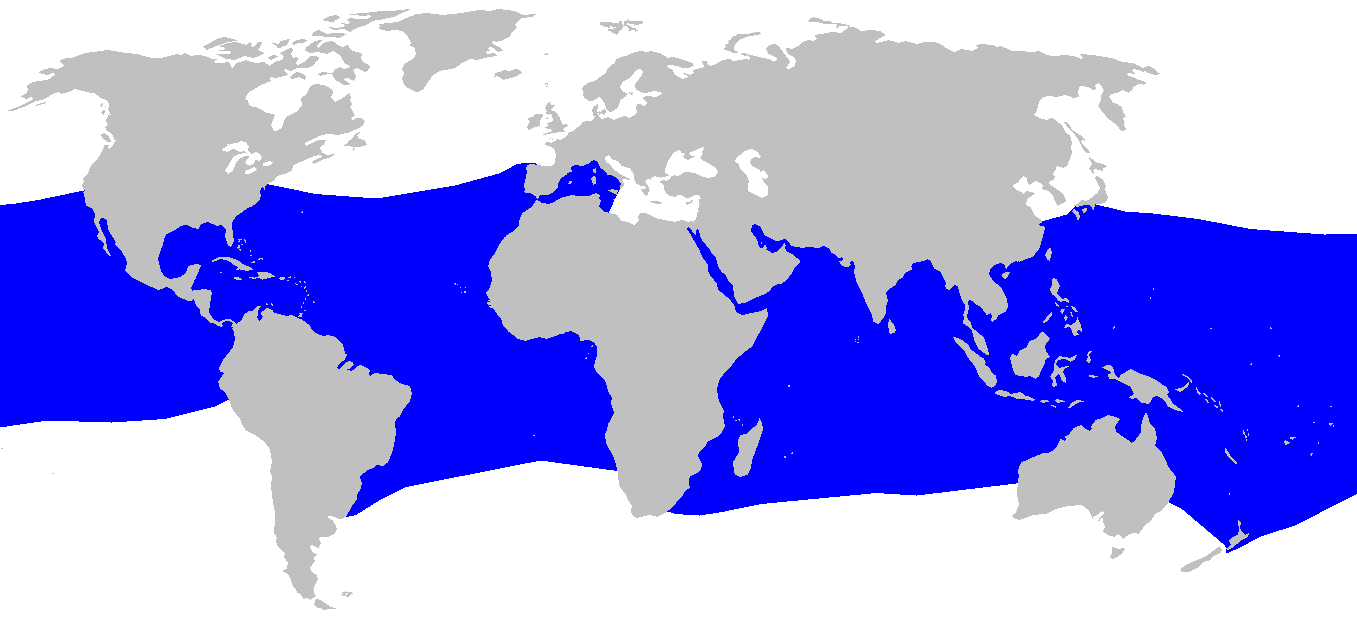
The species lives predominantly pelagically in the open sea, but it also occurs over continental shelves and occasionally near the coast. Acoustic detections and catch data indicate pronounced vertical migrations: during the day, the animals often remain deeper, while at night they rise to near-surface layers. Records range from the surface to at least about 730 meters depth.
Widespread, but rarely directly observed
Well-documented regions range from Portugal and South Africa in the eastern Atlantic to Australia and Japan in the Pacific. A Specialist overview of catches in the Mediterranean also shows how much the known picture depends on individual bycatch and historical collection data.
The distribution map therefore only depicts a rough, historically summarized area. It was created in 2007 based on an identification guide published in 2005 and neither shows current frequencies nor migration corridors or population boundaries. White gaps do not automatically mean that the species is absent there; just as a colored area does not indicate a regular presence on every section of the coast.
Life history, diet & reproduction
The bigeye thresher is an active open-ocean predator with a clear day-night rhythm. The large eyes improve vision in low light. During the day, the shark often uses cooler, deeper water layers; at night it follows prey upward. This pattern presumably also reduces competition with other large pelagic predators.
The diet includes schooling fish such as herrings and mackerels, as well as hake, smaller tunas, young swordfish relatives, squids, and crustaceans. Like other thresher sharks, it can stun prey with quick lateral strikes of the long caudal fin lobe and then take up individual injured or disoriented animals.
Only a few, already very large young animals
Reproduction occurs without a placenta. After the yolk is consumed, the embryos in the womb feed on additionally produced, unfertilized eggs; this process is called oophagy. Usually, only two young develop, one in each uterus, occasionally up to four embryos have been observed. At birth, the young already measure approximately one to 1.4 meters.
A Study from the tropical eastern Pacific assigns sexual maturity of males at about 2.53 to 2.88 meters and that of females at 3.32 to 3.53 meters. A clearly defined mating or birthing season is not documented. Late maturity, slow growth, and very small litter size together result in an exceptionally low reproduction rate.
Threats & conservation status
The IUCN Red List classifies the bigeye thresher globally as endangered and describes a declining population trend. The underlying global assessment dates from 2019; more recent international consultations continue to point to heavy fishing pressure and no signs of large-scale recovery.
The main threat is fishing. The species is caught in pelagic longlines, gillnets, purse seines, and other gear either as a target species or as bycatch. Meat, skin, and fins are utilized, while species-specific catch numbers remain incomplete in many areas. Due to late maturity and usually only two offspring, even relatively low additional mortality can be difficult to compensate for in the long term.
Strictly protected internationally
Since June 27, 2026, the species has been listed under the Amendments adopted at the 15th Meeting of the Parties to the Bonn Convention in both CMS Appendix I and Appendix II. This combines strict protection in the range states with international cooperation for the widely migrating species.
For EU fisheries, the 2026 applicable fishing opportunities regulation prohibits the targeted fishing of all thresher sharks. In the case of the bigeye thresher, neither parts nor whole carcasses may be kept on board, transshipped, or landed. Effective protection still depends on correct species identification, reporting of bycatches, careful release of live animals, and consistent control at sea and in ports.
Bigeye thresher & humans
Direct encounters with swimmers or divers are rare because the bigeye thresher usually lives in the open sea and often at great depth. The Florida Museum does not report any documented unprovoked attacks of this kind on humans. This does not constitute a general promise for every situation, but it does provide a clear classification against a sensationalized portrayal.
Anyone who encounters an animal underwater should keep their distance, not block its escape route, and avoid touching its tail or fins. Fox sharks can accelerate their long tail very quickly; its function is to hunt prey fish, not to approach humans. Calm observation without chasing or feeding protects both the animal and the diver equally.
Bycatch is the most common encounter
The closest contact with humans occurs in fishing. bigeye threshers are mainly caught on longlines for swordfish and tuna, but also in gillnets and trawl nets. The meat is offered fresh, smoked, dried, or salted; the skin can be processed into leather, and the fins enter international trade. This use increases the incentive not to release bycatches.
A NOAA project on bycatch reduction studied the survival and movements of released animals using satellite transmitters and developed release protocols for this purpose. For crews, this means: A live shark should be freed with appropriate equipment, as short a handling time as possible, and without unnecessary bringing on board. Inexperienced persons should keep their distance due to the size, hooks, and powerful tail.
Profile
- First described:
- Max. size:
- Depth:
- Max. age:
- Max. weight:
- Water type:
- IUCN Status:
Taxonomy
- Kingdom:
- Phylum:
- Subphylum:
- Infraphylum:
- Parvphylum:
- Class:
- Subclass:
- Superorder:
- Order:
- Family:
- Genus:
Newsletter
Shark Alert in Your Inbox