


Australian angelshark - Squatina australis

Body structure, features & anatomy
The Australian angelshark Squatina australis is a broadly flattened ground shark whose outline is reminiscent of a ray at first glance. Taxonomically, however, it remains clearly a shark: WoRMS leads the species within the Squalomorphi, the order Squatiniformes, the family Squatinidae and the genus Squatina.
What is striking is the broad head, overhead eyes and spray holes, a terminal mouth with pointed teeth and very large pectoral and pelvic fins. The fins form a flat silhouette but are not completely fused to the head. Two small dorsal fins sit far back; an anal fin is missing, as is typical for angel sharks.
Color, tail and field characteristics
- Upperside gray to light brown, usually with small irregular light spots and good ground camouflage.
- underside whitish; Small dark spots may be visible on the lower caudal fin lobe.
- The edges of the pectoral and pelvic fins often show alternating light and dark dashes.
- The tail is short and not sickle-shaped; the lower lobe may appear slightly longer than the upper one.
- The maximum length of around 1.52 m recorded in the species profile matches literature information for the species.
Shark-References particularly emphasizes the greatly enlarged pectoral fins, the wing-like pelvic fins and the short tail. For photos in the field, the side view, head, tail fin and the drawing of the fin edges are more important than just a single picture from above.
Distribution & habitat
The Australian angelshark is endemic to southern Australian shelf waters. For the shark diving connection is therefore above all Australia relevant; In terms of marine space, its area belongs to the transition between Indian Ocean and Pacific.
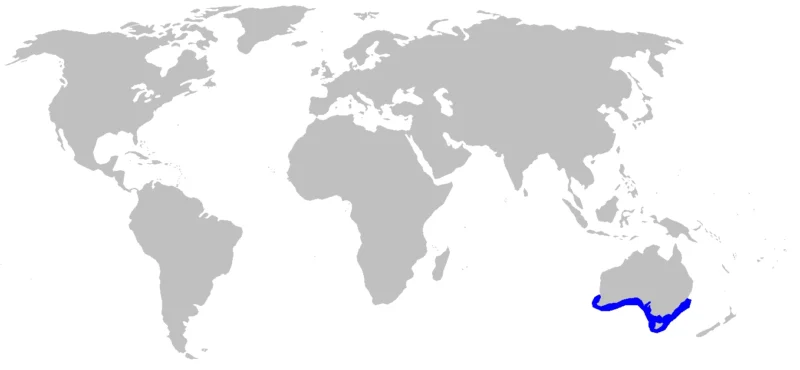
After Fishes of Australia The known occurrence extends from Port Stephens or Port Jackson in New South Wales via Victoria, South Australia and Tasmania to Western Australia. The species uses sandy and muddy bottoms, seagrass areas and areas near rocky reefs.
Southern shelf bottom shark
The habitat is predominantly on the continental shelf and in the upper slope areas. A range from 0 to 130 m is stored in the species profile; Depending on the recording, literature data also mention deeper occurrences of up to a good 250 m. For divers, shallower areas of sand, mud and seagrass are particularly important, where a resting angel shark is very easily overlooked.
During the day the species can lie half-buried and visually almost merge with the ground. This makes their real frequency difficult for snorkelers and divers to estimate: an unseen animal is not automatically absent, but is often simply perfectly camouflaged.
Life history, diet & reproduction
Loud FishBase lives Squatina australis demersal on or near the bottom, eats mainly small fish and crustaceans and is ovoviviparous. The way of life fits exactly to the body type: camouflage, patience and a short, quick advance replace long hunting distances in open water.
Hunting and activity
The Australian angelshark is a perched predator. During the day it often rests hidden in the sediment, while at night it can search more actively for prey close to the ground. Prey are primarily small bony fish, crabs and other bottom-dwelling invertebrates that move above or on the substrate.
The large pectoral fins stabilize the shark on the ground, while eyes and spray holes on the top of the head make it easier to observe and breathe from cover. If prey comes close enough, the shark opens its mouth very quickly; this surprise attack is typical of angel sharks.
Reproduction and growth
The study Raoult, Peddemors & Williamson 2017 examined angel sharks from southeast Australian fisheries and shark protection nets. She found female-emphasized height differences and names for male ones S. australis full maturity at approximately 800 mm total length; other Australian profiles give males around 90 cm and females around 97 cm as maturity sizes.
The young animals develop in the mother from eggs without a placental connection and are born alive. Litters of up to around 20 young animals are reported for the species. This method of reproduction makes populations more robust than with very small litters, but does not protect against high, permanent ground equipment pressure.
Threats & protection status
The Status of Australian Fish Stocks rates the Australian angelshark as Least Concern and for Australian fisheries reports as sustainable. This is an important difference to many other angel sharks: the species is comparatively common in its core area, endemic to Australia and not globally distributed across many separate remnants.
Nevertheless, it is not a risk-free stock. Angel sharks lie on the bottom and can be caught by demersal trawls or Danish Seine. Historically, animals were kept and marketed as a by-product, while hook and gill net catches are significantly less important regionally.
Why monitoring remains necessary
- The species is endemic; Regional management errors therefore affect a large part of the world population.
- Bottom-dwelling sharks are sensitive to fishing pressure in their exact resting and hunting habitats.
- Stock data often come from fisheries observations and are not spatially equally dense everywhere.
- Confusion with other angel sharks can muddy catch statistics and conservation decisions.
The more positive classification also depends on management measures and reduced fishing intensity in parts of the distribution area. For conservation work, this means: do not dramatize, but continue to take catch data, observer programs and the quality of benthic habitats seriously.
Australian angelshark & humans
To humans, the Australian angelshark is not typically an aggressive shark. The risk arises particularly when a resting animal is touched, harassed or accidentally held. With its sharp teeth it can cause serious wounds in a defensive situation.
For divers, the species is more of a quiet observation find than a classic encounter shark. Anyone who spots an angel shark should keep their distance to the side, do not reach into the sand, do not expose the animal and do not press the camera directly in front of its mouth or eyes. Good photos for sighting reports can also be taken from a respectful distance.
Fishing, cuisine and perception
In Australia the angel shark was and is partly kept as bycatch; Angel sharks may appear commercially as monkfish or under similar names. For sustainable use, clean species identification, correct catch reports and clear management boundaries are more important than the general impression that angel sharks are rare everywhere or common everywhere.
Ecologically, the Australian angelshark stands for healthy southern shelf habitats: sand, mud, seagrass and reef areas are not empty areas, but hunting and resting areas for specialized bottom sharks. For shark diving, that’s exactly the practical message: float mindfully over the bottom, respect camouflage and document encounters without forcing them.
Profile
- First described:
- Max. size:
- Depth:
- Max. age:
- Max. weight:
- Water type:
- IUCN Status:
Taxonomy
- Kingdom:
- Phylum:
- Subphylum:
- Infraphylum:
- Parvphylum:
- Class:
- Subclass:
- Superorder:
- Order:
- Family:
- Genus:
Newsletter
Shark Alert in Your Inbox