


Angular angelshark - Squatina guggenheim

Body structure, features & anatomy
The Angular angelshark Squatina guggenheim is a strongly flattened bottom shark of the southwest Atlantic. Like other angel sharks, it resembles a ray at first glance, but taxonomically it remains clearly a shark: WoRMS leads the species within the Squalomorphi, the order Squatiniformes, the family Squatinidae and the genus Squatina.
Shark-References describes as an important feature a row of enlarged, cone-shaped dermal denticles along the middle of the back. This row of thorns helps distinguish the species from other Southwest Atlantic angel sharks like Squatina occulta or Squatina Argentina to separate.
Identifying features
- Broad, flat forebody with large, angled pectoral fins.
- Light to dark brown upperside with larger whitish to yellowish spots.
- Enlarged thorns between the spray holes and along the center of the back.
- Lateral gill slits and pectoral fins that are not attached to the head distinguish it from rays.
- Two small dorsal fins are located far back on the body; an anal fin is missing.
For reliable identification, good photos of the head, spot pattern, edge of the pectoral fin, injection holes and midline of the back are particularly valuable. Catch statistics often do not clearly identify the species of angel sharks in the region.
Distribution & habitat
The Angular angelshark lives in the southwest Atlantic. The species profile is with Brazil, Uruguay and Argentina linked; Published distribution information ranges from southern to southeastern Brazil via Uruguay to northern Patagonia.
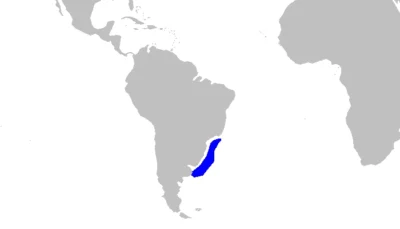
The species mainly inhabits soft shelf bottoms. Typical habitats are sandy, sandy-silty and muddy substrates where an angel shark can flatten itself to the bottom or partially burrow.
Southwest Atlantic shelf
The live species profile states 10 to 80 m depth; other databases also provide shallower and deeper evidence. For the ecological classification, it is more important that the species closely overlaps with the continental shelf used and thus also with bottom-level fisheries.
For divers, the Angular angelshark is not a predictable encounter. Sightings are more likely to be accidental finds in suitable ground habitats or come from scientific surveys and fishing observations.
Life history, diet & reproduction
FishBase leads Squatina guggenheim as a marine, brackish water-tolerant and demersal shark. The species uses camouflage on the ground instead of long chases in open water.
Hunting and food
The Angular angelshark is probably often partially buried. Eyes and spray holes remain free while the body contours blend into sand or mud. If prey comes into range, a short suction attack follows.
The main food mentioned is bottom-dwelling bony fish, as well as crustaceans and molluscs. This way of life makes the species highly dependent on intact shelf bottoms and at the same time brings it into contact with bottom trawls, gillnets and other bottom-hugging fishing gear.
Reproduction
The species is yolk sac viviparous: the young develop in the mother and are born fully developed. Literature reports mention small litters of a few young animals and a multi-year reproductive cycle for the females.
The generation age of around eight years stored in the species profile fits a species whose populations react only slowly to strong fishing pressure. It is precisely this combination of soil attachment, low reproduction and fishery overlap that shapes conservation status.
Threats & protection status
The IUCN Red List classifies the Angular angelshark worldwide as highly endangered a. The decisive factors are significant declines over three generations and persistent fishing pressure over large parts of the distribution area.
Angel sharks are particularly vulnerable to bottom trawls, gillnets and demersal longlines because they lie on the bottom and have little escape. In addition, southwest Atlantic angel shark species are often recorded or marketed together in practice.
Main hazards
- Targeted catch and bycatch in bottom-level fisheries.
- Marketing as edible shark or angel shark meat.
- Slow population recovery due to small litters and multi-year reproductive cycles.
- Difficult species identification in catch data and in markets.
- Strong overlap of shelf habitats with intensively used fishing grounds.
Effective protection therefore requires catch limits, enforcement of existing rules, better species reporting, market and genetic controls, and protection of particularly important shelf habitats.
Angular angelshark & humans
The Angular angelshark is not normally an actively dangerous shark to humans. It becomes risky when a resting animal is touched, pulled out of the sediment, harassed or treated as a catch. Then an angel shark can snap forward or sideways very quickly.
NOAA Fisheries summarizes the species under the English name spiny angel shark and emphasizes the fishery overlap in the southwest Atlantic. The most important human relationship is therefore not shark diving, but catch, bycatch, market identification and conservation management.
Observation and handling
- Do not expose, touch, or harass resting angel sharks for photos.
- Dive on sandy bottoms with clean buoyancy and do not search with hands or knees.
- Do not place the camera, lamp or hands directly in front of the mouth.
- Document sightings with photos, location, depth and habitat without moving the animal.
For shark diving, this species represents a quiet but important side of shark protection: rare bottom sharks are often barely visible, ecologically specialized and are more at risk from ordinary fishing gear than from direct encounters with humans.
Profile
- First described:
- Max. size:
- Depth:
- Max. age:
- Max. weight:
- Water type:
- IUCN Status:
Taxonomy
- Kingdom:
- Phylum:
- Subphylum:
- Infraphylum:
- Parvphylum:
- Class:
- Subclass:
- Superorder:
- Order:
- Family:
- Genus:
Newsletter
Shark Alert in Your Inbox