


Body structure, features & anatomy
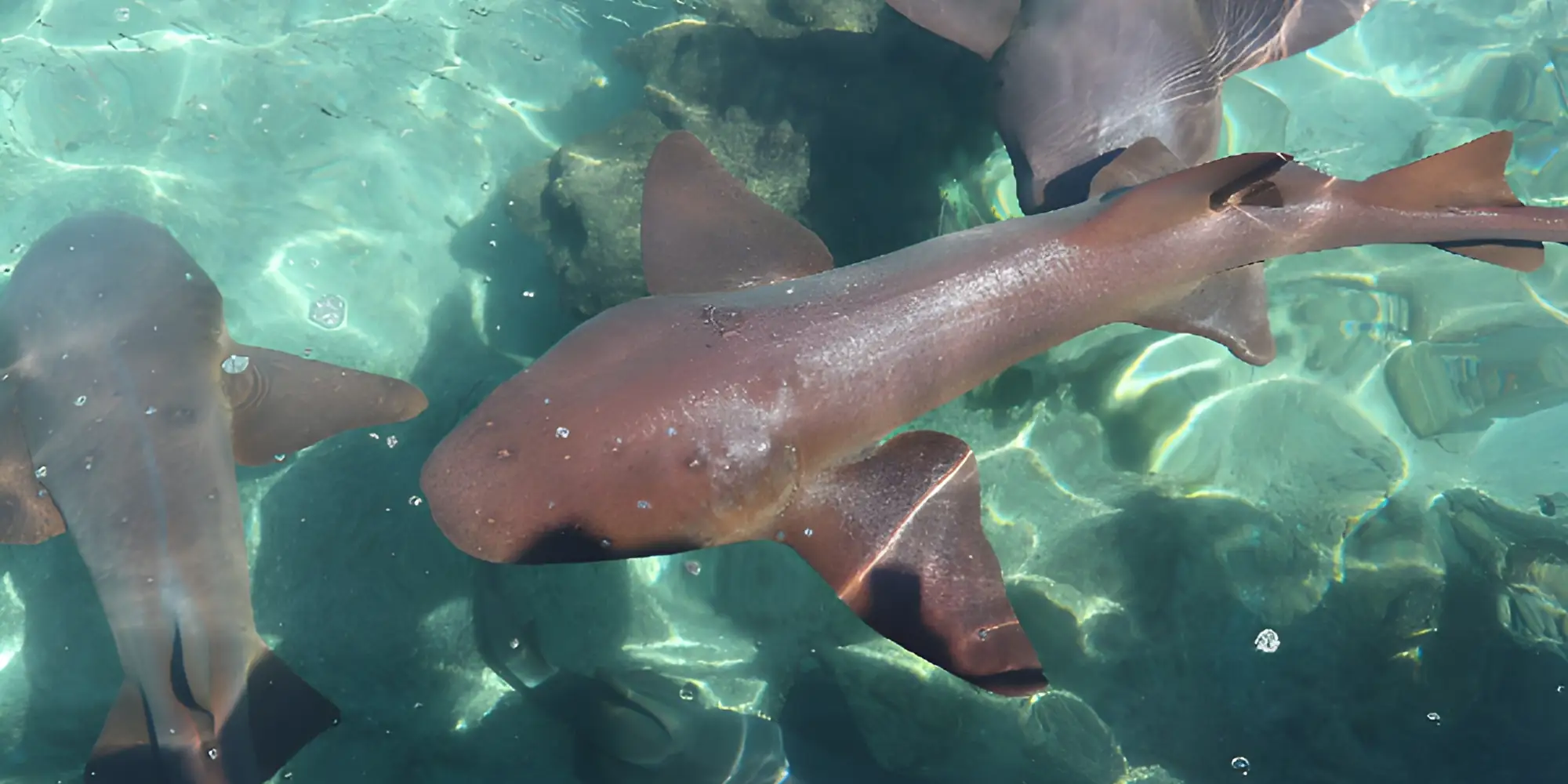
The African angelshark Squatina africana is a flattened bottom shark with a broad head, large pectoral fins and a ray-like silhouette. Taxonomically it remains clearly a shark: WoRMS leads the species within the Squalomorphi, the order Squatiniformes, the family Squatinidae and the genus Squatina.
Typical features are eyes and spray holes on top, a terminal mouth with small, sharp teeth and very broad pectoral fins that are not completely fused to the head. This combination clearly separates angel sharks from real rays, even if they appear similarly flat on the ground.
Identifying features
- Upper side greyish to brownish, usually with darker spots and very good ground camouflage.
- Broad front body, short snout and large, laterally projecting pectoral fins.
- Two small dorsal fins are located far back on the body; an anal fin is missing.
- Adult animals are usually around one meter long, with individual reports reaching up to around 1.2 m.
- Young animals have more contrasting markings and are therefore easier to confuse.
Shark-References documents the species under the scientific name Squatina africana and cites Regan, 1908 as the first description. For field photos, the head, eyes/splashholes, fin edges, dorsal fin position and spot pattern are particularly useful.
Distribution & habitat
The African angelshark is a western angel shark Indian Ocean. The country links in the species profile range from Somalia, Kenya and Tanzania above Mozambique, Madagascar and Mauritius until after South Africa.
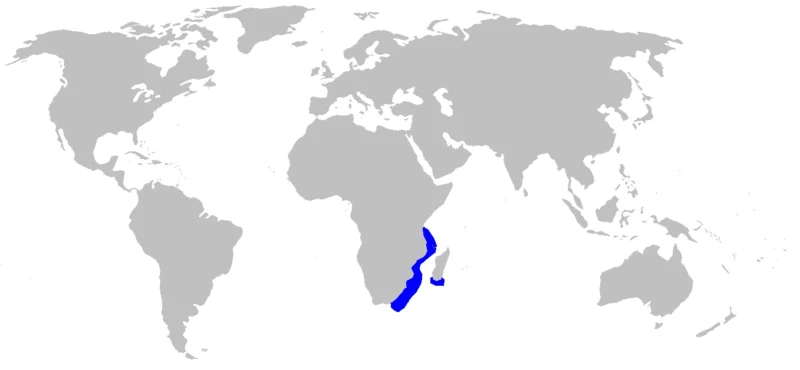
FishBase describes the species as a bottom-hugging shark of the continental shelf and upper slope. In a narrower sense it is primarily known from the East African coast and adjacent island areas; Older or southern information must be read carefully due to possible confusion with other angel sharks.
Shelf edges, sand and soft bottom
The habitat ranges from shallow coastal areas to depths of several hundred meters. The species profile states 1 to 494 m; Particularly typical are sandy, muddy and mixed soils, where the shark can lurk half-buried.
For divers, the species is not a predictable encounter. Sightings are more likely where soft bottom, reef or edge structure and bottom-hugging prey fish come together. Precisely because the shark is so well camouflaged, it can easily be overlooked in suitable habitats.
Life history, diet & reproduction
Like other angel sharks Squatina africana a hideout robber. The revision of Weigman et al. 2023 summarizes the species in the context of the genus Squatina together: The flat body, the large fins and the shape of the head are adapted to lurking quietly on the seabed.
Hunting and food
The African angelshark is often partially hidden in the sediment. When small fish, squid or crustaceans pass close enough, the head snaps up or forward and the mouth creates a brief suction effect. Long chases are not his strategy.
As a nocturnal or crepuscular ground hunter, it benefits from areas in which prey shuttles between soft ground, near the reef and the edge of the shelf. Exactly such transitions are also vulnerable to bottom fishing.
Reproduction
The species is aplacental viviparous: the young develop in the mother from yolk-rich eggs and are born alive. Litters are usually described as having several young animals; Juveniles use shallower or more sheltered areas before colonizing greater depths and open shelf areas.
The maximum age of around 23 years recorded in the species profile shows that the species is not a short-lived small fish component. As with many ground sharks, late maturity and slow recovery can make local populations vulnerable to sustained fishing pressure.
Threats & protection status
The IUCN Red List classifies the African angelshark as potentially at risk a. This fits the pattern of many angel sharks: The species is not everywhere on the verge of collapse, but it lives exactly where bottom trawls, gillnets and other bottom-hugging fishing gear are effective.
The IUCN assessment data particularly mention bycatch in commercial and small-scale fishing as a risk. Angel sharks are easily caught by bottom tackle because of their body shape and lifestyle; At the same time, landings in species groups can disappear if the identification is not carried out correctly.
Main hazards
- Bycatch in bottom trawls, gillnets, longlines and small-scale coastal fisheries.
- Confusion with other angel sharks, leaving catch statistics and population data unclear.
- Use as food fish or local commodity after accidental catch.
- Habitat disturbance on sandy, muddy and reef shelf bottoms.
- Slow life history and limited recovery with repeated local sampling.
Conservation work therefore needs better species identification, observer data, catch reduction for ground-level devices and the documentation of animals released alive. Especially for a little-known species, every reliable photo with location, depth and context of capture or sighting is valuable.
African angelshark & humans
The African angelshark is not usually an aggressive shark to humans. The risk of injury arises particularly when a resting animal is touched, uncovered from the sand or treated as a catch. An angel shark can then quickly snap forward or sideways.
FAO Fisheries leads the species in the fishing context. This shows the most important human relationship: not spectacular attacks, but catch, bycatch, marketing and the question of whether animals can be recognized alive and released.
Observation and handling
- Do not kneel or search with your hands on sandy or muddy areas.
- Do not expose, touch or harass resting animals for photos.
- Keep your distance to the side and do not place the camera directly in front of your mouth or eyes.
- Report sightings with photo, location, depth and habitat without moving the animal.
For shark diving, the species represents a quieter side of shark watching: not an open-water shark, but a perfectly camouflaged bottom predator. Anyone who floats mindfully over the bottom not only protects the shark, but also the habitat that makes it visible in the first place.
Profile
- First described:
- Max. size:
- Depth:
- Max. age:
- Max. weight:
- Water type:
- IUCN Status:
Taxonomy
- Kingdom:
- Phylum:
- Subphylum:
- Infraphylum:
- Parvphylum:
- Class:
- Subclass:
- Superorder:
- Order:
- Family:
- Genus:
Newsletter
Shark Alert in Your Inbox