


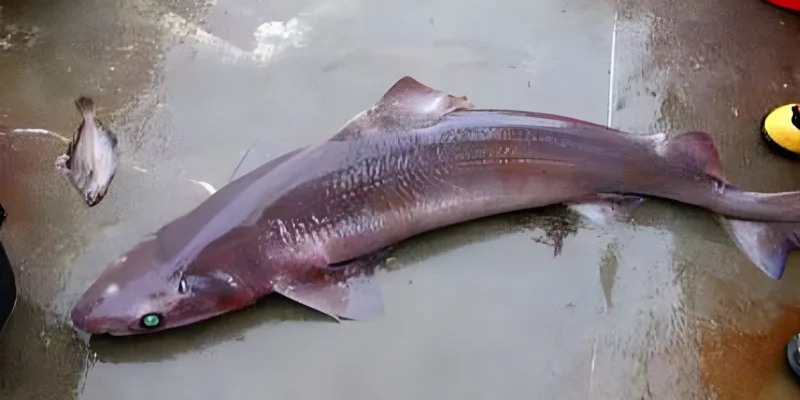
Between three and nine in the morning, the port of Bosaso in Puntland is bustling with activity. Traders, fishermen, food vendors and officials loudly negotiate the night’s catch—amidst dilapidated processing rooms, makeshift eateries and open fish markets. Among many fish species, the small gulper sharks are the main focus. While a scribe records the catch quantities, a young man butchers the animals, removes the fish stomachs and places the livers into plastic buckets.
“Business is going well,” he tells researchers from the ENACT project on organised crime.
In the semi-autonomous Puntland, gulper shark liver oil has become the core of a burgeoning illegal trade. According to TRAFFIC, it is in demand for its high squalene content—for cosmetics, dietary supplements and pharmaceuticals, especially in Asian markets. The global market for shark liver oil was around 157.2 million US dollars in 2024 and could grow to 263.6 million US dollars by 2033.
Biology that makes them vulnerable to overfishing
Several gulper shark species are classified as endangered or critically endangered. They grow slowly, reach sexual maturity late (females at around 16 years, males at around 18 years) and have extremely low reproductive rates, with only one pup per two-year gestation period. Deep-sea sharks are thus even more vulnerable to over-exploitation than most other marine vertebrates. According to TRAFFIC data, half of the species used for the international liver oil trade are threatened with extinction; in the southern Indian Ocean, the gulper shark population declined by 97 percent between 2015 and 2020.
Ban on paper, thriving black market
In August 2024, Puntland’s government prohibited the catching of gulper sharks and adopted further measures to strengthen marine management. However, weak enforcement allows the lucrative trade to continue growing. Official statistics are lacking, but local fishermen report declining catch volumes. ENACT investigations in Bargaal, Qandala and Bosaso confirm the alarming developments in the Gulf of Aden.
Interviewees describe a network of influential government actors, local clan elders, businesspeople and fishermen that organises the catch, processing and export. Despite the ban, the business continues: organs are sold to a small circle of buyers in Bosaso—regardless of size for about one US dollar each. In makeshift facilities, the oil is extracted using primitive, unregulated methods—without supervision, environmental regulations or permits.
Crude oil, quick profits, high risks
“We chop up the liver, heat it to 70 to 100 degrees and add alkaline solutions to control the pH,” explains an operator.
The oil is then distilled and filtered using centrifuges to remove impurities and obtain squalene-rich oil. Small teams linked to exporters or intermediaries check the quality and organise transport. The lack of regulation jeopardises product quality and leads to environmental and health problems, such as the disposal of contaminated waste.
In Somalia, the oil costs about 14.44 to 38.50 US dollars per kilogram, depending on quality. End buyers abroad pay significantly more. To evade controls, the goods are illegally transferred at sea to foreign ships, bypassing official ports, landing sites or export channels. Shipments are hidden under legal cargo or obscured through intermediaries. This covert supply chain primarily serves markets in China and the Gulf region.
Knowledge gaps and potential CITES protection
Experts from TRAFFIC, including Glenn Sant and Markus Burgener, point to significant knowledge gaps: regarding the scale of global trade, the origin and capacities of processors, and oil quality. Due to the lack of specific codes for gulper shark liver oil, it is unclear how much is exported. A CITES proposal is currently being discussed that could place gulper sharks under protection in December 2025. Countries would then need to issue licences and demonstrate legal, sustainable fishing practices; illegal fishing could result in global trade bans. Traceability along the supply chain would be mandatory.
What needs to be done now
Puntland’s bans have not yet taken effect but are a necessary first step. Alignment of legislation between Somalia’s federal and state levels is needed—both for catching and processing liver oil. Equally important: reliable data on gulper shark refuges and a comprehensive management strategy for the species.
Maritime surveillance systems against illegal, unreported and unregulated fishing have proven effective. Indonesia published its vessel monitoring system in cooperation with Global Fishing Watch, creating more transparency for fisheries data and management. For Somalia, greater investment in surveillance and law enforcement would also be crucial—such as in partnership with the FAO, UN Office on Drugs and Crime, and the European Union to identify and deter illegal operations.