


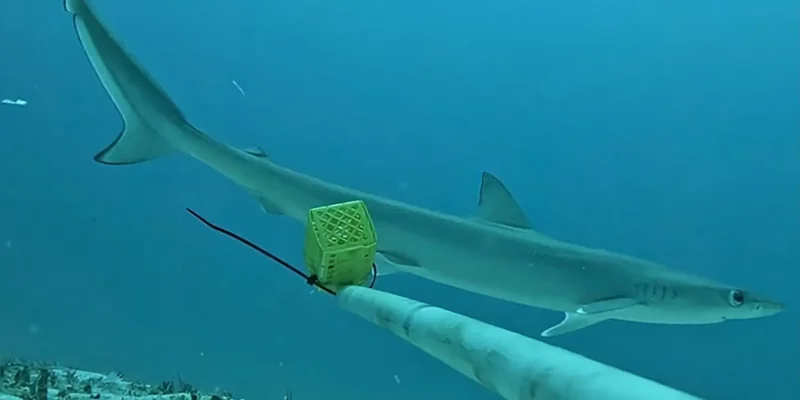
On the Great Chagos Bank, the world’s largest coral atoll structure, the sliteye shark (Loxodon macrorhinus) has been documented for the first time. The finding expands the known distribution range of this near-threatened species and underscores the ecological importance of the Chagos Archipelago and its large-scale marine protected area.
Deep-Sea Seagrass Meadows as Biodiversity Hotspots
The recent sightings were made in previously unexplored seagrass meadows on the southern edge of the Great Chagos Bank. Two individuals were recorded just 11 kilometres apart at depths of 23 to 29 metres—using BRUV systems (Baited Remote Underwater Video), which attract and record marine life without human disturbance.
Named for its narrow, slit-like eyes, the sliteye shark is optimised for low light and thrives in both deeper, dimly lit zones and clear shallow waters. Given its wide distribution, researchers consider it unlikely that the species is rare in the Chagos Archipelago.
“The discovery of the sliteye shark in the Chagos Archipelago was incredibly exciting. It shows how much we still have to learn about deep-sea seagrass ecosystems and their role in marine biodiversity, especially in remote regions of the Indian Ocean.” – Charlotte Oulton, Swansea University
You are currently viewing a placeholder content from Facebook. To access the actual content, click the button below. Please note that doing so will share data with third-party providers.
More InformationChance Discovery: Extensive Seagrass Meadows at 25–30 Metres Depth
The extensive seagrass meadows were discovered when researchers were actually tracking the migrations of green sea turtles via satellite. The surprising aspect was not only the depth of 25 to 30 metres but also the diversity of the habitat: over 110 fish species and now the sliteye shark use the meadows as a feeding oasis and refuge.
Protection Needs of a Species Under Pressure
For the sliteye shark, a population decline of up to 29% is projected over the next 15 years—primarily due to fishing pressure. The recent record raises important questions about abundance, habitat use, and protection priorities and highlights the urgency of specifically researching and safeguarding deeper habitats.
Collaborative Project for Mapping and Habitat Modelling
The findings come from surveys conducted at the end of 2024 and are part of a collaborative project between Swansea University and international partners, funded by the Bertarelli Foundation (Indian Ocean Marine Science Programme). The goals are to map current seagrass coverage, model suitable habitats, and assess the ecological significance of these deep-sea seagrass ecosystems across the archipelago.
Large Protected Areas Work – The Chagos Example
A new study shows that large-scale marine protected areas can effectively protect migratory species such as sea turtles, manta rays, and seabirds across large parts of their life cycles. The protected area in the Chagos Archipelago currently covers 640,000 km².
“Very large marine protected areas are central to achieving international targets such as 30% protection by 2030. Our findings demonstrate the value of the VLMPA in the Chagos Archipelago for protecting a wide range of large, mobile marine species.” – Dr. Alice Trevail, University of Exeter
What the Change in Sovereignty Means
With the expected transfer of the Chagos Archipelago to Mauritius, the results of both studies gain additional relevance. They not only provide strong evidence for the value of the protected area but also identify priority zones for long-term protection to secure the future of marine megafauna.