


Tope shark - Galeorhinus galeus
Body structure, characteristics & anatomy
The tope (Galeorhinus galeus) is a medium-sized shark species from the houndshark family (Triakidae). Due to overfishing, it is now classified worldwide as critically endangered.
External characteristics
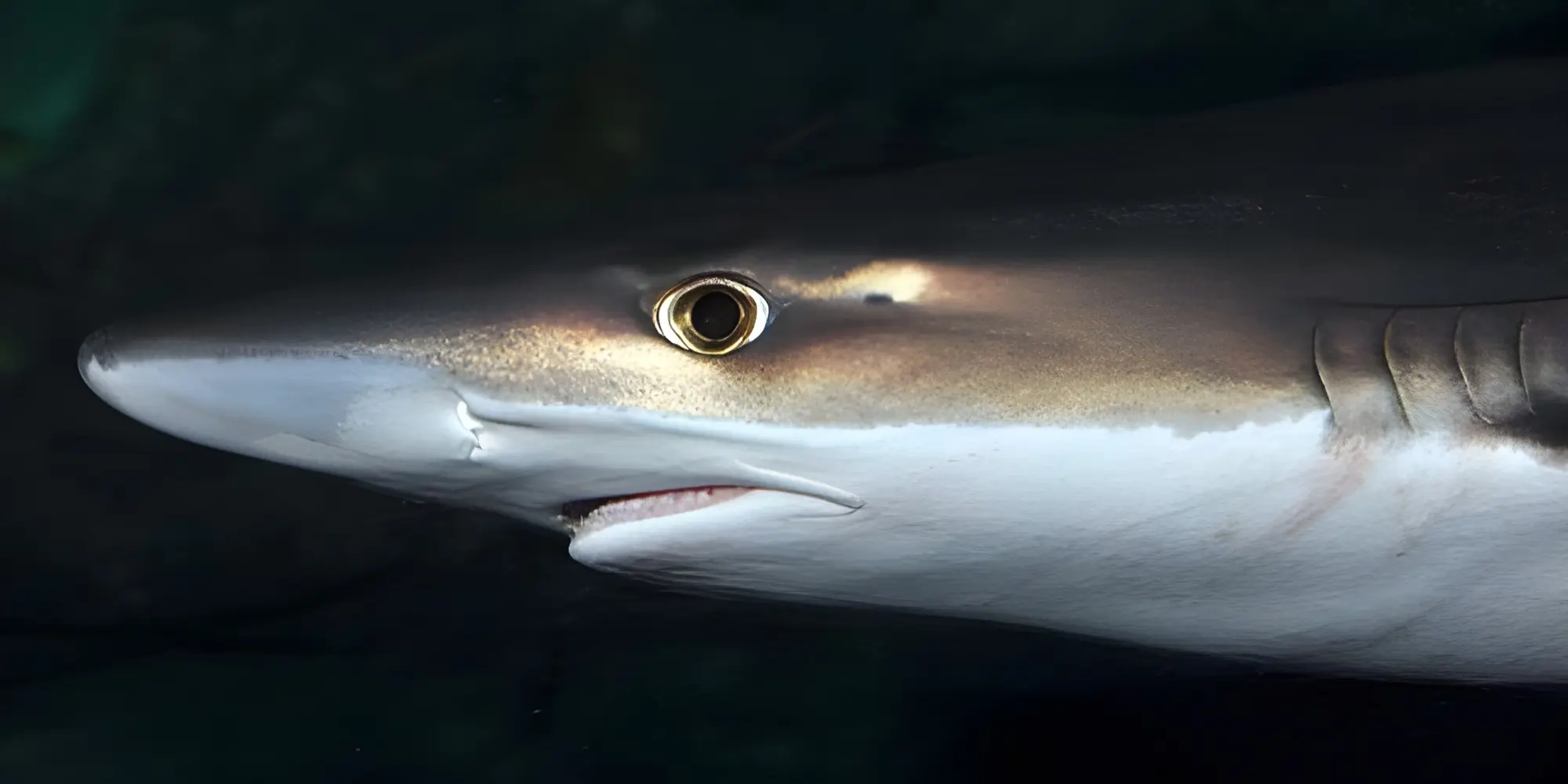
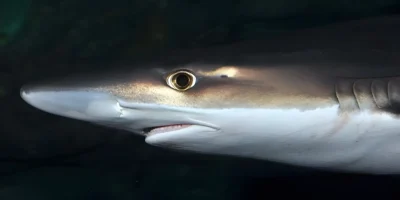
The tope has an elongated, slender body with an aerodynamic, spindle-shaped silhouette. A striking feature is the tope’s long, pointed snout, on the underside of which is a relatively large, wide mouth.
The dentition consists of numerous small, blade-like teeth with obliquely positioned, slightly serrated tips in both jaws.
The tope’s eyes are comparatively large and oval-shaped; like many sharks, they have a protective lid (nictitating membrane), which is barely visible in adult animals at rest. Behind the eyes are small spiracles on both sides. Five gill slits are located laterally on the head, with the last two positioned above the pectoral fins, which is typical for bottom-dwelling sharks.
Overall, the tope’s head, with its pointed snout, large eyes, and wide mouth, gives a characteristic “dog-like” impression, which contributes to its common name in German.
Body and fins
The tope’s torso is slender and muscular, with a smooth skin surface. Like all sharks, its skin is covered with tiny dermal denticles, creating a rough, sandpaper-like texture.
The tope’s base colouration ranges from grey to grey-brown or slightly bronze on the upper side, depending on the individual, while the underside is significantly lighter to whitish. This contrasting colouration (dark back, light belly) serves as camouflage in the water (from above against the dark seabed, from below against the light water surface).
In juveniles, additional dark markings appear on the fins: the tips of the dorsal and caudal fins are black, and the pectoral fins often show a striking white edge. As they age, these markings fade, so adult animals have a uniformly grey appearance with largely plain-coloured fins.
Fin arrangement and caudal fin
Like all ground sharks (Carcharhiniformes), the tope has two dorsal fins, an anal fin, and paired pectoral and pelvic fins.
The first dorsal fin is large, triangular, and positioned relatively far forward on the body. Its base starts just behind the end of the pectoral fin base. The second dorsal fin is significantly smaller and roughly the same size as the anal fin. It is located in the rear third of the body and begins slightly ahead of the anal fin’s base.
The pectoral fins are moderately large, broad, and slightly triangular in shape, with a slightly concave trailing edge. The pelvic fins are also present and located, as usual, in the rear abdominal area just before the anal fin.
A striking feature of the tope is its well-developed caudal fin: it has a heterocercal structure, meaning the upper lobe of the caudal fin is significantly larger than the lower one. The upper caudal fin lobe has a deep notch (subterminal indentation) and an elongated trailing edge, creating a kind of “double tail” appearance that gives the tope its unmistakable profile. The lower lobe of the caudal fin is smaller but also clearly developed.
Overall, the tope has a powerful, asymmetrical caudal fin structure that serves as propulsion when swimming, enabling both short sprints and sustained swimming.
Size and weight
According to FishBase, the tope can grow up to about 200 cm in length, though on average, the animals reach around 160 cm in total length. Female topes grow slightly larger than males: the maximum documented length for females is around 1.95 m, while males reach a maximum of about 1.93 m.
The weight of adult animals can be up to about 45 kg, although most specimens are significantly lighter. The tope’s body is relatively slender, so a nearly two-metre-long tope weighing around 40 kg appears relatively graceful. Nevertheless, these sharks are powerful swimmers and have well-developed musculature along the spine and caudal fin, which is crucial for their movement.
Differences between males and females
In Galeorhinus galeus, some sex-specific differences in body structure and characteristics are evident. Females are not only slightly larger on average than males, but they also grow more slowly and reach sexual maturity later and at a greater body length. According to various sources, male topes become sexually mature at around 1.2–1.5 m in length, while females only reach reproductive capability at about 1.3–1.8 m in length.
Additionally, adult females tend to be heavier. They usually have a slightly broader torso, particularly during pregnancy.
A particularly noticeable external difference, however, is found in the pelvic fin area. Male topes have two elongated, rod-shaped copulatory organs called claspers. These paired claspers (a feature of all male sharks and rays) point backward and are clearly visible on the inner sides of the pelvic fins. Female topes do not have these organs, so their abdominal region appears smoother.
| Merkmal | Männchen | Weibchen |
|---|---|---|
| Maximum length | approx. 1.8–1.9 m | approx. 2.0 m |
| Sexual maturity at | ~1.3 m length (8–12 years) | ~1.5 m length (10–15 years) |
| Copulatory organs | Two claspers on the pelvic fins | None (not present) |
Apart from size and reproductive organs, male and female topes do not exhibit drastically different external characteristics. Both sexes have the same colouration, fin arrangement, and general body proportions.
Differences only become apparent in behaviour (e.g., females and males sometimes form separate schools), but such behavioural aspects are outside the focus on body structure.
Distribution & Habitat
The tope shark (Galeorhinus galeus) is a widely distributed species of shark found in temperate seas and is a typical representative of nearshore habitats. Its ecological adaptability allows it to inhabit a variety of marine regions, though it still shows clear preferences regarding temperature, depth, and substrate.
Preferred Habitats
Tope sharks primarily live in temperate climate zones and are mostly found in nearshore areas. Typical habitats include shallow shelf seas, continental margins, and expansive bays. They are frequently observed over sandy or muddy seabeds, where they find ideal conditions for foraging.
The species utilises a broad depth range. Adults are usually found at depths between approximately 10 and 200 metres, while juveniles prefer much shallower areas. Nearshore shallow waters, seagrass meadows, and protected bays serve as important nursery grounds. These regions offer protection from larger predators and a high availability of prey.
Temperature and Environmental Conditions
The tope shark is clearly adapted to temperate water temperatures. It avoids both tropical and very cold polar waters. It is most commonly found in seas with seasonal temperature variations, as these encourage migratory movements and create productive feeding grounds.
Saltwater is essential for this species. Brackish water areas are occasionally used, such as near river mouths, but they play only a minor role in the tope shark’s habitat.
Global Distribution
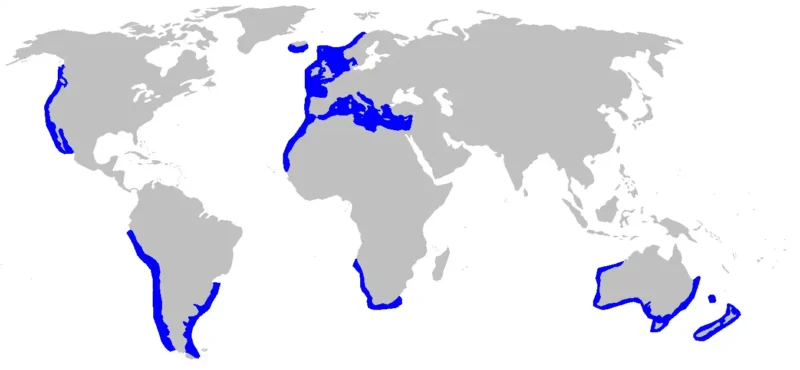
The distribution of the tope shark is nearly global, though not continuous. It occurs in many temperate marine regions of both hemispheres, with individual populations often geographically separated.
Distribution in the Northern Hemisphere
In the Northern Hemisphere, the tope shark is primarily found in the eastern Atlantic. Its range extends from the coasts of Scandinavia, across the North Sea and the English Channel, to the Mediterranean. It is regularly recorded in the western Mediterranean, particularly along the continental slopes. In the western Atlantic, the species occurs along the east coast of North America, from Canada to the temperate regions of the United States, where it prefers the continental shelf.
Distribution in the Southern Hemisphere
In the Southern Hemisphere, the tope shark is particularly common off South Africa, Australia, New Zealand, and in southern South America. These regions are among the most important distribution hotspots for the species. The coastal waters of Australia, in particular, are considered a significant habitat, with sometimes large seasonal populations. It is also regularly documented off Chile and Argentina, especially in productive coastal seas with cold upwelling water.
Seasonal Migrations
The tope shark is known for pronounced seasonal migrations. These are closely linked to water temperatures, reproductive cycles, and food availability. In many regions, adult sharks move closer to the coast in spring and summer, while in winter, they retreat to deeper and slightly warmer waters.
Juveniles often remain in the same shallow coastal areas for extended periods, indicating strong site fidelity in the early life stages. This separation of habitats by age class is a characteristic feature of the species.
Importance of Nearshore Protected Areas
Since the tope shark spends much of its life in nearshore areas, it is particularly dependent on intact shelf regions. Changes due to fishing, coastal development, or environmental pollution directly affect its habitats. Protected areas in shallow coastal zones therefore play a central role in the conservation of local populations.
Lifestyle, Diet & Reproduction
Lifestyle of the dogfish shark
The dogfish shark is an active, widely migratory shark that spends a large part of its life in coastal marine areas. It prefers temperate to subtropical waters and is mostly found above the continental shelf. It uses both shallower coastal zones and deeper areas of the open sea.
A typical feature of the dogfish shark is its pronounced migratory behaviour. Many populations undertake seasonal migrations, which are oriented towards water temperatures, food availability and reproductive cycles. These migrations can cover several hundred kilometres and often occur along coastlines.
Activity patterns and social behaviour
Dogfish sharks are predominantly nocturnal. They intensify their search for food in the evening and night hours, while during the day they are often found in deeper water layers. Their pronounced social behaviour is particularly striking: juveniles and adult animals often form loose groups, which can be separated by size and sex.
This group behaviour offers several advantages. It facilitates the search for food, reduces the risk from larger predators and may also play a role in orientation during long migrations.
Diet of the dogfish shark
The dogfish shark is an opportunistic predator with a versatile diet. Its diet adapts flexibly to the available prey, making it particularly adaptable to changing environmental conditions.
Prey spectrum and hunting strategy
The main prey includes:
- small to medium-sized bony fish
- cephalopods such as squid and cuttlefish
- crustaceans and other marine invertebrates
The dogfish shark usually hunts close to the seabed but can also catch prey in open water. Its slender body shape and well-developed caudal fin enable fast, targeted lunges. It relies on both its eyesight and its highly developed sense of smell.
Role in the ecosystem
As a medium-sized predatory fish, the dogfish shark plays an important role in the marine food web. It regulates populations of smaller fish and invertebrates, thus contributing to the stability of the ecosystems in which it lives.
Reproduction of the dogfish shark
The reproduction of the dogfish shark is characterised by a comparatively slow reproductive rate. This biological characteristic makes the species particularly vulnerable to external influences such as overfishing.
Reproductive strategy and development
Dogfish sharks are viviparous. The embryos develop inside the female’s body and are nourished via a yolk sac. After a gestation period of about twelve months, the female gives birth to several fully developed young.
Litter size is usually between 10 and 35 young, depending on the size and age of the female. Birth often takes place in protected, coastal areas that offer the young better chances of survival.
Sexual maturity and reproductive cycle
Dogfish sharks reach sexual maturity relatively late. Females are often not capable of reproducing until they are about 12 to 17 years old, males somewhat earlier. In addition, females do not reproduce every year but take breaks between pregnancies.
This slow reproductive rate means that populations can only recover very slowly once they have been severely reduced.
Threats & Conservation Measures
The tope shark Galeorhinus galeus is one of the most endangered shark species worldwide. The International Union for Conservation of Nature (IUCN) classifies the species globally as endangered. In several regions, populations are already considered to have collapsed. Particularly affected are the northeast Atlantic, the Mediterranean, parts of South America, and Australia’s coastal waters.
Long-term data from commercial fisheries show declines of more than seventy percent within just a few decades. In European waters, the tope shark is now only occasionally recorded. Historical catch statistics prove that formerly significant populations are no longer reproductively viable.
Causes of Threat
The main cause of the population decline is intensive fishing. The tope shark has been targeted for decades. Its meat, and particularly its large, oil-rich liver, fetched high market prices. Additionally, the species frequently ends up as bycatch in longlines and bottom-set nets.
The tope shark’s biological strategy exacerbates its vulnerability. The species grows slowly, reaches sexual maturity late, and produces only a few offspring. Even a slight increase in mortality is enough to destabilise populations in the long term.
Coastal habitats play a central role for juvenile sharks. These areas are under high pressure from fishing, shipping, and coastal development. The loss of safe nursery grounds further intensifies the population decline.
International Conservation Measures
IUCN and Scientific Assessment
The classification as endangered is based on global population analyses and regional time series. Scientific assessments have recommended for years a complete end to commercial exploitation in all distribution areas.
European Union
In the European Union, the tope shark is subject to strict protection regulations. Landing is prohibited, regardless of whether the catch was targeted or incidental. Captured animals must be released immediately. This regulation applies to all EU fisheries in the northeast Atlantic.
Despite the ban on landing, bycatch remains a significant issue, as the survival rate after release is limited. Expert committees call for additional technical measures to avoid bycatch.
Australia and New Zealand
Australia introduced fishing restrictions as early as the 1990s. After an initial stabilisation, populations continued to decline. Today, several states have implemented very low quotas or complete bans on fishing. Scientific monitoring programmes continuously accompany these measures.
In New Zealand, the tope shark continues to be fished under regulations. However, population models also show there a high vulnerability to over-exploitation. Conservation organisations are pushing for stricter limits.
South America and South Africa
Off the coasts of Argentina, Chile, and South Africa, the tope shark is one of the most common bycatch species. Conservation measures are inconsistent regionally and often inadequately enforced. A lack of catch data makes a reliable assessment of population trends difficult.
International Agreements
The tope shark is not yet listed in the Washington Convention on International Trade in Endangered Species of Wild Fauna and Flora. However, several expert committees recommend its inclusion in Appendix II to regulate international trade.
Under the Bonn Convention, the species is classified as migration-relevant. However, concrete conservation plans have not yet been bindingly implemented. The United Nations Food and Agriculture Organization lists the tope shark as a high-risk species in its guidelines for sustainable fisheries.
Assessment of Conservation Impact
The measures taken so far have shown only limited success. In regions with consistent bans on fishing, local populations are slowly stabilising. A full recovery is not expected for several decades due to the slow reproduction rate.
Studies emphasise that isolated national regulations are insufficient. The tope shark uses large-scale migration corridors. Effective protection requires internationally coordinated fishing bans, systematic bycatch reduction, and long-term monitoring.
Classification
Today, the tope shark is seen as an example of the consequences of decades of over-exploitation of supposedly common shark species. The current threat status is well documented and scientifically proven. Without comprehensive and binding conservation measures, a recovery of populations remains unlikely.
Profile
- First described:
- Max. size:
- Depth:
- Max. age:
- Max. weight:
- Water type:
- IUCN Status:
Taxonomy
- Kingdom:
- Phylum:
- Subphylum:
- Infraphylum:
- Parvphylum:
- Class:
- Subclass:
- Superorder:
- Order:
- Family:
- Genus:
News

Archaeological sample points to an unknown shark species
Sharks return to the Wadden Sea after decades
UK: Warmer seas are changing shark occurrences
Chile tightens CITES protection for whale sharks, mantas and houndsharks
Île de Ré: Around 500 tope sharks observed off the coast
Nearly £1 million for England’s sharks: Exeter launches conservation project
Tope sharks off Borkum – nursery discovered in the North Sea


Newsletter
Shark Alert in Your Inbox