


Crested bullhead shark - Heterodontus galeatus
Body structure, features & anatomy
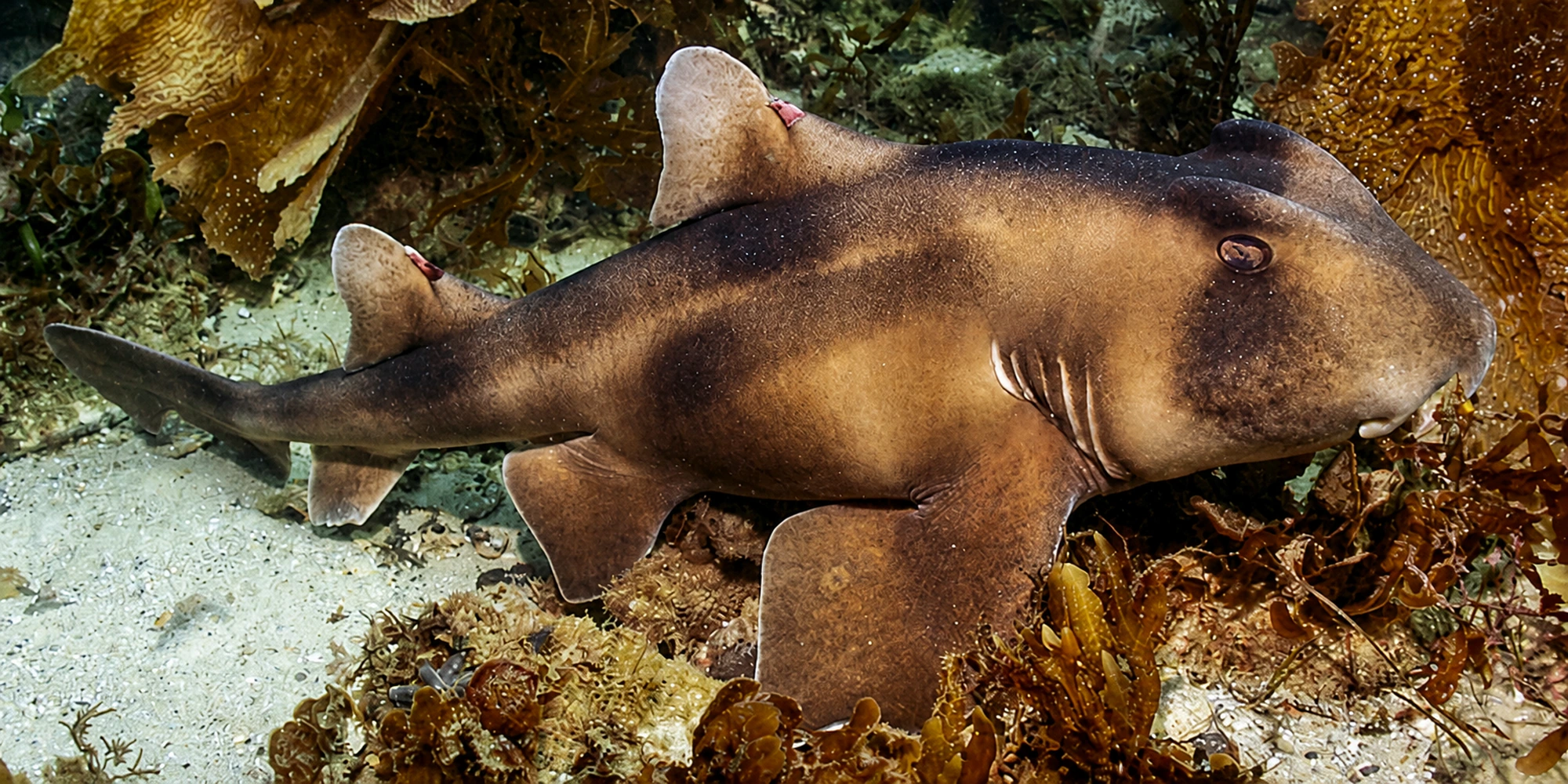
The crested bullhead shark is a robust bottom shark with a short, blunt head. Its most striking features are the high ridges above the eyes; the Australian Museum also gives a maximum length of about 1.5 metres.
A stout spine stands in front of each dorsal fin. The ground colour is yellowish to grey-brown, crossed by broad dark saddles that may become less distinct in older animals.
High eye ridges and powerful crushing teeth
Small pointed teeth at the front of the jaws grip prey, while broad molar-like teeth at the rear crush it. This lets the shark handle hard-bodied animals such as sea urchins, crustaceans and molluscs.
It differs from the similar Port Jackson shark mainly in its much higher eye ridges and the absence of the characteristic harness-like pattern. Females mature at about 70 centimetres, males at roughly 54 to 60 centimetres.
Habitat & distribution
According to Fishes of Australia, the species is restricted to the east coast of Australia in the south-western Pacific Ocean. Its known range extends approximately from Cape Moreton in southern Queensland to at least Eden in southern New South Wales.
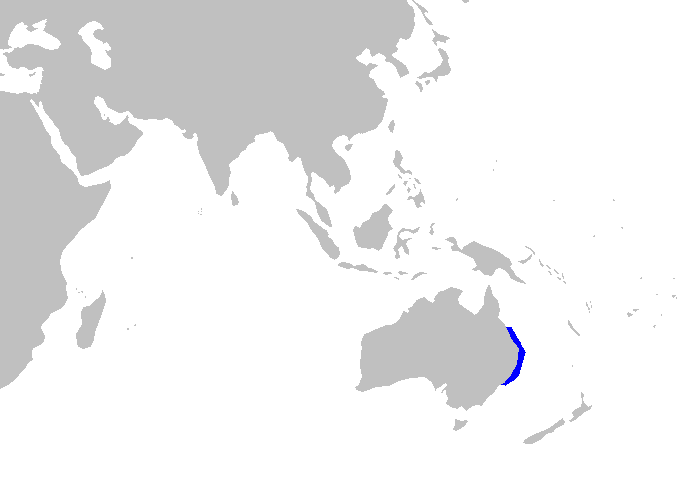
It inhabits coastal rocky reefs with large algae, adjoining sand flats and seagrass beds. Records range from very shallow water to about 93 metres; in the warmer part of the range it appears more common and may favour deeper reefs.
Endemic to Australia's east coast
By day it usually rests among rocks, beneath overhangs or camouflaged on the bottom. At night it moves slowly across reefs and neighbouring soft substrates in search of food.
The map shows the broad known range, not every confirmed record. Because the species is rarely observed overall, new reliably identified sightings may refine its range limits.
Life history, diet & reproduction
The crested bullhead shark is mainly nocturnal. It searches close to the bottom for sea urchins, crabs, molluscs and small fishes; the powerful rear teeth are specialised for cracking hard shells and armour.
The species lays eggs. In late austral winter, females deposit dark-brown, spirally twisted egg cases that are anchored to sponges, algae or other firm substrates by exceptionally long tendrils.
Spiral egg cases with long tendrils
A recent comparative study of shark egg cases documents a wild egg case of this species attached to coral substrate. The long tendrils probably help secure the egg at more exposed or deeper laying sites.
The embryos rely entirely on yolk. After about eight to nine months, the young hatch at a length of roughly 17 to 22 centimetres.
Threats & conservation status
The Australian Shark Report Card assesses the crested bullhead shark as sustainable and cites the global IUCN category Least Concern. The species is not commercially targeted.
It is occasionally taken as bycatch in bottom fisheries or on recreational fishing lines. Because these sharks are hardy and are generally released alive, resulting mortality is currently considered low.
Favourable status, but a limited range
The population trend remains uncertain: the species is considerably less common than the Port Jackson shark, and reliable data on population size, structure and trend are lacking.
Its small range makes continued monitoring sensible. Accurate bycatch identification, careful release and protection of rocky reefs, algal habitat and egg-laying sites are important.
Crested bullhead shark & humans
For divers, the crested bullhead shark is a rare and usually calm animal to observe. It does not hunt people and often lies motionless on the bottom by day, but it should never be touched or cornered in a rocky crevice.
FishBase classifies the species as potentially traumatogenic. This does not refer to unprovoked attacks, but to possible bites when the animal is harassed and to its sturdy dorsal-fin spines, which are particularly sharp in juveniles.
A calm bottom shark with defensive spines
Underwater, keep your distance, leave an escape route, do not feed the shark and avoid placing a hand on the animal or on the bottom immediately beside it for a photograph.
The species has only minor economic importance in fisheries. Its greatest value to people lies in research, wildlife observation and as a vivid example of the unusual anatomy and reproduction of bullhead sharks.
Profile
- First described:
- Max. size:
- Depth:
- Max. age:
- Max. weight:
- Water type:
- IUCN Status:
Taxonomy
- Kingdom:
- Phylum:
- Subphylum:
- Infraphylum:
- Parvphylum:
- Class:
- Subclass:
- Superorder:
- Order:
- Family:
- Genus:
Newsletter
Shark Alert in Your Inbox