


This article was published on 27 August 2026 and updated on 6 September 2026.
Update: 6 September 2026
Important governance structures are now in place for the Panaon Island Protected Seascape, which includes Pintuyan. An Oceana statement dated 2 September states that the Protected Area Management Board has been established and its Executive Committee has approved the management plan. A local management office of the DENR environment agency is still planned.
The plan is intended to support enforcement, resilient ecosystems and sustainable tourism. Oceana also highlights the legal requirement to develop vessel speed regulations to protect whale sharks and other large marine animals. The release specifies no new numerical speed limits or visitor caps. The progress concerns how protection is organised, rather than demonstrated improvements in the whale shark population.
The original report
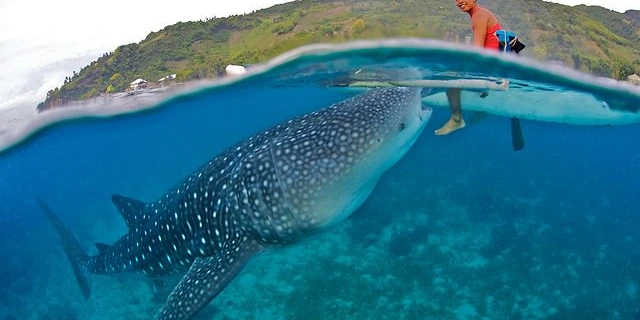
In Pintuyan on the Philippine island of Southern Leyte, whale sharks are not fed, and guests are not guaranteed a sighting. The community relies on natural encounters, even as the more lucrative feeding model in Oslob, about 80 kilometres away, becomes increasingly tempting. A feature in Oceanographic Magazine examines this conflict.
Whale shark tourism began in Pintuyan in 2005 and was locally regulated in 2009. Fishermen from the community now work as spotters and guides. They search for the animals on the surface before guests enter the water in small groups. If a whale shark doesn’t appear, there is no artificial bait feeding and therefore no guaranteed encounter.
Wildlife watching without daily feeding
The official Southern Leyte tourism page describes the whale shark season from approximately November to May, when plankton-rich water attracts the animals. The magazine mentions October to May. The slightly different information shows that this is not a fixed calendar of events: the beginning and end depend on natural conditions and the actual presence of the animals.
You are currently viewing a placeholder content from Facebook. To access the actual content, click the button below. Please note that doing so will share data with third-party providers.
More InformationSources also differ when it comes to the number of locals involved. The official site speaks of an organization with 40 trained and registered members. The current report reports on around 60 spotters and guides and an impending reorganization. It is undisputed that the work is locally anchored and offers former or still active fishermen additional income.
Why Oslob is financially tempting
In Oslob on the neighboring island of Cebu, whale sharks are attracted with food every day. This makes sightings more predictable, visitor numbers higher and revenue more predictable. It is precisely this economic predictability that is missing from a place that ties its offerings to natural migration and plankton deposits.
Representatives from Pintuyan visited Oslob to study its model. According to the feature, adopting it is being discussed, but no decision has been made. Tourism officer Joel Alapag says such a change remains unlikely for now. The fact-finding visit must therefore not be presented as a decision to begin feeding.
Feeding changes more than the sighting rate
Whale sharks are highly migratory animals. Feeding them regularly in one place can change their stay times, movement patterns and behavior towards boats. With the whale shark, there is also the fact that many boats and swimmers can gather in a small space at predictable meeting points. This increases the risk of contact and collisions.
A no-feed model does not completely eliminate these risks. Natural encounters also require clear distances, limited group sizes, controlled boat movements and trained guides. The crucial difference is that the animals are not tied to the location for a guaranteed tourist service.
More visitors increase pressure even without feeding
According to Oceanographic, individual months with more than 800 guests were recorded in the most recent season. Increasing demand can bring additional income to the community, but at the same time increase the burden on the water. An ethical model therefore depends not only on the absence of food, but also on how many boats and people are allowed in at the same time.
The report describes Pintuyan as an alternative to guaranteed encounters. Whether this approach will last in the long term depends on the local distribution of income. If spotters, boatmen and families benefit sufficiently from the slower model, the pressure to feed the animals for higher visitation numbers will decrease.
Rules need enforcement and current data
Local regulations and the Philippine Joint Memorandum Circular No. 01/2020, according to the report, feeding is prohibited. In practice, however, controls are just as important as the rule itself. Distances, entry and exits, boat routes and the number of guests must be organized in such a way that economic success does not grow at the expense of the animals.
Pintuyan is also within the area of the 2025 Panaon Island Protected Seascape. This creates an additional framework for the protection of large marine animals and the regulation of boat traffic. Which specific speed limits and visitor caps apply on site should be published transparently and checked with observation data.
Uncertainty is part of the experience
The strongest protective idea of the Pintuyan model is also its most difficult sales condition: Anyone who books a tour can return without a whale shark. This uncertainty preserves the difference between a wildlife viewing and a planned attraction.
Pintuyan still adheres to this principle. However, the economic comparison with Oslob makes it clear that rules alone are not enough. In order for the feeding-free model to survive, revenue must be distributed fairly, visitor numbers must be limited, and natural whale shark encounters must be conveyed as valuable – even if no animal appears on a given day.