


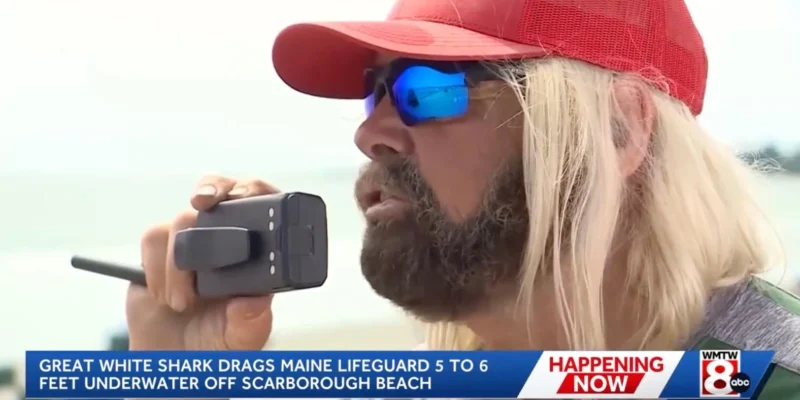
At Scarborough Beach State Park in the U.S. state of Maine, 71-year-old lifeguard Greg Wilfert was pulled underwater by a shark on Saturday, August 8, 2026. The New York Post reports that Wilfert was swimming with other lifeguards near the marker buoys when he was suddenly dragged down.
An important distinction is that, according to the available reports, the shark did not bite Wilfert. It grabbed the rescue buoy that was strapped to his body. Wilfert released himself, swam to the surface and returned to shore without injury.
From presumed boat wake to swimming for shore
Wilfert initially thought that the sudden pull had been caused by the wake or propeller of a passing boat. Only after he was underwater did he realize that no boat was nearby. He said he was pulled about five to six feet deep—roughly 1.5 to 1.8 metres.
The lifeguard released the buoy’s strap, surfaced and swam back as quickly as he could. Local media reported that a witness told police the rescue buoy shot out of the water shortly afterwards. That observation supports Wilfert’s account, but it does not establish which shark species was involved.
Wilfert has worked at Scarborough Beach State Park for 55 years and serves as both park manager and lifeguard. He said that he had never experienced anything comparable during that time and described the incident to local media as frightening.
Beach closed for an hour
According to WGME, Wilfert immediately ordered everyone out of the swimming area. The beach remained closed to swimmers for about an hour. Drones then scanned the water’s surface while two lifeguards checked the area on a personal watercraft.
The team maintained increased surveillance after the beach reopened. Drones were to be flown regularly, and rescuers also patrolled the water. Wilfert said that he would stop swimming along the buoys for the time being.
Great white shark suspected but not confirmed
Wilfert suspects that the animal was a great white shark. Several sharks, including great whites, had been reported off Pine Point, Scarborough Beach and Higgins Beach in the days before the incident. Police said his account was consistent with the region’s recent shark activity. Media reports also quoted a New England Aquarium expert who considered the circumstances plausible.
There is, however, no direct evidence identifying the animal involved. The reports mention neither a recording of the encounter nor a forensic examination of the buoy that could establish the species. The suggestion that the animal mistook the yellow buoy for prey remains a plausible interpretation, not a proven motive.
Large sharks are part of the Atlantic Ocean ecosystem off Maine. Large numbers of baitfish and striped bass were observed around the beach at the same time. Such concentrations of prey can draw predators closer to shore, but on their own they do not indicate a specific threat to people.
Close encounter without a bite injury
The distinction between a bite to equipment and a bite to a person matters. This was a dangerous close encounter in which the pull on a tethered rescue buoy dragged a swimmer underwater. No injury or direct physical contact between the shark and Wilfert was reported.
The case should therefore not be described as a confirmed shark bite on a person without that qualification. In the attack data it is classified as a questionable, non-fatal swimming incident: the contact with the equipment is credibly described, the species is unconfirmed and the person was not bitten.
Swimmers in Maine and other coastal regions of the USA should follow lifeguard instructions, temporary closures and local warning levels. The incident also shows that equipment tethered to the body can itself become a hazard under an unexpected load. Wilfert escaped because he quickly released the strap.