


Tasselled wobbegong - Eucrossorhinus dasypogon
Body structure, features & anatomy
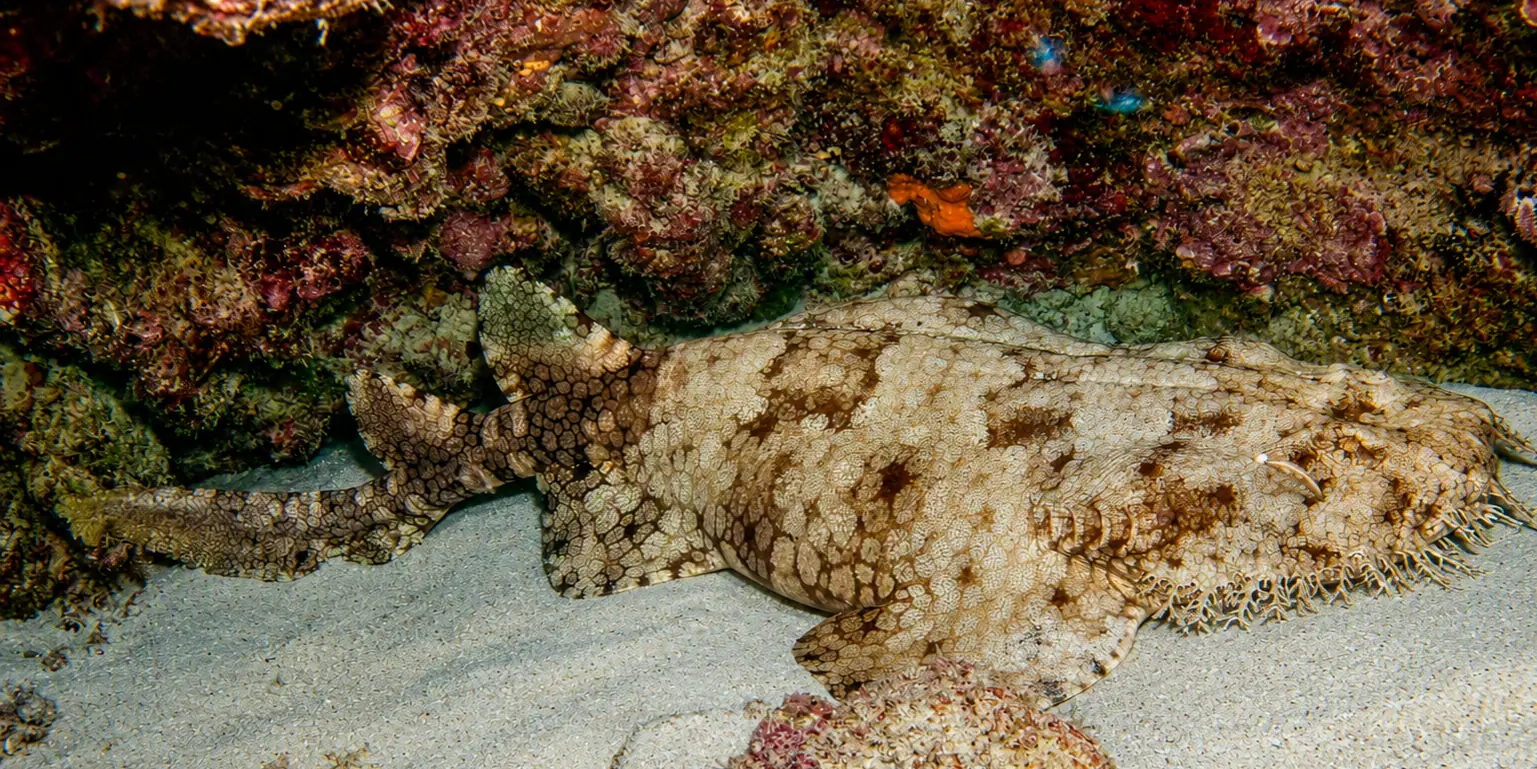
The tasselled wobbegong Eucrossorhinus dasypogon is a broad, flattened carpet shark. WoRMS lists it as an accepted living species and the sole species of its genus. Its mouth lies near the front of the head, while the eyes face upward and two spineless dorsal fins sit far back on the body.
Its most striking feature is the dense fringe of highly branched skin lobes around the snout, head and chin. Together with a reticulated pattern of dark lines and blotches, these lobes break up the animal’s outline among coral, sponges, rubble and shadow.
Fringes that complete the camouflage
Fishes of Australia describes a reef-associated shark with broad rounded pectoral fins and an asymmetrical tail. This body plan suits a hidden ambush hunter rather than a fast pursuit predator in open water.
Many individuals measure roughly 1.2 to 1.8 metres. The often repeated maximum of 3.66 metres is uncertain, so the elaborate head fringe and camouflage pattern are more reliable identification traits than size alone.
Distribution & habitat
The known range lies in the western Pacific, from eastern Indonesia through Papua New Guinea to tropical northern Australia, including Western Australia, the Northern Territory, Queensland and the Great Barrier Reef. Reports from Malaysia are treated as questionable.
FishBase records the species from about 2 to 50 metres and characterises it as reef-associated. Typical sites include coral reefs, reef channels and faces, caves, ledges and other structured places that provide daytime shelter and nearby hunting grounds.
Shallow coral reefs and shelf waters
Records are geographically concentrated, but that does not mean every coast within the range is occupied equally. The shark is difficult to detect and suitable microhabitats may be patchy even within one reef system.
Divers are more likely to find one by scanning shaded reef edges, cave entrances and overhangs slowly than by looking into open water. Hands should never be placed in hidden crevices, and an animal’s exit route must remain clear.
Life history, diet & reproduction
Tasselled wobbegongs often rest motionless in sheltered reef sites by day and become more active around dusk and at night. Camouflage and patience replace a long chase: when a fish comes close, the shark opens its mouth rapidly and draws the prey in by suction.
The Florida Museum lists bottom-dwelling bony fishes and invertebrates as food. Squirrelfish, soldierfish and sweepers that use the same caves and reef structures are documented prey, while the head fringe may help make the waiting shark less conspicuous.
Ambush hunting and live birth
The species is aplacental viviparous. Embryos develop inside the mother, initially nourished by yolk, and the pups are born alive. Older reports mention litters of at least 20 and pups around 20 centimetres long, but reproductive observations remain scarce.
Growth, age, movements and population density are still poorly known. Repeated, well-documented sightings can improve knowledge, provided observers do not disturb resting animals to obtain photographs or measurements.
Threats & conservation status
The current global IUCN Red List assessment lists Eucrossorhinus dasypogon as Least Concern. The assessment was carried out in 2023 and published in 2024. This category means current evidence does not justify a threatened listing, not that the species faces no risk.
Its shallow reef habitat exposes the shark to coastal nets, hooks and other fisheries, while destructive fishing, pollution, coastal development and coral loss can remove resting and hunting sites. A limited and patchy range can make local losses important.
Least Concern, but not free of pressure
The Australian Shark Report Card likewise evaluates the Australian population as sustainable and the global species as Least Concern. Marine parks around the Great Barrier Reef and elsewhere in northern Australia protect a significant part of its habitat.
Protection still depends on intact coral reefs, effective controls on destructive fishing, better bycatch records and correct identification. Dive tourism can help by leaving resting sites undisturbed and avoiding feeding or staged interactions.
Tasselled wobbegong & humans
For divers, the tasselled wobbegong is a memorable encounter because its outline often becomes visible only after careful observation. A motionless shark may look placid, but it remains a powerful wild animal with a very rapid suction strike.
Bites are rare but may occur if the shark is touched, stepped on, blocked or mistakes a nearby limb for prey. The safest response is calm movement, generous distance and a clear escape route, never an attempt to handle or reposition the animal.
Respectful diving encounters
At a daytime resting site, divers should avoid crowding a cave entrance, shining strong lights continuously or forcing the shark into the open for a photograph. A sighting is best enjoyed from the side without hovering directly above the head.
Photographs and observations submitted to platforms such as iNaturalist can help document distribution and seasonality. Useful records include date, depth and habitat, but the location should be no more precise than conservation allows and the shark’s welfare comes first.
Profile
- First described:
- Max. size:
- Depth:
- Max. age:
- Max. weight:
- Water type:
- IUCN Status:
Taxonomy
- Kingdom:
- Phylum:
- Subphylum:
- Infraphylum:
- Parvphylum:
- Class:
- Subclass:
- Superorder:
- Order:
- Family:
- Genus:
Newsletter
Shark Alert in Your Inbox