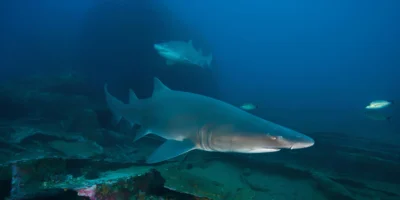
A small marine protected area off Australia’s east coast safeguards more than a well-known aggregation site for critically endangered sand tiger sharks. It also supports more fish species, many more individual fish and more potential shark prey than nearby reefs open to fishing. That is the finding of a new study of Cod Grounds Marine Park in New South Wales.
Four square kilometers of protection for an important aggregation site
The Cod Grounds Marine Park is located approximately 5.5 kilometers off the mid-north coast of New South Wales. The protected area, which is only around four square kilometers in size, includes rocky underwater peaks at a depth of around 20 to 40 meters. Extractive uses such as fishing are prohibited there.
This location is particularly important for sand tiger sharks. In Australia that is Carcharias taurus mostly sand tiger shark; This is the same species that is called sand tiger shark in Germany and Ragged-tooth Shark in South Africa. The eastern Australian population is considered critically endangered. It is slow to recover because sand tiger sharks reach sexual maturity late and only produce a few young.
The animals move along the coast and move between different gathering places. However, on suitable rocky reefs they show a pronounced local loyalty. Such places offer protection and play an important role in several phases of life. At the same time, many of them are popular with divers and anglers.
220 underwater videos on protected and fished reefs
To compare fish communities, the research team used baited underwater cameras, called BRUV systems. Seven surveys took place between April 2015 and August 2018. Reef sites within the marine park as well as four nearby comparison sites where fishing was permitted were examined.
Each mission attracted around 500 grams of sardines in front of the camera. The researchers evaluated 220 video clips and used the highest number of simultaneously visible animals of a species as a measure. This reduces the risk of counting the same fish multiple times. In total, the cameras recorded 114 fish species from 54 families.
Very large swarms of three open-water plankton eaters were excluded from the analyses. Their highly variable distribution could have masked differences in the actual reef fish communities.
50 percent more fish in the protected area
The differences were clear. At each study site, the researchers found an average of 15.18 species in the protected area and 13.72 outside. This corresponds to around nine percent more species. The gap in the total number was even greater: within the marine park the average value was 50.76 fish, on the fished reefs it was 32.58 – an increase of around 50 percent.
Species caught commercially or in recreational fisheries responded the most. These included Australian snapper and yellowtail kingfish. But non-targeted species were also more common within the protected area. This suggests that a fishing ban can affect not only individual target species, but broader ecological processes in the reef.
Temperature and visibility in the water were also checked. They did not explain the measured differences in species number, total abundance and potential shark prey. Protection status, however, remained a clear factor for several metrics.
55 percent more potential prey for sand tiger sharks
Particularly relevant for sharks: According to known dietary data, 32 of the recorded fish species from 22 families are considered possible prey of sand tiger sharks. On average, their frequency in the marine park was around 55 percent higher than on the comparison reefs fished. 60 percent of these potential prey species are also used by fishermen.
During the study, sand tiger sharks themselves only appeared in photographs from the protected area. They were not recorded on any of the four comparison reefs in the seven study periods. Within the marine park, their measured abundance increased along with the abundance of potential prey fish. The correlation was with r = 0.78 positive and statistically significant.
This is a plausible indication that an abundant food supply determines the use of the gathering place. But it is not proof of cause and effect. Seasonal migration, low shark numbers and other environmental conditions can also influence when the animals appear in front of the cameras. No sand tiger shark was recorded in the marine park during the last survey.
Not every shark species benefits in the same way
In total, the study recorded 20 species of sharks and rays. For the remaining sharks, there was no consistent difference between protected areas and fished reefs. Many ground-dwelling species such as wobbegongs experience comparatively little fishing pressure. Long-distance migratory species, in turn, move over areas that far exceed a four square kilometer reserve.
This is precisely where an important boundary of small protected areas lies. They can secure crucial reef spots, but mobile sharks regularly move beyond their boundaries. Outside they remain exposed to hooks, bycatch and other fishing mortality. Networked protected areas and buffer zones around key aggregation sites could reduce these gaps.
The study shows a strong connection, but no before-and-after proof
The results fit well with what is expected from effective no-take zones. Nevertheless, the authors formulate things cautiously. Before the marine park was established, there was no comparable baseline survey. Therefore, it cannot be ruled out that the later protected reef was already home to more fish. In addition, the small size of the park, the availability of similar reefs and somewhat shallower comparison sites limited the study design.
The number of patrols and recorded violations also showed no clear connection to the fishing data during the study period. It does not follow that controls are unimportant. It is more likely that enforcement was sufficient overall and short-term fluctuations in the control numbers poorly reflect ecological changes.
More than a safe parking spot for sharks
According to these data, the Cod Grounds Marine Park does not just appear to be a separate place where sand tiger sharks are less easily caught. It simultaneously protects a richer reef fish community and probably better feeding space. For a rare, slow-reproducing species, both can count: fewer avoidable deaths and high-quality habitat in familiar gathering places.
For divers, the study makes it clear why, ecologically speaking, a single famous shark spot never consists solely of sharks. A healthy gathering place needs the entire reef – prey fish, protective structures and rules that are followed. Local fishing bans can create a strong basis for this. However, for migratory sand tiger sharks, they must be part of a larger protective network along the coast.