


Dark shyshark - Haploblepharus pictus
Body structure, features & anatomy
The Dark Dogfish Haploblepharus pictus is a small, bottom-dwelling catshark of southern Africa. WoRMS lists the name as a valid species; on Haitauchen it is within the Selachii, the Galeomorphi, the Carcharhiniformes, the Scyliorhinidae and the genus Haploblepharus.
The family demarcation of catsharks is not the same everywhere. Shark-References leads Haploblepharus pictus currently under Pentanchidae, while the site taxonomy here uses the Scyliorhinidae framing. For the public species page, the secured species name is therefore more important than a seemingly simple family formula.
Drawing and body shape
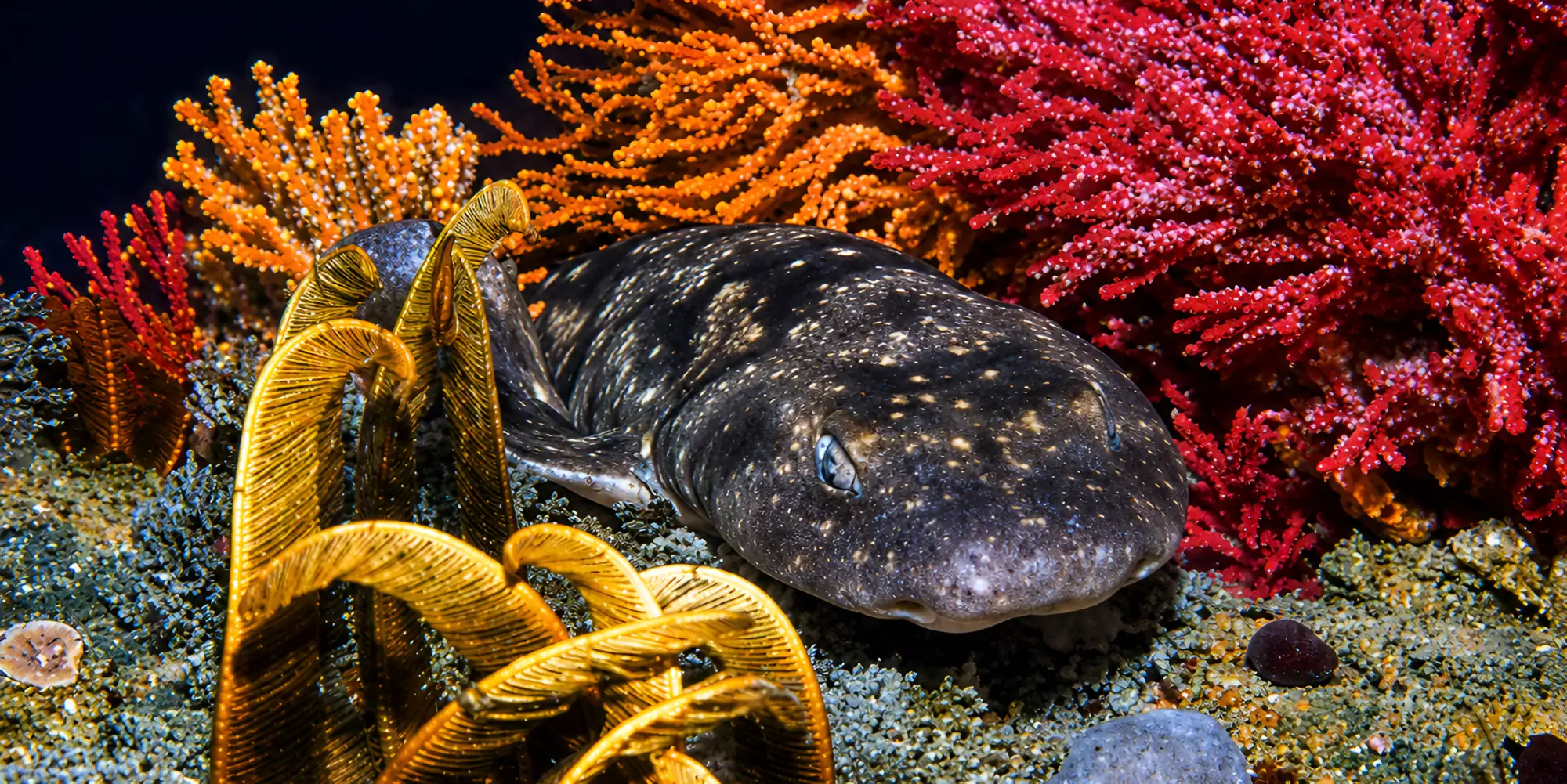
The body remains small and elongated; FishBase states 57 cm total length, other summaries around 60 cm. Typical features are a yellowish-brown to darker base color, large light spots without black edges and seven dark brown to blackish saddles over the back and tail.
- Small, bottom-hugging catshark with a blunt snout and cat-like eyes.
- Yellowish-brown to dark back with dark saddles and light spots.
- No dorsal or anal fin spines; elongated catshark shape.
- English names are Dark shyshark, Dark shyshark and Shyshark.
- When disturbed, the species can curl up tightly and shield its head with its tail.
The German name emphasizes the dark markings, while the English name shyshark takes up the defensive behavior of the genus. The combination of flat South African habitat, small body size, dark saddles and light spots without dark edges are particularly important for identification in the water.
Distribution & habitat
FishBase describes the Dark shyshark Haploblepharus pictus for the southeast Atlantic from Namibia to the southwestern Cape Province Südafrikas. Sharks and Rays encompasses the area further from the north Lüderitz Namibia to East London in Südafrika together. The species therefore remains a regional endemic to southern Africa.
The habitat is coastal, demersal and mostly flat. Rocky reefs, forests, sandy areas, crevices and sandy-rocky transitions are mentioned. The live maintained species page lists a depth range of 0 to 35 meters, suitable for many shallow coastal and diving habitats in southern Africa.
Kelp, reefs and sandy areas
The dusky catshark is not an open blue water shark. It uses bottom structures, daytime hiding places and the camouflage effect of algae, rock and sand. The species can be visible in Kelp forests and rocky diving sites, but is easily overlooked due to its small size and bottom-hugging lifestyle.
A distribution map was not included for this German-only detailed series. The text is more useful here: southern Africa, offshore shallow water habitats, lots of structure and clear ties to regional Kelp, reef and sand areas.
Life history, diet & reproduction
The Dark Dogfish Haploblepharus pictus is a small ground predator. Florida Museum describes the species as rather loyal to its location and close to the ground; FishBase lists small bottom-dwelling fish, crustaceans and cephalopods as food.
The way of life is designed for short search movements on the ground. The shark rests in crevices, between rocks or in structures and primarily takes advantage of situations in which small prey can be reached near the ground. In diving practice, this species appears to be quiet and hidden rather than conspicuously hunting.
Egg capsules and development
Reproduction is oviparous. Shark-References and FishBase call two egg capsules at once; The young hatch when they are around 11 cm long. The embryos live in the egg on the yolk until they hatch as small, independent catsharks.
- Eggs instead of live birth.
- Two egg capsules at the same time are described for the species.
- Juveniles hatch as clearly recognizable small catsharks.
- Small ground prey such as fish, crustaceans, cephalopods and snails characterize the diet.
- Curling up when in danger is a protective behavior, not a play behavior.
The life cycle seems unspectacular, but is closely linked to intact coastal structures. Egg capsules need support, young animals need shelter and adult animals need a place to retreat. When Kelp, reef crevices or quiet sand-rock transitions disappear, this small shark species loses more than just living space.
Threats & conservation status
The IUCN Red List evaluated Haploblepharus pictus global as Least Concern, on Haitauchen as not at risk. This classification is consistent with the fact that the species still occurs regularly in parts of its range and is not considered a heavily fished target.
Not endangered does not mean irrelevant. The dusky dogfish has a regionally limited range and lives in coastal habitats that can be influenced by fishing, recreational use, water quality and local habitat change. Small catsharks are easily overlooked in such debates because they are neither large nor particularly commercially valuable.
Take local risks seriously
FishBase describes catch by surf anglers, and Sharks and Rays describes high proximity to dive sites. Both show how close the species lives to human use. Although the global status is reassuring, local losses in Kelp or reef areas may be noticeable for a local species.
Sensible protection therefore consists of clean species identification, careful handling when in contact with fishing, intact Kelp and reef habitats and good water quality. For a small, seemingly harmless species, this is often more important than spectacular conservation rhetoric.
Dark shyshark & humans
The dark catshark is harmless to humans. FishBase expressly lists it as harmless and in diving practice Haploblepharus pictus more of a quiet small shark encounter than a flashy big shark experience.
Sharks and Rays describes the species as very approachable and often observed at rocky or kelp-rich dive sites in False Bay. It is precisely this closeness that requires consideration: do not touch, do not drive out of crevices, do not circle and do not provoke curling up.
Observe small sharks consciously
- Look slowly instead of searching frantically.
- Keep your distance with lights and cameras, especially in crevices and daytime hiding places.
- Do not use bait to lure animals from cover.
- If you come into contact with a fishing rod, quickly loosen the hook and treat the animal moistly and close to the ground.
- Kelp, do not damage sponges and reef structure just to get closer to an animal.
For Haitauchen, this species is a good example of the value of small endemic sharks. It makes it clear that Südafrika not only offers large shark species, but also its own world of Kelp, rocky reefs and local catsharks. Anyone who respectfully observes such animals learns a lot about the quiet, ground-level aspects of shark biology.
Profile
- First described:
- Max. size:
- Depth:
- Max. age:
- Max. weight:
- Water type:
- IUCN Status:
Taxonomy
- Kingdom:
- Phylum:
- Subphylum:
- Infraphylum:
- Parvphylum:
- Class:
- Subclass:
- Superorder:
- Order:
- Family:
- Genus:
Newsletter
Shark Alert in Your Inbox