


Puffadder shyshark - Haploblepharus edwardsii

Body structure, features & anatomy
The Puffadder shyshark Haploblepharus edwardsii is a small, bottom-dwelling catshark from South Africa. WoRMS lists the name as a valid species; on Haitauchen it is within the Selachii, the Galeomorphi, the Carcharhiniformes, the Scyliorhinidae and the genus Haploblepharus.
The family demarcation of catsharks is not completely consistent in databases. Shark-References leads Haploblepharus edwardsii currently under Pentanchidae, while the older Scyliorhinidae framing used on Haitauchen continues to explain well why this species is externally perceived as a catshark. The combination of genus, species name and regional occurrence is therefore particularly important.
Pattern, head and fins
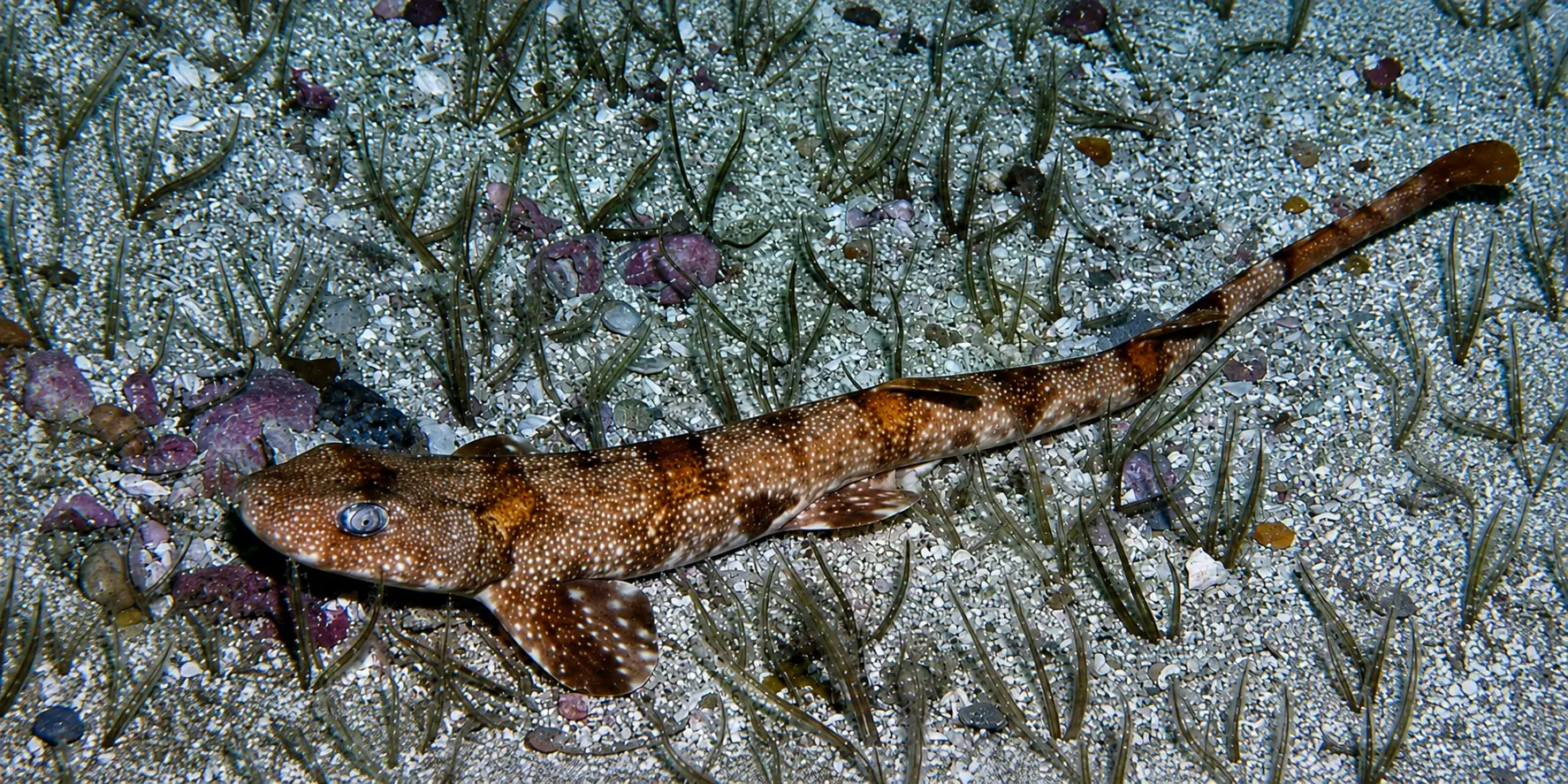
The body remains slim and flattened, the head appears broad and short, rounded. The large, cat-like slitted eyes, greatly expanded nasal lobes, short mouth gaps and two thornless dorsal fins give the species the typical catshark impression. The first dorsal fin inserts approximately above or just behind the pelvic fins; the second is further back over the area of the anal fin.
- Small shark, usually well under a meter; the sources mention a maximum length of around 59 to 60 cm.
- Sand brown to lighter ground color with dark, reddish brown saddle spots.
- Lots of small dark and white dots between saddles; Belly side whitish.
- Broad head, short snout, large nasal lobes and cat-like eyes.
- English names are Puffadder shyshark and Happy Eddie.
The German name alludes to the striking pattern: the dark saddles are reminiscent of the pattern of African puff adders. The English name shyshark, on the other hand, refers to the behavior of many Haploblepharus-Ways to curl up tightly when disturbed and protect the head with the tail. For in-water identification, this combination of pattern, small body, and shallow coastal habitat is more meaningful than any single detail.
Distribution & habitat
The Puffadder shyshark is a South African endemic. FishBase describes the species for the southeast Atlantic from Cape Agulhas to Natal; other recent summaries put the confirmed framework more narrowly along the South African coast, particularly from the Western Cape to the Algoa Bay area. On Haitauchen the species is therefore with South Africa linked.
The species lives demersally, i.e. on or close to the sea floor. Typical habitats include sandy and rocky soils, kelp areas, reefs, shallow bays and the continental shelf. FishBase gives a depth range of 0 to 130 meters and describes 40 to 130 meters as the more common range. The western part of the distribution area is particularly relevant for divers, where such small catsharks can also occur in shallower, cooler water.
Cape and Natal shape
In older literature, a cape and a Natal form were distinguished. Among other things, they differ in color and preferred habitat; In some cases, such forms were later reassessed taxonomically. Caution therefore makes sense for the website: not every historical report far east or north of the South African core coast should automatically be considered safer Haploblepharus edwardsii-Proof can be read.
Ecologically, the species is suited to cool, structurally rich coastal habitats. The pattern camouflages them between sand, rubble, rock, algae and kelp. Because it is small, close to the bottom and often hidden, it is easily overlooked during quick reef surveys. Anyone looking specifically for smaller endemic sharks in South Africa must therefore look more slowly than at free-swimming reef sharks.
Life history, diet & reproduction
The Puffadder shyshark Haploblepharus edwardsii is not a fast open water hunter, but rather a small predator of the bottom. The Florida Museum describes it as a long, slender catshark that rests on the seabed and primarily consumes crustaceans, polychaetes and small fish. FishBase also names fish, crustaceans and cephalopods as prey.
During the day the species may lie hidden among rocks, kelp and crevices; In more active phases it searches the ground for small prey. The broad head area, the nasal lobes and the small mouth are suitable for a shark that is not looking for large prey, but rather uses short movements on the bottom. This is still relevant for the ecosystem: small sharks connect invertebrates, small fish and larger coastal predators in a local food web.
Eggs instead of live young animals
Reproduction is oviparous. Females lay egg capsules, often called small mermaid’s purses. FishBase reports one egg capsule per oviduct; Florida Museum describes egg capsules with tendrils that can cling to structures. The embryos feed on the yolk in the egg and hatch as small catsharks that are already recognizable.
Such egg capsules make the species clear on the one hand, but vulnerable to local disturbances on the other. When shallow habitats, kelp, rock structures or suitable nesting sites are damaged, this affects not only adult animals, but also early development. The life cycle appears to be small-scale compared to large sharks, but is spatially closely linked to South African coastal habitats.
Threats & conservation status
The IUCN Red List evaluated Haploblepharus edwardsii global as Endangered; on Haitauchen this corresponds to Endangered status. What is important is not a single dramatic catch, but the combination of small distribution area, coastal ties and multiple fisheries operating in the same habitat.
The species is not particularly attractive to large commercial markets, but is recorded as bycatch in bottom trawling, net, line and inshore fisheries or is hooked by surf anglers. Small sharks are then often discarded or treated as nuisances. For a widespread species this would be less critical; However, in an endemic with a limited coastal area, such permanent additional mortality can be significant.
Why a small shark can be at great risk
Critically endangered does not mean that the Puffadder shyshark has to be rarely seen everywhere. Locally, small catsharks can still appear regularly, for example in suitable kelp and rocky areas. However, the protection status looks at the entire population, its distribution and development over time. If a large part of the population lives in a single intensively used coastal region, local deteriorations are enough to affect the entire population.
Risks include fishing pressure, habitat change, poorer water quality in coastal bays and climate effects that may shift cool southern African habitats. Therefore, not only a ban on catching individual animals is important for protection, but also the quality of the habitats in which eggs are laid, young animals grow and adult animals rest.
Puffadder shyshark & humans
For humans is the Puffadder shyshark Haploblepharus edwardsii harmless. Sharks and Rays describes it as a small, responsive shark that can be observed in suitable South African diving areas between kelp, rock and sand. It is precisely this proximity that makes it interesting for underwater photography, but requires calm behavior and distance.
The most important frame of encounter is not danger, but disruption. A curled shyshark is not a fun trick for photos, but a defensive behavior. Anyone who intentionally touches an animal, pulls it out of a crevice or causes it to curl up turns an observation into stress. Good practice therefore means: approach slowly, do not touch, do not block and do not lure animals into unnatural situations with bait.
South Africa, kelp and small endemics
For shark divers, this species is a good example of how special shark experiences don’t just consist of large species. In South Africa, endemic catsharks, kelp forests and shallow rocky reefs form their own, very local shark world. If you dive there, with patience you can see species that only occur in a small section of the coast worldwide.
Anglers and fishermen encounter the species in other ways. Because it is small and has little food value, it is often discarded or discarded. Gentle handling is still important: loosen hooks quickly, keep animals moist, do not carry them by their tails or gills and return them quickly to calm water. For a critically endangered endemic, a small animal on the hook also counts.
Profile
- First described:
- Max. size:
- Depth:
- Max. age:
- Max. weight:
- Water type:
- IUCN Status:
Taxonomy
- Kingdom:
- Phylum:
- Subphylum:
- Infraphylum:
- Parvphylum:
- Class:
- Subclass:
- Superorder:
- Order:
- Family:
- Genus:
Newsletter
Shark Alert in Your Inbox