


Mexican angelshark - Squatina mexicana
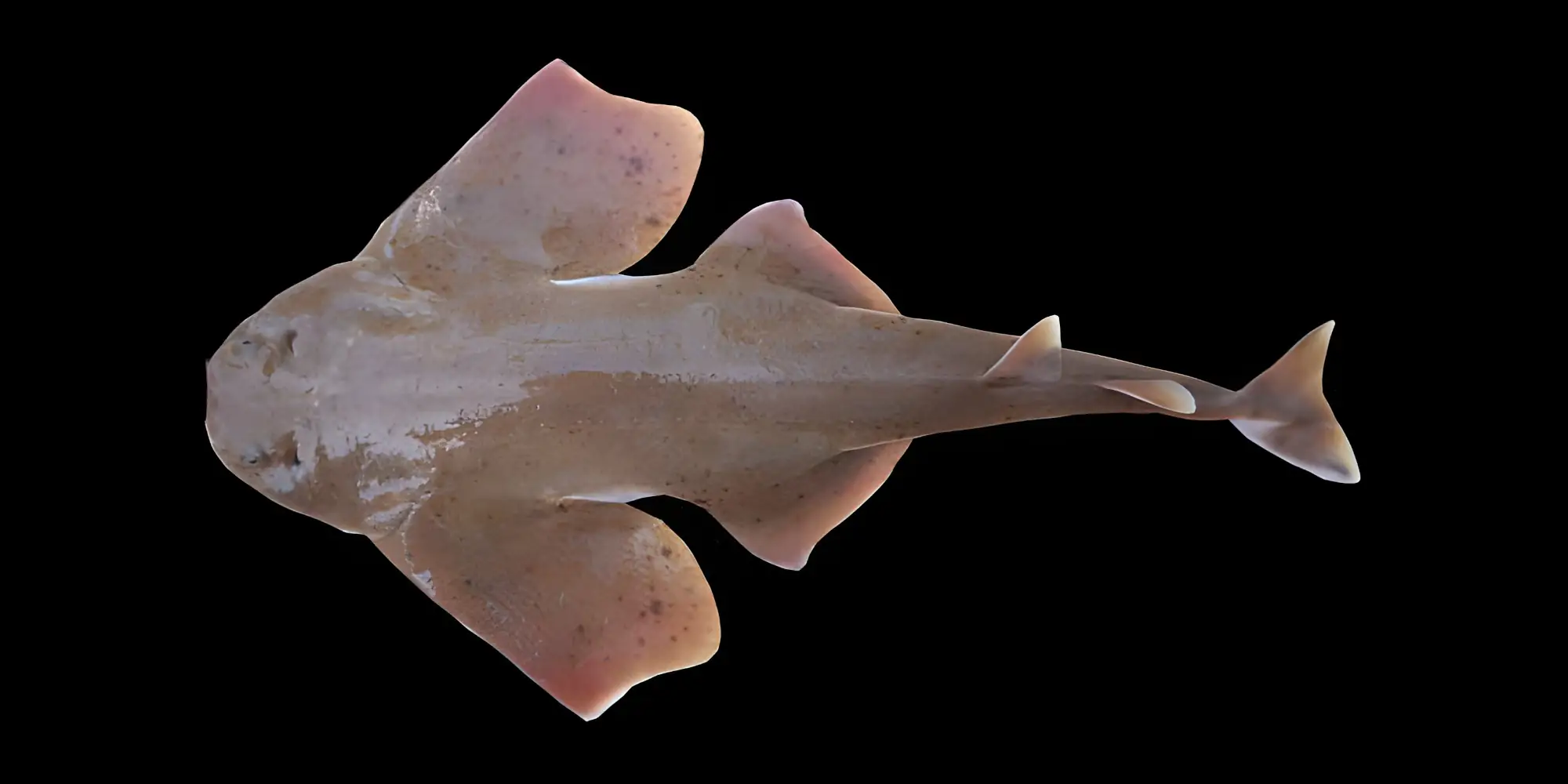
Body structure, features & anatomy
The Mexican angelshark Squatina mexicana is a small, strongly flattened angel shark of the western Atlantic. Taxonomically it leads WoRMS as an accepted species within the Squalomorphi, the order Squatiniformes, the family Squatinidae and the genus Squatina.
Like other angel sharks, it appears to be ray-like at first glance: the head and body are flat, the pectoral fins are very wide and the tail is significantly narrower. Nevertheless, it remains a shark because the gill slits are on the sides of the head and the pectoral fins are not completely fused to the head.
Identifying features
- No spines or enlarged denticles along the midline of the back.
- Dermal denticles with three keels running backwards.
- Two dorsal fins of similar size and shape, located far back on the body.
- Gray to brownish upperside without eyespots, but with noticeable dark spots on the pectoral fins.
- The known maximum length is around 88 cm total length.
Shark-References adopts the features from the first description and refers to the shape of the teeth, nasal lobes, dorsal fins and the dark markings on the pectoral fins as important distinguishing features. Especially with angel sharks, good photos of the head, barbels, base of the pectoral fin and tail area are crucial.
Distribution & habitat
The Mexican angelshark is from the west Atlantic known, especially from the Gulf of Mexico before Mexico. FishBase briefly summarizes the distribution as Western Atlantic: Gulf of Mexico.
There is currently no verified distribution map in the Wikipedia/Commons media environment. The secured discovery data is therefore more important than a schematic map: the initial description names specimens from the Mexican shelf edge off Tamaulipas, Tabasco and Yucatán.
Mexican shelf
The known animals come from the outer coastal and shelf areas. FishBase gives a depth range of 71 to 180 m; The type and paratype finds in the original work lie in this area and were recorded during ground-level investigations.
The species is therefore not a predictable encounter for divers. Rather, it represents the less visible bottom shark fauna of the Gulf of Mexico: sandy and muddy shelves, murkier depths, and a habitat more closely associated with research and fishing than with recreational diving.
Life history, diet & reproduction
The first description of Castro-Aguirre, Espinosa Pérez & Huidobro Campos 2007 arranges Squatina mexicana as a benthic shelf shark. Angel sharks are lurking hunters: they lie flat on or slightly in the sediment and snap at prey that moves close enough to the bottom.
food and hunting
Direct dietary data for this young, rarely documented species are scarce. However, the body structure and habitat result in the typical angel shark pattern: bottom-hugging fish, small rays, cephalopods and crustaceans are not pursued over long distances, but are surprised from a short distance.
Eyes and spray holes are on top of the head. This allows the shark to breathe while being buried and observe its surroundings, while its mouth and body almost merge with the ground. This camouflage is both a strength and a risk because ground-level fishing gear easily catches such animals.
Reproduction
Species-specific reproductive data are currently hardly available. The Mexican angelshark probably follows the basic pattern of the Squatinidae: aplacental viviparous, with fully developed young and rather slow population recovery.
Precisely because the data is sparse, clear discovery reports with location, depth, photo and context of capture or observation are important. They help to clarify whether documented animals really belong S. mexicana, to S. dumeril or belong to a line that is not yet clearly separated.
Threats & conservation status
The Mexican angelshark is currently listed on FishBase as not rated led. This is not an all-clear, but rather means that there is not enough verified assessment data for a reliable global IUCN classification.
In addition, the taxonomy is not completely tension-free: Cañedo-Apolaya et al. 2021 points out that Squatina mexicana in parts of the literature as a possible synonym of Squatina dumeril was treated, while WoRMS currently accepts the species. This uncertainty is practically relevant for protection and monitoring.
Possible hazards
- Bycatch in bottom trawls, gillnets and other shelf fisheries.
- Very limited discovery data, making inventory size and trend difficult to estimate.
- Confusion with other western Atlantic angel sharks.
- Habitats on sandy and muddy shelves overlap with used fishing grounds.
- Slow recovery can be expected for angel sharks even without species-specific detailed data.
Precaution here primarily means better species identification, photographic documentation, preserved specimens, genetic testing and bycatch data from the Gulf of Mexico. Without this basis, a protection status would appear to be more secure than the data actually provides.
Mexican angelshark & humans
To humans, the Mexican angelshark is considered an inconspicuous ground shark. He is not an actively searching human hunter. As with other angel sharks, risk arises primarily when a resting animal is touched, pulled from the sand or treated as a catch.
The in Wikimedia Commons The linked photos show a documented research and collection context rather than a classic diving sighting. This fits the species: it is small, close to the bottom, rarely reported and lives at depths that normal recreational diving profiles usually cannot reach.
Respectful treatment
- Never expose, touch or harass resting angel sharks for photos.
- If you accidentally find it, keep your distance and do not handle it directly in front of its mouth.
- Document the location, depth, soil type and photos without moving the animal.
- If you come into contact with fisheries, secure species photos and data that are as clean as possible because mix-ups are likely.
For shark diving, this species is primarily an indication of how much shark diversity exists outside of the known large shark encounters. The Mexican angelshark is quiet, rarely visible, and not yet fully understood scientifically; that is precisely why it deserves careful data.
Profile
- First described:
- Max. size:
- Depth:
- Max. age:
- Max. weight:
- Water type:
- IUCN Status:
Taxonomy
- Kingdom:
- Phylum:
- Subphylum:
- Infraphylum:
- Parvphylum:
- Class:
- Subclass:
- Superorder:
- Order:
- Family:
- Genus:
Newsletter
Shark Alert in Your Inbox