


Eastern angelshark - Squatina albipunctata
Body structure, features & anatomy
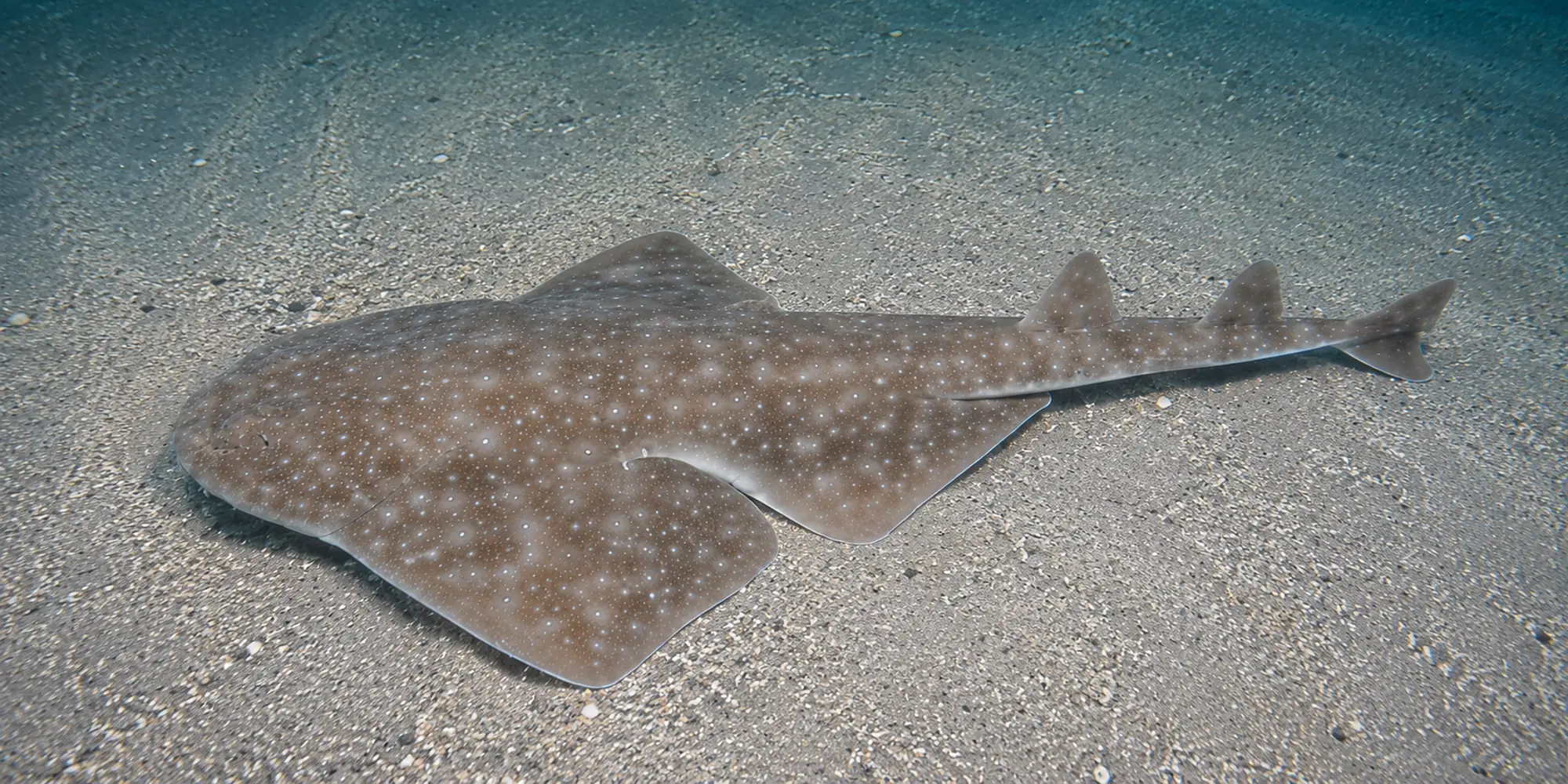
The Eastern angelshark Squatina albipunctata is a robust, strongly flattened bottom shark with a broad head, large pectoral fins and a ray-like silhouette. Taxonomically it remains clearly a shark: WoRMS leads the species within the Squalomorphi, the order Squatiniformes, the family Squatinidae and the genus Squatina.
Australian Museum describes the species as an Eastern Angelshark. In the field it appears flat and wide, but the lateral gill slits, the terminal mouth and the pectoral fins that are not attached to the head clearly separate angel sharks from real rays.
Identifying features
- Robust, strongly flattened body with very large, fleshy pectoral fins.
- Yellowish to chocolate brown upper surface with many small white, dark-edged dots.
- No noticeable eyespots on the pectoral fins; the unpaired fins are rather light and unspotted.
- Short muzzle, broad head shape, fringed nose barbels and strong thorns behind the eyes.
- Two small dorsal fins sit far back; an anal fin is missing.
Adults usually remain significantly smaller than many better-known angel sharks. Photos of the head, barbels, spot markings, pectoral fins and dorsal fin position are particularly useful for reliable identification.
Distribution & habitat
The Eastern angelshark is an Australian western endemic Pacific. Shark-References calls the east coast of Australia as a distribution area; The species occurs approximately from the Cairns area in Queensland south to Lakes Entrance in Victoria.
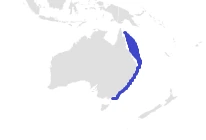
Australia is the only country to have the species profile. This means that the species is biogeographically more narrowly defined than many other angel sharks: when reporting finds, the exact assignment to the coastal section, depth and circumstances of capture or sighting is particularly important.
Outer shelf and upper slope
Typical habitats are sandy and muddy soils on the outer continental shelf and upper slope. The depth range of 35 to 415 m stored in the species profile fits a species that predominantly lives deeper than classic recreational diving habitats.
The Eastern angelshark is therefore difficult to plan for divers. Relevant evidence tends to come from scientific surveys, fishing observations and rare sightings in suitable bottom habitats.
Life history, diet & reproduction
FishBase describes Squatina albipunctata as a marine, benthopelagic shark of the shelf and slope area. Like other angel sharks, it uses camouflage on the ground instead of long chases in open water.
Hunting and food
The Eastern angelshark is probably often partially hidden in the sediment. Eyes and spray holes remain exposed while the body merges with sand or mud bottom. If small fish, cephalopods or crustaceans come into range, a short, quick suction attack follows.
This hunting method saves energy, but ties the species closely to intact ground habitats. Where bottom gear operates over the same areas, habitat and fishing risk directly overlap.
Reproduction
The species is aplacental viviparous. Young animals develop in the mother and are born fully developed; Literature reports indicate a birth size of around 27 to 30 cm and up to around 20 young animals per litter.
Males reach sexual maturity around 91 cm, females around 107 cm. The maximum age of around 23 years stored in the species profile shows that local populations cannot react as quickly as they want to strong fishing pressure.
Threats & protection status
The IUCN Red List classifies the Eastern angelshark worldwide as endangered a. The classification fits a species that is endemic, lives close to the bottom and has been heavily fished in parts of its range for a long time.
The report from Status of Australian Fish Stocks describes significant declines in the fished southern part of the range. There, the Eastern angelshark is caught as marketable bycatch in bottom-level fisheries, while more northerly catches are rarer and often discarded as bycatch.
Main hazards
- Bycatch and marketing in bottom trawling and other bottom-based fisheries.
- Strong historical declines in the southern area from New South Wales to Victoria.
- Endemic, restricted range along eastern Australia.
- Overlap of important shelf and slope habitats with used fishing grounds.
- Uncertain population estimates because precise population sizes are missing.
Protection therefore requires better species reporting in catches, bycatch reduction, spatially appropriate fishing rules and long-term monitoring. Especially with an endemic angel shark, regional declines can quickly shape the global status.
Eastern angelshark & humans
The Eastern angelshark is not normally an actively dangerous shark to humans. It becomes risky when a resting animal is touched, pulled out of the sediment, harassed or treated as a catch. Then an angel shark can snap forward or sideways very quickly.
Fishes of Australia describes the Eastern angelshark as commercial bycatch. This is exactly where the most important human relationship lies: not in the spectacular shark diving, but in the question of how deeper bottom fisheries deal with a rare endemic species.
Observation and handling
- Do not expose, touch, or harass resting angel sharks for photos.
- Dive on sandy bottoms with clean buoyancy and do not search with hands or knees.
- Keep your distance to the side and do not place the camera, hands or lamps directly in front of your mouth.
- Document sightings with photos, location, depth and habitat without moving the animal.
For shark diving, the Eastern angelshark is a quiet but important example: Some shark species are not known through large encounter scenes, but through the need to take less visible bottom habitats and bycatch species seriously.
Profile
- First described:
- Max. size:
- Depth:
- Max. age:
- Max. weight:
- Water type:
- IUCN Status:
Taxonomy
- Kingdom:
- Phylum:
- Subphylum:
- Infraphylum:
- Parvphylum:
- Class:
- Subclass:
- Superorder:
- Order:
- Family:
- Genus:
Newsletter
Shark Alert in Your Inbox