


Clouded angelshark - Squatina nebulosa
Body structure, features & anatomy
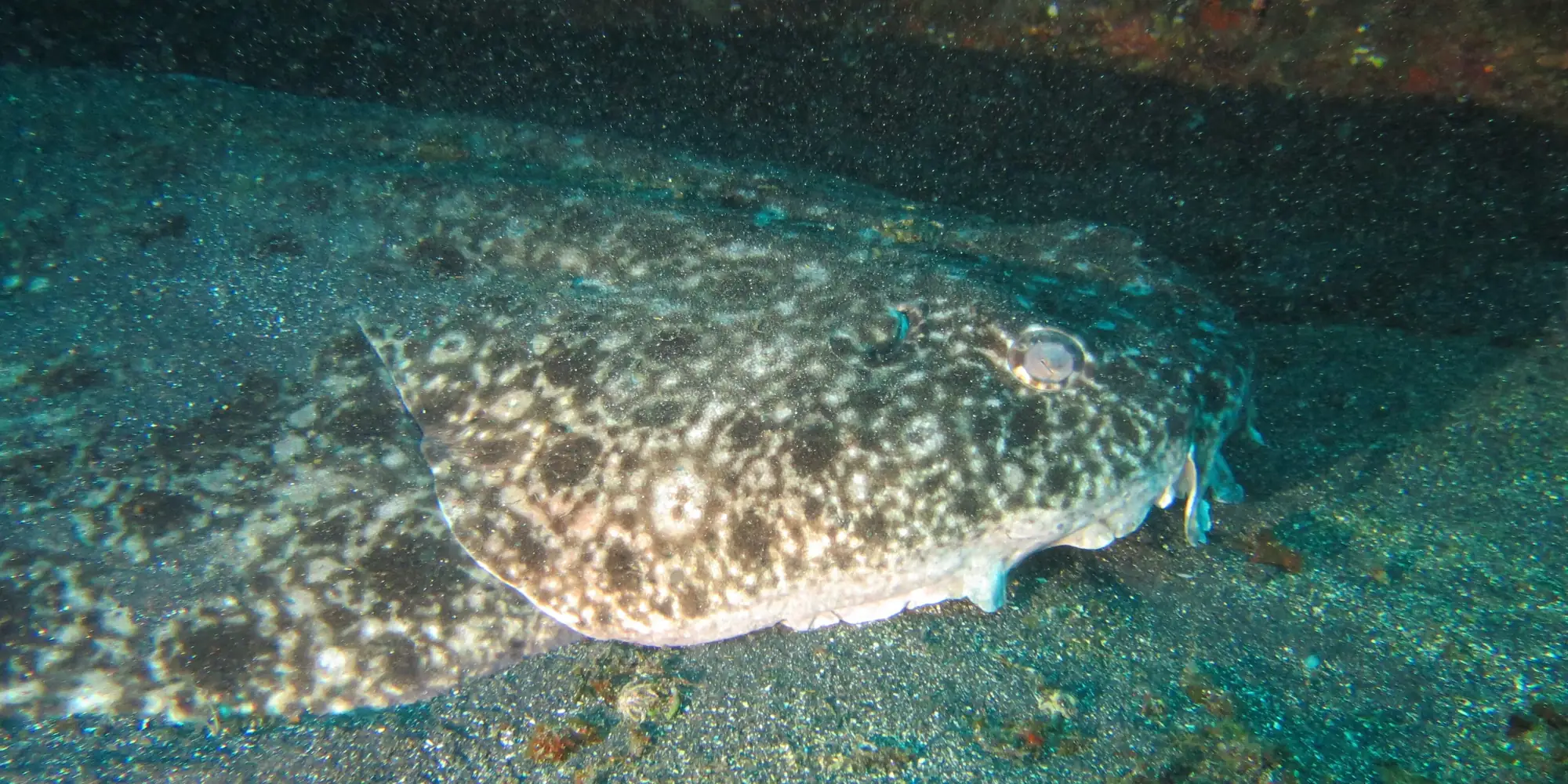
The Clouded angelshark Squatina nebulosa is a strongly flattened bottom shark with a broad head, large pectoral fins and a ray-like silhouette. Taxonomically it remains clearly a shark: WoRMS leads the species within the Squalomorphi, the order Squatiniformes, the family Squatinidae and the genus Squatina.
The eyes and spray holes are on top of the head, while the gill slits are on the sides. The broad pectoral fins are not completely fused to the head; This makes the angel shark clearly different from real rays despite its flat shape.
Identifying features
- Broad, flattened front body with large, laterally projecting pectoral fins.
- Brownish to dark marbled upperparts, matching the English name Clouded angelshark.
- Head clearly in front of the front edges of the pectoral fins, with short nasal barbels and a wide mouth.
- Two small dorsal fins sit far back; an anal fin is missing.
- According to sources, adult animals reach a total length of around 1.6 to 2.0 m.
Photos of the head, barbels, dorsal fin position, tail base and body markings are particularly helpful for reliable field identification. Especially in the Northwest Pacific region, several species of angel sharks can appear similar when only a single image is available from above.
Distribution & habitat
The Clouded angelshark lives in the northwest Pacific. Shark-References summarizes the distribution from the southeastern Sea of Japan to Taiwan; this includes coastal areas Japan, China, Taiwan, North Korea and South Korea.
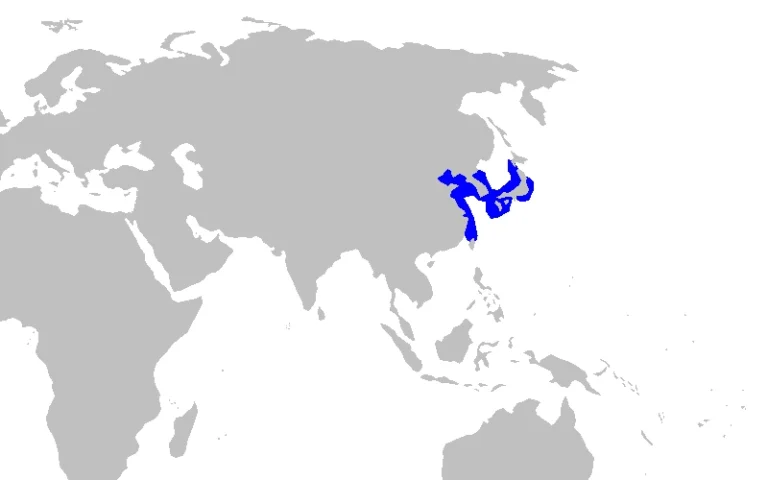
The species is primarily a shelf shark. It uses sandy and muddy bottoms, the edges of bays and the transitions to deeper soft bottoms. The distribution pattern lies between the cooler marginal seas of East Asia and warmer areas around Taiwan and the northern South China Sea.
Shelf, sand and depth
Continental shelf areas are typical, in which a flattened lurking hunter can partially burrow. Depending on the source, the depths range from very shallow water to several hundred meters; The practical focus for detection is where soft bottom and prey fish meet.
For divers, the species is not a predictable encounter. Good sightings depend more on clear documentation of location, depth, bottom type and photos than on classic shark hotspots. Rare evidence in particular can be valuable for the distribution map.
Life history, diet & reproduction
FishBase describes Squatina nebulosa as a marine demersal shark of the shelf. Like other angel sharks, it does not hunt by long pursuit in open water, but rather uses camouflage, proximity to the bottom and short, quick attacks.
Hunting and food
The Clouded angelshark can rest half-hidden in the sediment while leaving its eyes and spray holes exposed. If fish, squid or crustaceans swim close to the bottom within reach, the head snaps forward and the mouth creates a brief suction effect.
This behavior makes the species energy efficient but also vulnerable. An animal lying on the bottom waiting for prey is easily caught by ground-level fishing gear and hardly has time to avoid nets or hooks.
Reproduction
Reproduction is aplacental viviparous: the young animals develop in the mother and are nourished by the yolk. Relatively large litters within the angel sharks are described for the species; Young animals are born fully developed and use flatter or more protected ground.
The maximum age of around 23 years stored in the species profile shows that the Clouded angelshark is not a short-lived small fish. Slow recovery, a land-based lifestyle and regional fishing are therefore an unfavorable combination for local stocks.
Threats & protection status
The IUCN Red List classifies the Clouded angelshark worldwide as highly endangered a. The decisive factor is an assumed significant population decline over several generations, especially due to ongoing fishing pressure in parts of the northwest Pacific range.
The IUCN-Bewertungsdaten mention, among other things, fishing and bycatch risks for the assessment. Angel sharks lie on the ground, burrow in and are therefore particularly easy to get caught in bottom trawls, gill nets and other bottom-hugging fishing gear.
Main hazards
- Bycatch and occasional targeted catch in shallow coastal and shelf fisheries.
- High fishing pressure in parts of Japan, China, Korea and Taiwan.
- Slow population recovery despite comparatively larger litters than some angel shark relatives.
- Uncertain catch statistics if angel sharks are only grouped and not clearly recorded down to the species.
- Habitats on sandy and muddy shelves overlap heavily with used fishing grounds.
Effective protection therefore requires better species identification in landings, bycatch reduction, protection of important shelf habitats and reliable time series. For rare angel sharks, even clean individual finds with a photo, depth and location are much more than just a side note.
Clouded angelshark & humans
The Clouded angelshark is not normally an actively dangerous shark to humans. Problems arise when a resting animal is touched, pulled out of the sand, harassed or treated as a catch. Then an angel shark can snap forward or sideways very quickly.
FAO Fisheries and Aquaculture leads the species in the fishing context. This is exactly where the most important human relationship lies: The Clouded angelshark is not a typical target shark for diving tourism, but above all a rare bottom shark that comes into contact with regional fisheries and bycatch.
Observation and handling
- Tare carefully on sandy areas and do not use your hands or knees to look for hidden animals.
- Do not expose, touch, or harass resting angel sharks for photos.
- Keep your distance to the side and do not place the camera, hands or lamps directly in front of your mouth.
- Document sightings with photos, location, depth and habitat without moving the animal.
For shark diving, the species represents a quiet but important side of shark observation: a perfectly camouflaged bottom predator whose protection works primarily through better fishing data, gentle fishing practices and respectful observation.
Profile
- First described:
- Max. size:
- Depth:
- Max. age:
- Max. weight:
- Water type:
- IUCN Status:
Taxonomy
- Kingdom:
- Phylum:
- Subphylum:
- Infraphylum:
- Parvphylum:
- Class:
- Subclass:
- Superorder:
- Order:
- Family:
- Genus:
Newsletter
Shark Alert in Your Inbox