


Cigar shark - Isistius brasiliensis

Body structure, features & anatomy
The cookiecutter shark (Isistius brasiliensis) is a small deep-sea shark of the genus Isistius, also known as the cookiecutter shark. It reaches only about 40–50 cm in length and has a slender, torpedo-shaped (“cigar-shaped”) body. Striking is its uniformly dark-brown upper side with a clearly defined dark collar. The shark’s pale underside is densely covered with photophores: these light organs emit green/blue light, which is thought to serve as camouflage (counter-illumination) while also attracting prey. With its scoop-shaped teeth, the cookiecutter shark can bite round pieces of flesh out of larger fish and marine mammals – hence its English name “cookiecutter shark”.
Body structure and external features
The body of the cookiecutter shark is elongated and laterally compressed, giving it a slender profile. The two dorsal fins are very small and set far back on the body; the anal fin is completely absent. The caudal fin is almost symmetrical in cross-section (“homocercal”) with a slightly elongated lower lobe (roughly the same length on both sides). The snout is short and rounded, and the large, forward-facing eyes give the shark a distinctive facial expression. The mouth runs transversely beneath the snout, and the cookiecutter shark has pronounced, sucker-like lips (so-called suctorial lips).
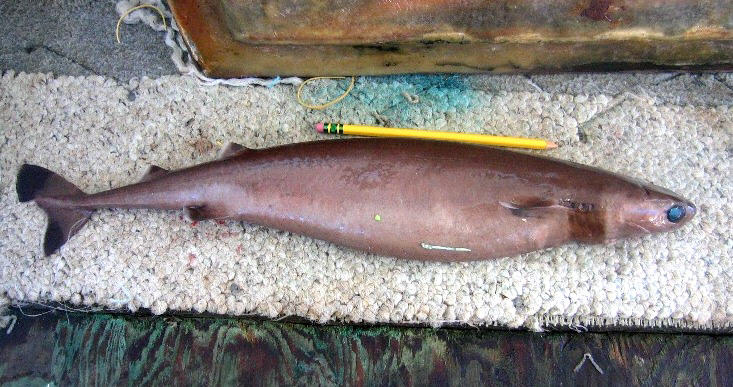
The skin colour is uniformly brown to grey-brown on the upper side, lighter underneath. A dark band (collar) around the gill region is characteristic. Along the underside of the belly extends a dense row of bioluminescent photophores, which in live captures emit green to blue light. The fin margins and the dark neck collar are excluded from the photogenic organs. This light-emitting function apparently helps the shark to camouflage itself in the dark ocean and to attract prey.
Anatomical special features
Dentition and jaw structure
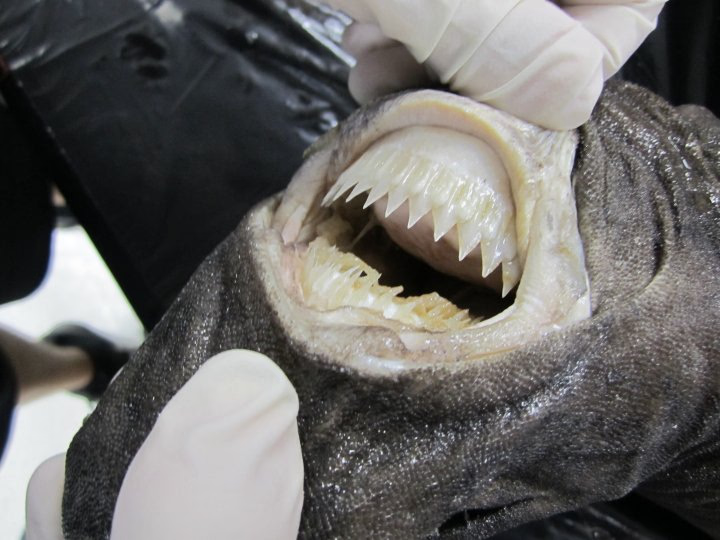
The cookiecutter shark’s dentition is highly specialised and strikingly asymmetrical. The upper jaw teeth are very small, pointed and needle-like, while the lower jaw teeth are large, broad and triangular. In the lower jaw there are about 25–32 tooth rows side by side, fused together to form a knife-like cutting edge. With this dentition the shark can tear wedge-shaped pieces of flesh out of its prey. To do so, it attaches itself firmly to the prey animal with its special lips and rotates around its axis with the lower lip raised, so that its saw-blade-like lower jaw teeth detach a conical piece of flesh. The upper tooth row serves as a hook that holds the piece of flesh in place while the shark pushes off and swallows the cut-out piece of flesh.
A special feature of the cookiecutter shark is simultaneous tooth replacement: it can shed all the teeth of its lower jaw at once when they are worn out. The shed teeth are often swallowed – presumably to recover calcium and mineralise the cartilaginous body. Overall, the dentition structure is therefore unique among sharks and closely adapted to its “cookiecutter” feeding method.
Bioluminescence
Like many members of the family Dalatiidae, the cookiecutter shark is bioluminescent. Its underside bears numerous light-producing organs (photophores) that emit a greenish to bluish light. This bioluminescence creates counter-illumination against the darker light from above in the sea and presumably helps the shark remain invisible in the water (countershading). At the same time, the glow attracts smaller fish and other potential prey closer to the shark. The dark collar around the head remains unlit. The function of bioluminescence has not yet been conclusively clarified, but it is assumed that it primarily serves camouflage and can additionally attract prey for larger predatory fish, such as whales or tuna-like fish.
Sexual differences
Cookiecutter sharks show slight sexual dimorphism: females are generally slightly larger than males. Males reach sexual maturity at around 36–38 cm in length and females at about 39–40 cm. The maximum body length is about 42–44 cm in males and over 50 cm in females. A clearly visible difference lies in the copulatory organs: like all cartilaginous fish, males have two paired claspers located on the rear underside at the base of the pelvic fins. These claspers serve the male as an intimate mating organ, with which it introduces sperm into the female’s cloaca during mating. Apart from size, no further external sex differences are known. Females have paired uteri; males have claspers for internal fertilisation.
Distinctive features compared to other sharks
Compared to most other shark species, the cookiecutter shark has several unusual features. It belongs to the family of kitefin sharks (Dalatiidae) and differs from related dogfish species in that its dorsal fins are without dorsal spines. Particularly striking is the dark collar that characterises the cookiecutter shark – its closest relative, the largetooth cookiecutter shark (Isistius plutodus), does not have such a band.
The highly parasitic way of life makes the cookiecutter shark unique: it can suck onto larger marine animals and use its teeth to cut out round pieces of flesh without killing the prey immediately. Only a few other sharks (such as some pygmy lanternsharks or rare deep-sea species) show similar circular bite wounds.
Together with its bioluminescence, powerful jaws and small size, this combination of features makes the cookiecutter shark one of the most unusual sharks of all (oophagy).
Distribution & Habitat
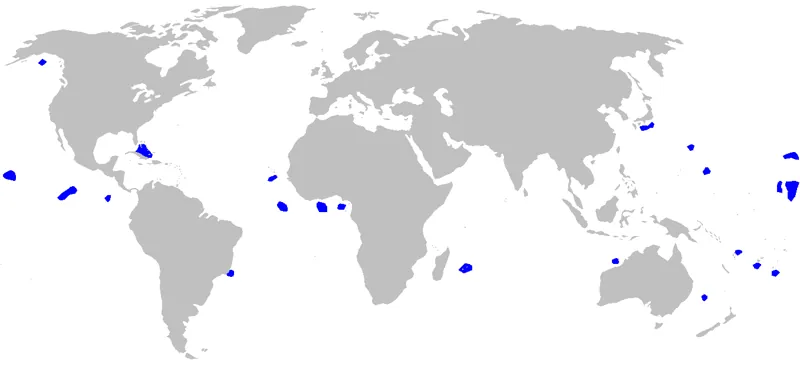
The cookiecutter shark is found in all three major oceans: Atlantic, Pacific and Indian Ocean. Its range extends mainly between latitudes 20°N and 20°S, where surface temperatures are usually between 18°C and 26°C.
Atlantic Ocean
- Western Atlantic: Observations range from the Bahamas to Brazil’s southern coast.
- Eastern Atlantic: Records exist from the Cape Verde Islands via Guinea and Sierra Leone to Angola and South Africa, including Ascension Island.
Indo-Pacific region
- Indian Ocean: Findings have been documented between Mauritius and New Guinea.
- Pacific: The shark has been sighted off Japan, Hawaii, New Zealand and the Galápagos Islands.
This wide distribution suggests that the cookiecutter shark has a high adaptability to various oceanic conditions.
Preferred water depths and daily vertical migrations
The cookiecutter shark inhabits the open ocean and occurs at depths between 85 and 3,700 metres. It shows pronounced vertical migratory behaviour:
- At night: It moves up into shallower layers of water to search for prey.
- During the day: It retreats to deeper regions, presumably as camouflage from predators.
These daily migrations allow the shark to find food efficiently while also avoiding predators.
Frequency and sightings
Due to its deep-sea habitat, the cookiecutter shark is only rarely directly observed or caught. However, characteristic bite marks on larger marine animals such as whales, dolphins and large fish provide evidence of its presence. Such marks have been documented, among other places, in Hawaii, the Galápagos Islands and off the coast of Brazil.
Environmental conditions of its habitat
The cookiecutter shark prefers certain environmental conditions:
- Temperature: Warm waters with temperatures between 18°C and 26°C.
- Depth: Habitats at depths of 85 to 3,700 metres.
- Distance from the coast: Open ocean regions, often near islands that may serve as breeding grounds.
These conditions provide the cookiecutter shark with optimal prerequisites for foraging and reproduction.
Lifestyle, diet & reproduction
Lifestyle in the deep sea
The cookiecutter shark is a nocturnal deep-sea dweller found in tropical and subtropical waters around the globe. During the day it usually stays at depths between 500 and over 3,000 metres ; at night it rises into the upper layers of the water – a behaviour known as vertical migration. These nocturnal excursions serve to search for food.
The shark lives pelagically, i.e. far from the seabed, and prefers to move in oceanic regions, often near islands. Because of its small body, it is very agile and can act with surprisingly precise movements.
Diet and hunting behaviour
Unique biting technique
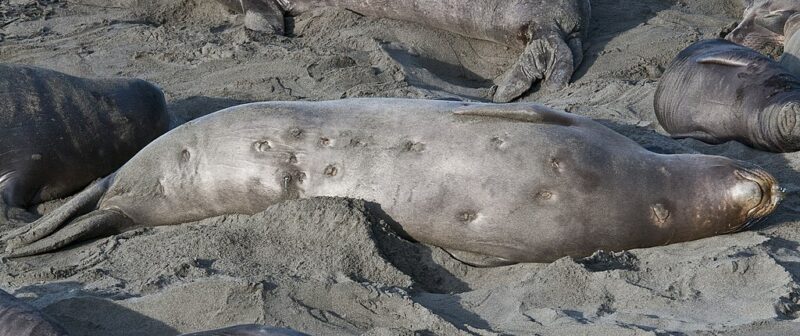
The cookiecutter shark is known for its unusual hunting method. Instead of swallowing its prey, it tears out round pieces of flesh – similar to a “cookie cutter” – from larger marine animals. These include tuna, swordfish, whales and dolphins. This behaviour has also earned it its English name, “cookiecutter shark”.
How the attack works
- Camouflage through light organs: Its underside is equipped with photophores (light organs). These produce a faint glow that makes the shark, coming up from the depths, invisible to prey.
- Approach: Camouflaged, it approaches larger animals.
- Suction and twisting: With its muscular lips it attaches itself to the prey by suction, anchors itself with its needle-shaped upper jaw teeth and cuts out a piece of tissue with the serrated lower jaw teeth as it rotates around its own axis.
This parasitic feeding behaviour is extremely rare among sharks.
Reproduction and offspring
Like other dogfish sharks, the cookiecutter shark is viviparous, but without a placenta. This means: the embryos develop inside the female’s body and are supplied by a yolk sac. This form of reproduction is referred to as “aplacental viviparity”.
Development in the womb
- Females have two functional uteri.
- Per litter, 6 to 12 young are born.
- During gestation, the embryos feed exclusively on the yolk.
- One documented case showed nine embryos measuring 12.4 to 13.7 cm in length. They already had pigmentation, but did not yet have developed teeth or the typical dark neck collar.
- The yolk sacs were still intact at this point, suggesting a long gestation period.
- Newborn cigar sharks measure about 14 to 15 cm at birth.
Sexual maturity
- Males reach sexual maturity at around 36 cm in body length.
- Females become sexually mature at around 39 cm.
- The maximum size is about 50 cm in females, slightly less in males.
Behaviour of the young
Young cookiecutter sharks are independent from birth and fully adapted to life in the deep sea. There is no parental care. Even at a young age, they begin using their typical biting strategy to feed.
Interaktion mit Menschen
Ist der Zigarrenhai für den Menschen gefährlich?
Im Gegensatz zu großen Haiarten wie dem Weißen Hai oder dem Tigerhai gilt der Zigarrenhai nicht als gefährlich im klassischen Sinne. Er ist klein – in der Regel nur 40 bis 50 Zentimeter lang – und lebt meist in großer Tiefe fernab von Küstenregionen. Dennoch gibt es dokumentierte Fälle, in denen Zigarrenhaie Menschen verletzt haben.
Die Angriffe verlaufen meist nach demselben Muster: Der Hai nähert sich, saugt sich mit seinen Lippen an der Haut des Opfers fest und schneidet mit seinen scharfen Unterkieferzähnen ein rundes Stück Gewebe heraus. Das Ergebnis sind kreisförmige Wunden, die meist harmlos, aber auffällig sind.
Dokumentierte Vorfälle mit Menschen
In sehr seltenen Fällen wurden Schwimmer, Taucher oder Soldaten bei nächtlichen Manövern in tropischen Gewässern gebissen. Besonders bekannt wurde ein Fall aus den 1970er-Jahren, bei dem mehrere US-Soldaten während eines nächtlichen Aufenthalts im Wasser im Pazifik kreisrunde Bisswunden davontrugen.
Typisch ist, dass diese Bisse relativ oberflächlich sind, aber durch das starke Ansaugen schmerzhaft sein können. Es sind bislang keine tödlichen Zwischenfälle mit Zigarrenhaien bekannt. Die Wunden heilen bei entsprechender Behandlung in der Regel problemlos ab.
Interaktion mit Technik und Ausrüstung
Der Zigarrenhai ist nicht nur für seine Interaktion mit Lebewesen bekannt. Es gibt zahlreiche Berichte, dass er auch Unterwassertechnik attackiert, insbesondere:
- Sonarbojen
- Tiefsee-Telekommunikationskabel
- U-Boot-Verkleidungen
Die kreisförmigen Bissspuren an Kabeln und Ausrüstung deuten darauf hin, dass der Hai möglicherweise durch elektromagnetische Signale oder die Beschaffenheit der Materialien angelockt wird.
Besonders empfindlich betroffen sind Gummiummantelungen, die er mit potenzieller Beute verwechselt. Dies führte in der Vergangenheit sogar zu technischen Ausfällen bei Unterwassergeräten.
Warum beißt der Zigarrenhai?
Das ungewöhnliche Beißverhalten des Zigarrenhais hat evolutionäre Gründe: Er ernährt sich parasitär, indem er kleine Fleischstücke aus größeren Tieren herausbeißt, ohne diese zu töten. Diese Strategie ist effizient und energiearm – ideal für das Leben in der nährstoffarmen Tiefsee.
Dass der Hai gelegentlich Menschen oder technische Objekte beißt, ist vermutlich kein aggressives Verhalten, sondern eine Verwechslung.
Wie kann man sich schützen?
Da Begegnungen mit Zigarrenhaien extrem selten sind und meist in offenen, tropischen Meeresgebieten bei Nacht stattfinden, besteht für gewöhnliche Badegäste kaum ein Risiko. Wer sich jedoch längere Zeit bei Nacht im tiefen Meer aufhält – etwa bei militärischen Einsätzen oder wissenschaftlichen Tauchgängen – kann einige Vorsichtsmaßnahmen beachten:
- Einsatz elektronischer Abschrecksysteme (wenn verfügbar)
- Schutzanzüge mit festen Außenmaterialien
- Vermeidung von Aufenthalten in typischen Jagdtiefen bei Nacht
Profile
- First described:
- Max. size:
- Depth:
- Max. age:
- Max. weight:
- Water type:
- IUCN Status:
Taxonomy
- Kingdom:
- Phylum:
- Subphylum:
- Infraphylum:
- Parvphylum:
- Class:
- Subclass:
- Superorder:
- Order:
- Family:
- Genus:



Newsletter
Shark Alert in Your Inbox